- 376 pages
- English
- PDF
- Available on iOS & Android
About this book
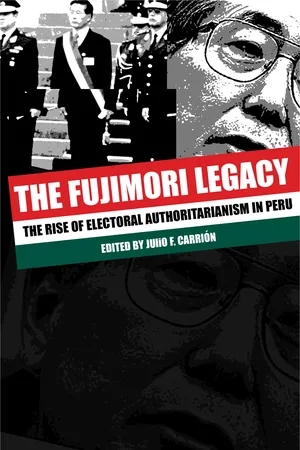
President Alberto Fujimori's sudden resignation in November 2000 brought an end to a highly controversial period in Peruvian history. His meteoric rise to power in 1990 fueled by widespread popular support, followed by his decision to dissolve Congress and rule by decree in 1992, has made his regime a focus of special attention by scholars trying to understand this complex and contradictory presidency.
This book offers a comprehensive assessment of Fujimori's regime in the context of Latin America's struggle to consolidate democracy after years of authoritarian rule. Setting the regime conceptually in a discussion of alternative forms of government—delegative democracy, neopopulism, and electoral authoritarianism—the essays study it from two different perspectives: external (in its relations with political parties, Lima's mayors, public opinion, women, the U.S. government) and internal (examining economic policies as determined by governing coalitions, networks of corruption, and Fujimori's unsavory relationship with his security advisor Vladimiro Montesinos). Overall, The Fujimori Legacy helps illuminate the persistent obstacles that Latin American countries face in establishing democracy.
In addition to the editor, contributors are Robert Barr, Maxwell Cameron, Catherine Conaghan, Henry Dietz, Philip Mauceri, Cynthia McClintock, David Scott Palmer, Kenneth Roberts, Gregory Schmidt, John Sheahan, Kurt Weyland, and Carol Wise.
Frequently asked questions
- Essential is ideal for learners and professionals who enjoy exploring a wide range of subjects. Access the Essential Library with 800,000+ trusted titles and best-sellers across business, personal growth, and the humanities. Includes unlimited reading time and Standard Read Aloud voice.
- Complete: Perfect for advanced learners and researchers needing full, unrestricted access. Unlock 1.4M+ books across hundreds of subjects, including academic and specialized titles. The Complete Plan also includes advanced features like Premium Read Aloud and Research Assistant.
Please note we cannot support devices running on iOS 13 and Android 7 or earlier. Learn more about using the app.
Information
Table of contents
- Front Cover
- Copyright
- Contents
- Acknowledgments
- List of Abbreviations
- Introduction
- 1 The Rise and Decline of Fujimori’s Neopopulist Leadership
- 2 An Authoritarian Presidency: How and Why Did Presidental Power Run Amok in Fujimori's Peru?
- 3 Fujimori and the Mayors of Lima, 1990-2001: The Impact and Legacy of Neopopulist Rule
- 4 Do Parties Matter? Lessons from the Fujimori Experience
- 5 The Immoral Economy of Fujimorismo
- 6 Public Opinion, Market Reforms, and Democracy in Fujimori's Peru
- 7 All the President's Women: Fujimori and Gender Equity in Peruvian Politics
- 8 Redirection of Peruvian Economic Strategy in the 1990s: Gains, Losses, and Clues for the Future
- 9 Against the Odds: The Paradoxes of Peru's Economic Recovery in the 1990s
- 10 The Often Surprising Outcomes of Asymmetry in International Affairs: United States-Peru Relations in the 1990s
- 11 Electoral Authoritarian Versus Partially Democratic Regimes: The Case of the Fujimori Government and the 2000 Elections
- 12 Endogenous Regime Breakdown: The Vladivideo and the Fall of Peru's Fujimori
- Conclusion: The Rise and Fall of Electoral Authoritarianism in Peru
- Bibliography
- Appendix: Peru, 1990–2000: A Basic Chronology
- List of Contributors
- Index
- Back Cover