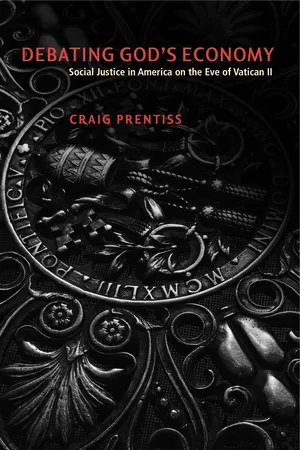
What would a divinely ordained social order look like? Pre–Vatican II Catholics, from archbishops and theologians to Catholic union workers and laborers on U.S. farms, argued repeatedly about this in the late nineteenth and early twentieth centuries. Debating God's Economy is a history of American Catholic economic debates taking place during the generation preceding Vatican II. At that time, American society was rife with sociopolitical debates over the relative merits and dangers of Marxism, capitalism, and socialism; labor unions, class consciousness, and economic power were the watchwords of the day. This was a time of immense social change, and, especially in the light of the monumental social and economic upheavals in Russia and Europe in the early twentieth century, Catholics found themselves taking sides. Catholic subcultures across America sought to legitimize—or, in theological parlance, "sanctify"—diverse economic systems that were, at times, mutually exclusive. While until now the faithful—both scholars and nonscholars—have typically spoken of "the Catholic Social Tradition" as if it were an established prescription for curing social ills, Prentiss maintains that the tradition is better understood as a debate grounded in a common mythology that provides Catholics with a distinctive vocabulary and touchstone of authority.
- 281 pages
- English
- PDF
- Available on iOS & Android
eBook - PDF
About this book
Information
Topic
Theology & ReligionSubtopic
North American HistoryTable of contents
- Front Cover
- Copyright
- List of Acronyms
- Acknowledgments
- Introduction
- 1. The Encyclicals
- 2. Sanctifying Life on the Land
- 3. Sanctifying Industrial Labor
- 4. Sanctifying American Capitalism
- 5. Catholics and Right-to-Work Laws
- 6. Industry Councils
- Conclusion
- Bibliography
- Index
- Back Cover
Trusted by 375,005 students
Access to over 1.5 million titles for a fair monthly price.
Study more efficiently using our study tools.
Frequently asked questions
Yes, you can cancel anytime from the Subscription tab in your account settings on the Perlego website. Your subscription will stay active until the end of your current billing period. Learn how to cancel your subscription
No, books cannot be downloaded as external files, such as PDFs, for use outside of Perlego. However, you can download books within the Perlego app for offline reading on mobile or tablet. Learn how to download books offline
We are an online textbook subscription service, where you can get access to an entire online library for less than the price of a single book per month. With over 1.5 million books across 990+ topics, we’ve got you covered! Learn about our mission
Look out for the read-aloud symbol on your next book to see if you can listen to it. The read-aloud tool reads text aloud for you, highlighting the text as it is being read. You can pause it, speed it up and slow it down. Learn more about Read Aloud
Yes! You can use the Perlego app on both iOS and Android devices to read anytime, anywhere — even offline. Perfect for commutes or when you’re on the go.
Please note we cannot support devices running on iOS 13 and Android 7 or earlier. Learn more about using the app
Please note we cannot support devices running on iOS 13 and Android 7 or earlier. Learn more about using the app
Yes, you can access Debating God's Economy by Craig Prentiss in PDF and/or ePUB format, as well as other popular books in Theology & Religion & North American History. We have over 1.5 million books available in our catalogue for you to explore.