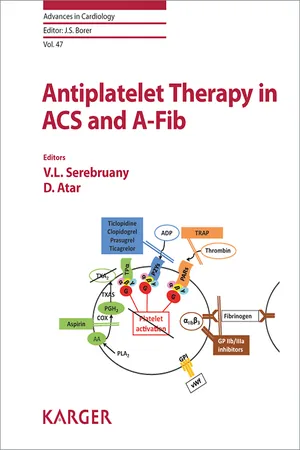
eBook - ePub
Antiplatelet Therapy in ACS and A-Fib
- 176 pages
- English
- ePUB (mobile friendly)
- Available on iOS & Android
eBook - ePub
Antiplatelet Therapy in ACS and A-Fib
About this book
Platelets play a critical role in the pathophysiology of acute coronary syndromes (ACS) and thromboembolic complications associated with atrial fibrillation. Anticoagulant and antiplatelet therapies are central to the treatment of ACS and atrial fibrillation. Over the last several decades, a better understanding of the pathogenesis of coronary heart disease and atrial fibrillation has led to refinements in antithrombotic strategies and clinical outcomes. With this in mind, some of the issues outlined in this book are new insights in genetic testing and modification of individualized antiplatelet therapy based on rapid bedside platelet analyzers. Most importantly, the current update of pros and cons of novel antiplatelet agents such as prasugrel and ticagrelor are provided in detail. Conventional antiplatelet strategies with aspirin and clopidogrel are also discussed. Special attention is devoted to experimental antiplatelet agents like PAR-1 thrombin receptor antagonists or aptamers. The ability to focus on different diseases beyond ACS, including heart failure and atrial fibrillation, distinguishes this publication. Each chapter was written by top experts in the field and scientists with the utmost authority and expertise to provide cardiologists, internists, and clinical pharmacologists with the latest updates.
Information
Topic
MedicineSubtopic
CardiologySerebruany VL, Atar D (eds): Antiplatelet Therapy in ACS and A-Fib.
Adv Cardiol. Basel, Karger, 2012, vol 47, pp 87–99
Adv Cardiol. Basel, Karger, 2012, vol 47, pp 87–99
______________________
Protease-Activated Receptor-1 Inhibitors: A Novel Class of Antiplatelet Agents for the Treatment of Patients with Acute Coronary Syndrome
Sergio Leonardia,d · Pierluigi Tricocia,b · Richard C. Beckera,c
aDuke Clinical Research Institute, bDivision of Cardiology, and cDivision of Hematology, Duke University Medical Center, Durham, N.C., USA; dDepartment of Cardiology, Fondazione IRCCS Policlinico San Matteo, Pavia, Italy
______________________
Abstract
The unifying basis of acute coronary syndrome (ACS) is the complication of a vulnerable coronary plaque, an event primarily mediated by platelet activation. Three major pathways are predominantly involved in this process: thromboxane A2 via the thromboxane A2 receptor, adenosine diphosphate via the P2Y12 receptor, and thrombin via the protease-activated receptor (PAR)-1, with the latter being the most potent platelet activator. Despite the effective inhibition of the first two pathways with aspirin and an expanding family of P2Y12 inhibitors, respectively, the recurrence of ischemic events in patients with ACS remains high. There is also a growing concern regarding the safety profile in terms of bleeding with more powerful antiplatelet agents, which has tempered expectations of newly developed compounds. PAR-1 inhibitors are a novel class of antiplatelet agents that inhibit thrombin-mediated platelet activation. Preliminary data indicate that these compounds have the potential to improve ischemic prognosis without increasing the bleeding risk. In this chapter we will discuss the rationale for developing this novel class of antiplatelet agents and specifically, the two compounds in most advanced clinical development, vorapaxar and atopaxar.
Copyright © 2012 S. Karger AG, Basel
The unifying pathophysiological basis of acute coronary syndrome (ACS) is the thrombotic complication (rupture or erosion) of a vulnerable atherosclerotic coronary plaque. This event, termed ‘acute atherothrombosis’, is primarily mediated by the activation of platelets. Of the several pathways involved in platelet activation, three are believed to be the most important and are triggered by (1) thromboxane A2 via the thromboxane A2 receptor, (2) adenosine diphosphate via the P2Y12 receptor, and (3) thrombin via the protease-activated receptor (PAR)-1 receptor.
The clinical relevance of the first two pathways in the genesis of acute atherothrombosis has been proven by the clinical efficacy of compounds able to block these pathways: aspirin [1] and a large family of P2Y12 inhibitors, respectively [2–4]. Until recently no agent was available to inhibit platelet activation mediated by thrombin, which is the most potent among these platelet activators. Thrombin receptor antagonists (TRAs), via the inhibition of the PAR-1 receptor, are the first class of antiplatelet agents able to specifically accomplish this goal. In this chapter, we will discuss the rationale for developing this novel class of antiplatelet agents and specifically the two compounds in the most advanced experimental phase: vorapaxar and atopaxar.
Rationale for Developing PAR-1 Inhibitors
Do We Need Another Class of Antiplatelet Agents?
The armamentarium of drugs available to physicians for the management of patients with ACS is growing rapidly, especially in the area of antiplatelet agents. After the introduction of aspirin, an irreversible inhibitor of cyclooxygenase-1 which produces a permanent defect in thromboxane A2-mediated platelet activation and recruitment, active research has been conducted on the pharmacological inhibition of the P2Y12 receptor. The first milestone was represented by the development of ticlopidine followed by clopidogrel, which is now a globally used drug in patients admitted with an ACS, especially if invasively managed [5]. After clopidogrel, two other P2Y12 inhibitors have proven to further reduce the occurrence of ischemic events in this population: prasugrel, a third-generation thienopyridine with more potent and a more rapid onset of action than clopidogrel [4], and ticagrelor, a first-in-class member of a novel generation of reversible P2Y12 inhibitors [3]. Other intravenous P2Y12 inhibitors derivatives are in phase II and III development [6–8].
Despite the availability of more potent inhibitors of the P2Y12 receptor, the risk of ischemic events in patients with atherothrombosis remains high. Even with the latest and most efficacious compounds, a proportion of patients ranging from 9.9% [4] to 10.2% [3] experience a major cardiovascular ischemic event within 1 year. In addition, the improved efficacy of novel P2Y12 antagonists has been accompanied by a heightened risk of bleeding. In the Trial to Assess Improvement in Therapeutic Outcomes by Optimizing Platelet Inhibition with Prasugrel-Thrombolysis in Myocardial Infarction 38 (TRITON-TIMI38), prasugrel was associated with a higher incidence of any TIMI bleeding compared with clopidogrel, including major bleeding and fatal bleeding [4]. Prasugrel-related bleeding risk was particularly high in patients undergoing coronary artery bypass grafting with a nearly fivefold [HR: 4.73 (1.90-11.82), p < 0.001)] increased risk of major bleeding. Ticagrelor, despite robust benefits in terms of anti-ischemic efficacy, caused more bleeding than clopidogrel. Although bleeding related to coronary artery bypass grafting was not increased with ticagrelor, presumably one of the advantages of its reversible inhibition, this compound has been associated with an increased risk of spontaneous bleeding compared with clopidogrel, including fatal intracranial hemorrhage [3]. Taken together, these data suggest that P2Y12-dependent platelet activation is important not only for thrombosis, but also for protective hemostasis, and despite the refinement of the pharmacological inhibition of this pathway, uncoupling the effects on prevention of arterial thrombosis from unwanted impairment of platelet-mediated hemostasis represents an unmet goal.
How Can Protease-Activated Receptor-1 Inhibitors Fill Existing Gaps in the Treatment of Patients with Acute Coronary Syndrome?
The persisting risk over time of major cardiovascular adverse events highlighted previously provides the opportunity to improve the care of patients with ACS. Neither aspirin nor clopidogrel has an effect on blood markers of coagulation activity. The Clopidogrel in Unstable Angina to Prevent Recurrent Events (CURE) Coagulation substudy found that in patients admitted with non-ST elevation (NSTE)-ACS, thrombin generation is (1) unaffected by clopidogrel plus aspirin, (2) persists beyond the acute phase of ACS, and (3) is related to adverse clinical outcomes, all aspects providing a theoretical basis for long-term inhibition of thrombin effects [9]. Also, platelet activation is a redundant biological process and platelets can be activated by a myriad of different stimuli. The presence of multiple and distinct pathways for platelet activation limits the effectiveness of any single agent and, as such, provides a rationale for dual antiplatelet therapy, which is now widely accepted in patients admitted for ACS [10].
Another aspect in the development strategy of TRAs, perhaps the most appealing one, is the possibility to uncouple the expected reduction in thrombotic complications from unwanted impairment of protective hemostasis. Indeed, nonhuman data indicate that hemostasis depends more upon the effects of thrombin in the coagulation cascade rather than its cellular effects: while fibrinogen-deficient mice show a severe bleeding phenotype, mice deficient in their primary platelet thrombin receptor (i.e. PAR-4) display reduced and delayed platelet activation, but no spontaneous bleeding [11].
Similar data have been observed in nonhuman primates, which share with humans PAR-1 as their primary platelet thrombin receptor. Cynomolgus monkeys treated with high doses of SCH 530348, a potent PAR-1 inhibitor described herein, showed no change in clotting times, platelet count, coagulation times, template bleeding times, and surgical blood loss compared with monkeys that received no active treatment. Notably, the administration of aspirin plus clopidogrel in this experimental model resulted in a marked prolongation of template bleeding time and surgical blood loss. However, coadministering SCH 530348 in addition to aspirin plus clopidogrel did not exacerbate the observed increases in bleeding time and blood loss [12].
These first promising nonhuman data have been confirmed in the preliminary human experience, and will be discussed in the detail in the next section.
Protease-Activated Receptor-1 Inhibitors in Advanced Clinical Development: Vorapaxar and Atopaxar
Protease-Activated Receptors and Protease-Activated Receptor-1 Inhibitors
Thrombin has important cellular actions beyond being the main effector protease of the coagulation cascade. Specifically, this regulatory enzyme is a very potent platelet agonist which acts via a specific class of surface platelet receptors - PARs - which are G-protein-linked members of the 7-transmembrane domain receptor superfamily [13]. It is worth mentioning that PARs are not solely located on platelets, but have also been identified in smooth muscle cells, endothelial cells, and fibroblasts, with the potential of broadening the overall implications of PAR-1 inhibition.
Thrombin activates PAR-1 by cleaving a peptide bond (Arg41-Ser42) in the receptor’s extracellular domain, which discloses a new N-terminus of the receptor. This new ‘tail’, referred to as a ‘tethered ligand’, interacts with a distinct domain of the cleaved receptor and ultimately causes its activation. Thus, PARs are receptors that carry their own ligand, which remains silent until activated by cleavage of the PAR N-terminal exodomain.
In human platelets, thrombin receptor signaling is mediated by two main PAR variants: PAR-1 and PAR-4, with the former being the principal platelet thrombin receptor. Indeed, PAR-1 is activated by subnanomolar concentrations of thrombin, while PAR-4 requires a higher concentration of the same agonist to be fully activated. Blocking antibodies directed against the interaction site of thrombin with PAR-1 have been shown to block receptor cleavage and platelet activation at low (1 nm), but not high (30 nm), concentrations of thrombin. In contrast, PAR-4-blocking antibodies had no measurable effect on thrombin-mediated platelet activation. However, combined PAR-1 and PAR-4 blockade markedly attenuates platelet activation, even at high thrombin concentrations [14]. These observations suggest that PAR-1 and PAR-4 account for most, if not all, thrombin signaling in humans and that PAR-1 is the primary platelet thrombin receptor. The available data also suggest that in absence of a functional PAR-1 (for example via pharmacological inhibition), thrombin can still activate platelets via PAR-4, but only at high concentrations.
The first generation of PAR-1 antagonists was designed on the basis of the tethered ligand sequence and were named ‘peptidomimetics’. A major challenge in early development of PAR-1 inhibitors was the synthesis of compounds able to have both a high affinity and a slow dissociation rate from the receptor, a critical requirement to effectively compete with the resident tethered ligand. Two nonpeptide inhibitors, a natural himbacine derivative (vorapaxar) and a synthetic compound based on the bicyclic amidine motif (atopaxar), w...
Table of contents
- Cover Page
- Front Matter
- Introduction
- Impact of Antiplatelet Therapy in Heart Disease
- Antiplatelet Therapy in Acute Coronary Syndrome and Atrial Fibrillation: Aspirin
- Clopidogrel in Coronary Artery Disease: Update 2012
- Prasugrel
- Antiplatelet Therapy in Acute Coronary Syndromes: Ticagrelor
- Dipyridamole in Antithrombotic Treatment
- Protease-Activated Receptor-1 Inhibitors: A Novel Class of Antiplatelet Agents for the Treatment of Patients with Acute Coronary Syndrome
- Genetic Considerations
- Stents and Antiplatelet Therapy
- Bleeding and the Use of Antiplatelet Agents in the Management of Acute Coronary Syndromes and Atrial Fibrillation
- Antiplatelet Therapy in Stroke Prevention
- Challenges in Atrial Fibrillation
- Conclusion
- Author Index
- Subject Index
Trusted by 375,005 students
Access to over 1.5 million titles for a fair monthly price.
Study more efficiently using our study tools.
Frequently asked questions
Yes, you can cancel anytime from the Subscription tab in your account settings on the Perlego website. Your subscription will stay active until the end of your current billing period. Learn how to cancel your subscription
No, books cannot be downloaded as external files, such as PDFs, for use outside of Perlego. However, you can download books within the Perlego app for offline reading on mobile or tablet. Learn how to download books offline
Perlego offers two plans: Essential and Complete
- Essential is ideal for learners and professionals who enjoy exploring a wide range of subjects. Access the Essential Library with 800,000+ trusted titles and best-sellers across business, personal growth, and the humanities. Includes unlimited reading time and Standard Read Aloud voice.
- Complete: Perfect for advanced learners and researchers needing full, unrestricted access. Unlock 1.5M+ books across hundreds of subjects, including academic and specialized titles. The Complete Plan also includes advanced features like Premium Read Aloud and Research Assistant.
We are an online textbook subscription service, where you can get access to an entire online library for less than the price of a single book per month. With over 1.5 million books across 990+ topics, we’ve got you covered! Learn about our mission
Look out for the read-aloud symbol on your next book to see if you can listen to it. The read-aloud tool reads text aloud for you, highlighting the text as it is being read. You can pause it, speed it up and slow it down. Learn more about Read Aloud
Yes! You can use the Perlego app on both iOS and Android devices to read anytime, anywhere — even offline. Perfect for commutes or when you’re on the go.
Please note we cannot support devices running on iOS 13 and Android 7 or earlier. Learn more about using the app
Please note we cannot support devices running on iOS 13 and Android 7 or earlier. Learn more about using the app
Yes, you can access Antiplatelet Therapy in ACS and A-Fib by V. L. Serebruany,D. Atar,V.L., Serebruany,D., Atar, J. S. Borer,J.S., Borer in PDF and/or ePUB format, as well as other popular books in Medicine & Cardiology. We have over 1.5 million books available in our catalogue for you to explore.