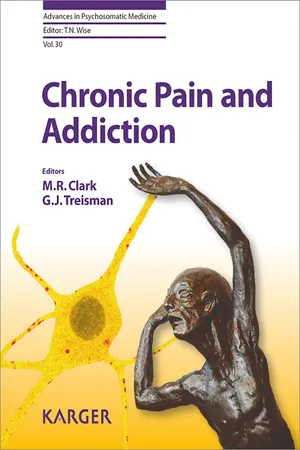
Patients with chronic pain understandably seek relief from their distress and discomfort, but many medications that alleviate pain are potentially addictive, and most chronic pain conditions only have a temporary response to opiate analgesic drugs. This volume reviews the fundamental topics that underlie the complex relationships of this controversial domain. The authors review behavioral models and practical methods for understanding and treating chronic pain and addiction including methods to formulate patients with complex comorbidity and screen patients with chronic pain for addictive liability. Finally, the authors describe the current findings from clinical and basic science that illuminate the role of opiates, cannabinoids and ketamine in the treatment of chronic pain. Up to date and comprehensive, this book is relevant to all professionals engaged in the care of patients with chronic pain or addiction and all others interested in these contemporary issues, particularly non-clinicians seeking clarity in the controversy over the best approach to patients with chronic pain.
- 172 pages
- English
- ePUB (mobile friendly)
- Available on iOS & Android
eBook - ePub
Chronic Pain and Addiction
About this book
Information
Topic
MedicineSubtopic
GeriatricsClark MR, Treisman GJ (eds): Chronic Pain and Addiction.
Adv Psychosom Med. Basel, Karger, 2011, vol 30, pp 22-60
Adv Psychosom Med. Basel, Karger, 2011, vol 30, pp 22-60
____________________________
Addiction and Brain Reward and Antireward Pathways
Eliot L. Gardner
Neuropsychopharmacology Section, Intramural Research Program, National Institute on Drug Abuse, National Institutes of Health, Baltimore, Md., USA
____________________________
Abstract
Addictive drugs have in common that they are voluntarily self-administered by laboratory animals (usually avidly), and that they enhance the functioning of the reward circuitry of the brain (producing the ‘high’ that the drug user seeks). The core reward circuitry consists of an ‘in-series’ circuit linking the ventral tegmental area, nucleus accumbens and ventral pallidum via the medial forebrain bundle. Although originally believed to simply encode the set point of hedonic tone, these circuits are now believed to be functionally far more complex, also encoding attention, expectancy of reward, disconfirmation of reward expectancy, and incentive motivation. ‘Hedonic dysregulation’ within these circuits may lead to addiction. The ‘second-stage’ dopaminergic component in this reward circuitry is the crucial addictive-drug-sensitive component. All addictive drugs have in common that they enhance (directly or indirectly or even transsynaptically) dopaminergic reward synaptic function in the nucleus accumbens. Drug self-administration is regulated by nucleus accumbens dopamine levels, and is done to keep nucleus accumbens dopamine within a specific elevated range (to maintain a desired hedonic level). For some classes of addictive drugs (e.g. opiates), tolerance to the euphoric effects develops with chronic use. Postuse dysphoria then comes to dominate reward circuit hedonic tone, and addicts no longer use drugs to get high, but simply to get back to normal (’get straight’).The brain circuits mediating the pleasurable effects of addictive drugs are anatomically, neurophysiologically and neurochemically different from those mediating physical dependence, and from those mediating craving and relapse. There are important genetic variations in vulnerability to drug addiction, yet environmental factors such as stress and social defeat also alter brain-reward mechanisms in such a manner as to impart vulnerability to addiction. In short, the ‘bio-psycho-social’ model of etiology holds very well for addiction. Addiction appears to correlate with a hypodopaminergic dysfunctional state within the reward circuitry of the brain. Neuroimaging studies in humans add credence to this hypothesis. Credible evidence also implicates serotonergic, opioid, endocannabinoid, GABAergic and glutamatergic mechanisms in addiction. Critically, drug addiction progresses from occasional recreational use to impulsive use to habitual compulsive use. This correlates with a progression from reward-driven to habit-driven drug-seeking behavior. This behavioral progression correlates with a neuroanatomical progression from ventral striatal (nucleus accumbens) to dorsal striatal control over drug-seeking behavior. The three classical sets of craving and relapse triggers are (a) reexposure to addictive drugs, (b) stress, and (c) reexposure to environmental cues (people, places, things) previously associated with drug-taking behavior. Drug-triggered relapse involves the nucleus accumbens and the neurotransmitter dopamine. Stress-triggered relapse involves (a) the central nucleus of the amygdala, the bed nucleus of the stria terminalis, and the neurotransmitter corticotrophin-releasing factor, and (b) the lateral tegmental noradrenergic nuclei of the brain stem and the neurotransmitter norepinephrine. Cue-triggered relapse involves the basolateral nucleus of the amygdala, the hippocampus and the neurotransmitter glutamate. Knowledge of the neuroanatomy, neurophysiology, neurochemistry and neuropharmacology of addictive drug action in the brain is currently producing a variety of strategies for pharmacotherapeutic treatment of drug addiction, some of which appear promising.
Copyright © 2011 S. Karger AG, Basel
Addiction - An Age-Old Medical and Societal Problem
The abusive use of addictive drugs is a medical and societal problem as old as recorded human history. One particularly ancient reference to it may be found in the Hebrew/Christian Bible, where in Genesis, chapter 9, verses 20-23, the Semite Patriarch Noah is described as becoming drunken, disheveled, naked and filthy from overindulgence in wine. Similarly ancient references to drug abuse may be found in the oral and written traditions of virtually all ethnic and cultural groups on the planet.
One of the most striking features of drug addiction is how few chemicals are subject to abuse. If one takes all congeners of all known chemicals, approximately 30,000,000 chemical substances are known [1]. Yet, only approximately 100 (including nicotine, ethanol, psychostimulants, opiates, barbiturates, benzodiazepines and cannabinoids) are addictive. In truth, 100 is a stunningly small subset of 30,000,000. It poses the question: what makes those 100 chemicals addictive, while the remaining 30,000,000 chemicals lack this property? After all, upon cursory examination, there seem few pharmacological similarities among addictive drugs. Some - including barbiturates, ethanol, opiates and benzodiazepines - are sedatives, while others - including nicotine, cocaine and the amphetamines - are stimulants. Some - including opiates and cannabinoids - are antinociceptive, while others (in the proper laboratory or clinical situations) are pronociceptive. Some - such as ethanol and opiates - produce striking degrees of physical dependence, while others - such as cocaine - produce little if any physical dependence. However, a few commonalities are both apparent and instructive. All addictive drugs are subjectively rewarding, reinforcing and pleasurable [1]. Laboratory animals volitionally self-administer them [2], just as humans do. Furthermore, the rank order of appetitiveness in animals parallels the rank order of appetitiveness in humans [2, 3]. Most tellingly, perhaps, all addictive drugs (with the exception of the LSD-like and mescaline-like hallucinogens) activate the reward circuitry of the brain [1, 4, 5], thereby producing the subjective ‘high’ that the drug abuser seeks. Furthermore, the degree of such activation of the brain’s reward circuitry correlates well with the degree of subjective high.
The Brain’s Reward Circuitry
The brain’s reward circuitry was first discovered by Olds and Milner [6] at McGill University in the early 1950s. They found that animals would repeatedly return to an area of the laboratory in which they had received mild electrical stimulation of subcortical structures anatomically associated with the medial forebrain bundle. Subsequently, they found that animals would avidly perform tasks (e.g. depressing wall-mounted levers in their test chambers) in order to receive such brain stimulation. In the aftermath of this discovery of the phenomenon of brain stimulation reward, Olds and Olds [7-10] carried out extensive mapping studies of the rodent brain, confirming that a large majority of the brain sites supporting brain stimulation reward are associated with the nuclei of origin, tracts and terminal loci of the medial forebrain bundle. Other researchers [11] studied electrical brain stimulation reward in nonhuman primates and confirmed that the anatomic brain substrates in primates were homologous to those in rodents. Using sophisticated electrophysiological techniques, Gallistel et al. [12] determined that the primary neural substrate supporting electrical brain stimulation reward is the moderately fast-conducting, myelinated descending neural fiber system of the medial forebrain bundle. This system originates in the anterior bed nuclei of the medial forebrain bundle (an array of deep subcortical limbic loci anterior to the hypothalamus and preoptic area), descends to the ventral tegmental area of the midbrain via the medial forebrain bundle, and then ascends via the medial forebrain bundle to a select group of forebrain limbic loci including the nucleus accumbens, olfactory tubercle and frontal cortex. Wise and Bozarth [13] were the first to realize that this assortment of brain loci and tracts constituted a neural circuit containing three synaptically connected, in-series neuronal elements: a descending link running from the anterior bed nuclei of the medial forebrain bundle to the ventral tegmental area, an ascending link running from the ventral tegmental area to the nucleus accumbens, and a further ascending link running from the nucleus accumbens to the ventral pallidum. The first link is the descending myelinated fiber tract first identified by Gallistel et al. [12], of unknown neurotransmitter type, although very recent evidence raises, by inference, the possibility that glutamate in the ventral tegmental area might play a role [14]. The second link is the ascending fiber tract from the ventral tegmental area to the nucleus accumbens, with dopamine as its neurotransmitter (see below). The third link is the projection from the nucleus accumbens to the ventral pallidum, using γ-aminobutyric acid (GABA), substance P and enkephalin as conjoint neurotransmitters [15-22]. This three-neuron, in-series circuit receives synaptic inputs from, and is functionally modulated by, a wide variety of other neural circuits including cholinergic, endorphi...
Table of contents
- Cover Page
- Front Material
- From Stigmatized Neglect to Active Engagement
- A Behaviorist Perspective
- Addiction and Brain Reward and Antireward Pathways
- Opioid Therapy in Patients with Chronic Noncancer Pain: Diagnostic and Clinical Challenges
- Optimizing Treatment with Opioids and Beyond
- Screening for Abuse Risk in Pain Patients
- Cannabinoids for Pain Management
- Ketamine in Pain Management
- Subject Index
Trusted by 375,005 students
Access to over 1.5 million titles for a fair monthly price.
Study more efficiently using our study tools.
Frequently asked questions
Yes, you can cancel anytime from the Subscription tab in your account settings on the Perlego website. Your subscription will stay active until the end of your current billing period. Learn how to cancel your subscription
No, books cannot be downloaded as external files, such as PDFs, for use outside of Perlego. However, you can download books within the Perlego app for offline reading on mobile or tablet. Learn how to download books offline
Perlego offers two plans: Essential and Complete
- Essential is ideal for learners and professionals who enjoy exploring a wide range of subjects. Access the Essential Library with 800,000+ trusted titles and best-sellers across business, personal growth, and the humanities. Includes unlimited reading time and Standard Read Aloud voice.
- Complete: Perfect for advanced learners and researchers needing full, unrestricted access. Unlock 1.5M+ books across hundreds of subjects, including academic and specialized titles. The Complete Plan also includes advanced features like Premium Read Aloud and Research Assistant.
We are an online textbook subscription service, where you can get access to an entire online library for less than the price of a single book per month. With over 1.5 million books across 990+ topics, we’ve got you covered! Learn about our mission
Look out for the read-aloud symbol on your next book to see if you can listen to it. The read-aloud tool reads text aloud for you, highlighting the text as it is being read. You can pause it, speed it up and slow it down. Learn more about Read Aloud
Yes! You can use the Perlego app on both iOS and Android devices to read anytime, anywhere — even offline. Perfect for commutes or when you’re on the go.
Please note we cannot support devices running on iOS 13 and Android 7 or earlier. Learn more about using the app
Please note we cannot support devices running on iOS 13 and Android 7 or earlier. Learn more about using the app
Yes, you can access Chronic Pain and Addiction by M. R. Clark,G. J. Treisman, T. N. Wise in PDF and/or ePUB format, as well as other popular books in Medicine & Geriatrics. We have over 1.5 million books available in our catalogue for you to explore.