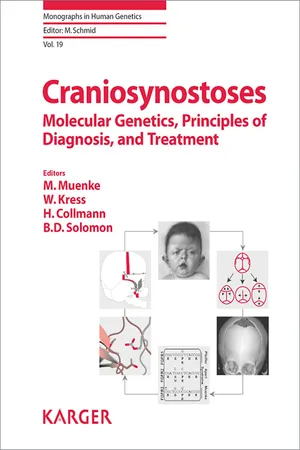
Craniosynostosis - the premature fusion of the cranial sutures of an infant's skull - is a challenging and complex condition that can occur as part of a syndrome or in isolation. In the last two decades increased knowledge about the structure and function of the human genome has enabled the discovery of the molecular etiologies of most forms of syndromic craniosynostosis, which in turn has allowed for the analysis of normal and abnormal sutural biology from the atomic to the population-based level. In parallel with the increase in basic biological understanding, advances in clinical diagnosis and treatment have been achieved including improved prenatal imaging technology and craniofacial surgical techniques as well as condition-specific care in specialized hospitals and clinical units. This book represents a comprehensive overview on the subject of craniosynostosis. Its 19 excellent chapters were written by the foremost authorities in the field for a wide range of readers. They cover topics including a historical review, basic biological and molecular studies, the various common and uncommon syndromes, nonsyndromic craniosynostoses, genetic testing, prenatal ultrasonography, and recent methods of neurosurgical and maxillofacial treatment. Both investigators at the bench and clinicians at the operating table will appreciate this timely book which will be the definitive volume on craniosynostosis for many years to come.
eBook - ePub
Craniosynostoses
Molecular Genetics, Principles of Diagnosis, and Treatment
- 260 pages
- English
- ePUB (mobile friendly)
- Available on iOS & Android
eBook - ePub
Craniosynostoses
Molecular Genetics, Principles of Diagnosis, and Treatment
About this book
Information
Topic
MedicinaSubtopic
Medicina pediatricaChapter 11
Muenke M, Kress W, Collmann H, Solomon BD (eds): Craniosynostoses: Molecular Genetics, Principles of Diagnosis, and Treatment.
Monogr Hum Genet. Basel, Karger, 2011, vol 19, pp 119-142
Monogr Hum Genet. Basel, Karger, 2011, vol 19, pp 119-142
______________________
Uncommon Craniosynostosis Syndromes: A Review of Thirteen Conditions
M.S. Raama,b · M. Muenkea
aMedical Genetics Branch, National Human Genome Research Institute, National Institutes of Health, Bethesda, Md., bHHMI-NIH Research Scholars Program, Howard Hughes Medical Institute, Chevy Chase, Md., USA
______________________
Abstract
Uncommon craniosynostosis syndromes, while individually less well characterized than more common conditions such as Apert, Crouzon, Pfeiffer, Muenke, and Saethre-Chotzen syndromes, comprise a significant proportion of craniosynostosis cases when considered in sum. Thirteen of these rare syndromes are covered here with respect to nosology, associated clinical characteristics, and molecular genetics. They were selected for discussion in this chapter due to recent molecular advances therein that can significantly enhance clinicians’ ability to diagnose and counsel patients with these syndromes. The syndromes discussed here include Antley-Bixler syndrome, Baller-Gerold syndrome, Beare-Stevenson cutis gyrata syndrome, Bohring-Opitz syndrome, C (Opitz trigonocephaly) syndrome, Carpenter syndrome, Crouzon syndrome with acanthosis nigricans, Jackson-Weiss syndrome, Jacobsen syndrome, Loeys-Dietz syndrome type I, osteoglophonic dysplasia, P450 oxidoreductase deficiency, and Shprintzen-Goldberg syndrome.
Copyright © 2011 S. Karger AG, Basel
Syndromic craniosynostosis comprises approximately 15% of craniosynostosis cases, with well over 180 syndromes identified to date [1]. Although much attention is given to several well-characterized craniosynostosis syndromes, including Apert syndrome, Crouzon syndrome, Pfeiffer syndrome, Muenke syndrome, and Saethre-Chotzen syndrome (see individual chapters on each in this volume), the vast majority of craniosynostosis syndromes are less well characterized and/or individually involve a comparatively small number of patients (see partial list in table 1). Despite these aspects of uncommon craniosynostosis syndromes, they comprise a significant proportion of craniosynostosis cases when considered in aggregate [2]. Additionally, the clinical issues observed in some uncommon syndromes differ from those encountered in the major syndromes: mental retardation and perinatal death, for instance, are seen more often in several uncommon syndromes, shifting focus away from simple surgical correction and creating a greater emphasis on prenatal diagnosis, psychomotor development, and genetic counseling [2]. Perhaps most importantly, description and delineation of uncommon craniosynostosis syndromes allow clinicians to better treat and counsel the significant numbers of families of patients with conditions that are not well understood.
Cohen Jr. and MacLean have provided a comprehensive discussion of the process of syndrome delineation, particularly with respect to craniosynostosis syndromes [2]. Based on whether or not a syndrome has an identifiable cause, it can be categorized as a syndrome of unknown genesis or as a syndrome of known genesis. Syndromes of unknown genesis can be further subdivided into syndromes with a provisionally unique pattern, in which a unique combination of anomalies has so far been observed in only 1 patient, and syndromes with a recurrent pattern, in which similar anomalies have been observed in 2 or more unrelated patients. Syndromes of known genesis can be further subdivided into those thought to have a monogenic cause, those with an identified chromosomal cause, those in which a specific enzymatic defect has been implicated, and those in which specific teratogens or environmental factors are causative. As of 1991, when 90 craniosynostosis syndromes had been identified, 40 syndromes were syndromes with mostly unidentified monogenic causes, 24 were syndromes of unknown genesis, 16 were syndromes with an identified chromosomal cause, and 4 were environmentally induced disorders [2].
Table 1. Partial list of uncommon craniosynostosis syndromes. Syndromes covered in this chapter are bolded and MIM numbers are provided wherever available. Although the text of this chapter covers relatively well-described syndromes for which underlying molecular bases are known, this list is provided as a starting point to demonstrate that the vast majority of the uncommon craniosynostosis syndromes are described in very few patients, do not clearly demonstrate Mendelian genetics, do not have a known underlying molecular basis, and/or are not clearly distinguishable from other syndromes. Better molecular characterization of patients and greater correlation between molecular findings and syndrome delineation can narrow this rather unwieldy list of syndromes to one that is more useful to clinicians and patients. (Adapted from Table 31-1, p. 385, Chapter 31, in [147] with permission from Oxford University Press, Inc.)
| MIM number | Uncommon craniosynostosis syndromes |
| Acrocephalospondylosyndactyly | |
| 201050 | Acrocraniofacial dysostosis |
| %201550 | Adducted thumbs (Christian) syndrome |
| #207410 | Antley-Bixler syndrome |
| Armendares syndrome | |
| #218600 | Baller-Gerold syndrome |
| Baraitser syndrome | |
| #123790 | Beare-Stevenson cutis gyrata syndrome |
| Berant syndrome | |
| Blair/Pakistan syndrome | |
| #605039 | Bohring-Opitz syndrome |
| #211750 | C (Opitz trigonocephaly) syndrome |
| CAP syndrome | |
| COH syndrome | |
| Calabro syndrome | |
| 302030 | Calvarial hyperostosis |
| #201000 | Carpenter syndrome |
| %605627 | Cerebrooculonasal syndrome |
| Cerebrotrichofacial syndrome | |
| 601853 | Cerebellotrigeminal dermal dysplasia (Gómez-López-Hernández syndrome) |
| 241519 | Chitayat hypophosphatemia syndrome |
| 112240 | Cole-Carpenter syndrome |
| #218330, #613610 | Cranioectodermal dysplasia |
| 218350 | Craniofacial dyssynostosis |
| Craniofaciocervical osteoglyphic dysplasia | |
| 602558 | Craniomicromelic syndrome |
| Cranio-oculo-arthrogrypotic syndrome | |
| 123050 | Craniorhiny |
| Craniosyndactyly/intestinal atresia syndrome | |
| 603595 | Craniosynostosis with ectopia lentis |
| #604757 | Craniosynostosis, Boston type |
| %601222 | Craniosynostosis, Philadelphia type |
| #612247 | Crouzon syndrome with acanthosis nigricans |
| 218670 | Craniotelencephalic dysplasia |
| Curry Carpenter-like syndrome | |
| 601707 | Curry-Jones syndrome |
| %224690 | Ear, patella, short stature (Meier-Gorlin) syndrome |
| 200995 | Elejalde syndrome |
| Fontaine-Farriaux syndrome | |
| #190440 | Frydman trigonocephaly syndrome |
| Fryns craniosynostosis syndrome | |
| 601370 | Genoa syndrome |
| 233500 | Gorlin-Chaudhry-Moss syndrome |
| Hall syndrome | |
| #235510 | Hennekam lymphangiectasia-lymphedema syndrome |
| #133701 | Hereditary multiple exostoses, type II |
| Herrmann syndrome | |
| Hersh syndrome | |
| 601379 | Hunter-McAlpine syndrome |
| %241310 | Hypomandibular faciocranial syndrome |
| Idaho syndrome | |
| #123150 | Jackson-Weiss syndrome |
| #147791 | Jacobsen syndrome |
| 123155 | Jones craniosynostosis/Dandy-Walker syndrome |
| Kozlowski craniosynostosis syndrome | |
| Kreiborg/Pakistan syndrome | |
| Lampert syndrome | |
| 218649 | Lin-Gettig syndrome |
| #609192, #610168 | Loeys-Dietz syndrome, type I |
| Lowry syndrome | |
| 600252 | Lowry-MacLean syndrome |
| Mehta syndrome | |
| 257920 | Michels syndrome |
| %251230 | Microcephaly-micromelia (Ives-Houston) syndrome |
| 602361 | Osteocraniostenosis/gracile bone dysplasia |
| #166250 | Osteoglophonic dysplasia |
| #201750 | P450 oxidoreductase deficiency |
| Passos-Bueno craniosynostosis/cataracts syndrome | |
| 218450 | Pfeiffer-type cardiocranial syndrome |
| Pfeiffer-type dolichocephalosyndactyly | |
| Richieri-Costa overgrowth syndro... |
Table of contents
- Cover Page
- Front Matter
- Craniosynostosis: A Historical Overview
- Discovery of MSX2 Mutation in Craniosynostosis: A Retrospective View
- Regulation of Calvarial Bone Growth by Molecules Involved in the Craniosynostoses
- Signal Transduction Pathways and Their Impairment in Syndromic Craniosynostosis
- The Molecular Bases for FGF Receptor Activation in Craniosynostosis and Dwarfism Syndromes
- Recurrent Germline Mutations in the FGFR2/3 Genes, High Mutation Frequency, Paternal Skewing and Age-Dependence
- Apert, Crouzon, and Pfeiffer Syndromes
- Muenke Syndrome
- Saethre-Chotzen Syndrome: Clinical and Molecular Genetic Aspects
- Craniofrontonasal Syndrome: Molecular Genetics, EFNB1 Mutations and the Concept of Cellular Interference
- Uncommon Craniosynostosis Syndromes: A Review of Thirteen Conditions
- Metopic Craniosynostosis Syndrome Due to Mutations in GLI3
- Craniosynostosis and Chromosomal Alterations
- Nonsyndromic Craniosynostoses
- Molecular Genetic Testing of Patients with Craniosynostosis
- Prenatal Sonographic Diagnosis of Craniosynostosis
- Clinical Approach to Craniosynostosis
- Imaging Studies and Neurosurgical Treatment
- Maxillofacial Examination and Treatment
- Author Index
- Subject Index
Trusted by 375,005 students
Access to over 1.5 million titles for a fair monthly price.
Study more efficiently using our study tools.
Frequently asked questions
Yes, you can cancel anytime from the Subscription tab in your account settings on the Perlego website. Your subscription will stay active until the end of your current billing period. Learn how to cancel your subscription
No, books cannot be downloaded as external files, such as PDFs, for use outside of Perlego. However, you can download books within the Perlego app for offline reading on mobile or tablet. Learn how to download books offline
Perlego offers two plans: Essential and Complete
- Essential is ideal for learners and professionals who enjoy exploring a wide range of subjects. Access the Essential Library with 800,000+ trusted titles and best-sellers across business, personal growth, and the humanities. Includes unlimited reading time and Standard Read Aloud voice.
- Complete: Perfect for advanced learners and researchers needing full, unrestricted access. Unlock 1.5M+ books across hundreds of subjects, including academic and specialized titles. The Complete Plan also includes advanced features like Premium Read Aloud and Research Assistant.
We are an online textbook subscription service, where you can get access to an entire online library for less than the price of a single book per month. With over 1.5 million books across 990+ topics, we’ve got you covered! Learn about our mission
Look out for the read-aloud symbol on your next book to see if you can listen to it. The read-aloud tool reads text aloud for you, highlighting the text as it is being read. You can pause it, speed it up and slow it down. Learn more about Read Aloud
Yes! You can use the Perlego app on both iOS and Android devices to read anytime, anywhere — even offline. Perfect for commutes or when you’re on the go.
Please note we cannot support devices running on iOS 13 and Android 7 or earlier. Learn more about using the app
Please note we cannot support devices running on iOS 13 and Android 7 or earlier. Learn more about using the app
Yes, you can access Craniosynostoses by M. Muenke,W. Kress,H. Collmann,B. D. Solomon, M. Schmid in PDF and/or ePUB format, as well as other popular books in Medicina & Medicina pediatrica. We have over 1.5 million books available in our catalogue for you to explore.