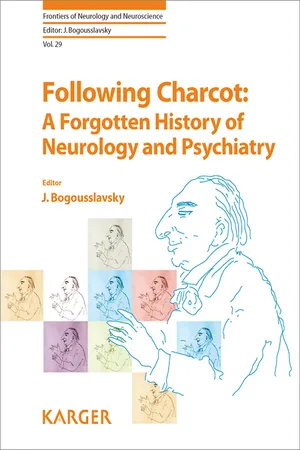
Jean-Martin Charcot, the iconic 19th century French scientist, is still regarded today as the most famous and celebrated neurologist in the world. Despite the development of strong independent schools of thought in the USA, UK and Germany, his 'Salpêtrière' school has become symbolic of the early development and rise of neurological practice and research. This book presents a fresh look at the origins of nervous system medicine, and at the fate of Charcot's school and pupils. Special emphasis is placed upon the parallels and interactions between developments in neurology and mental medicine, clearly demonstrating that Charcot is not only the father of clinical neurology, but also wielded enormous influence upon the field we would come to know as psychiatry. Providing new insights into the life and work of Charcot and his pupils, this book will make fascinating reading for neurologists, psychiatrists, physicians and historians.
eBook - ePub
Following Charcot: A Forgotten History of Neurology and Psychiatry
- 220 pages
- English
- ePUB (mobile friendly)
- Available on iOS & Android
eBook - ePub
Following Charcot: A Forgotten History of Neurology and Psychiatry
About this book
Information
Topic
MedicineBogousslavsky J (ed): Following Charcot: A Forgotten History of Neurology and Psychiatry.
Front Neurol Neurosci. Basel, Karger, 2011, vol 29, pp 137-161
Front Neurol Neurosci. Basel, Karger, 2011, vol 29, pp 137-161
______________________
Hysteria after Charcot: Back to the Future
Julien Bogousslavsky
Center for Brain and Nervous System Disorders, and Neurorehabilitation Services, Genolier Swiss Medical Network, Clinique Valmont, Montreux, Switzerland
______________________
Abstract
The studies on hysteria and hypnotism probably constitute the most important long-term work of Jean-Martin Charcot and his school, starting around 1870 until Charcot’s death in 1893. Désiré Bourneville, Charcot’s sixth interne at La Salpêtrière, was probably instrumental in stimulating his mentor’s interest in hysteria, while Charles Richet’s 1875 article on somnambulism was the trigger for Charcot to introduce hypnotism into the management of hysterics. Albert Pitres, Paul Richer, Georges Gilles de la Tourette, Paul Sollier, Joseph Babinski, Sigmund Freud and Pierre Janet became the most famous of Charcot’s collaborators on hysteria, either as ‘guardians of the temple’ (Richer, Gilles de la Tourette, who defended their mentor’s concepts against Hippolyte Bernheim and the Nancy school in the dispute during the 1880–1890s), or in renewing the field in psychology (Janet and Freud, in the 1890s) or clinical neurology (Babinski in the 1900s). In 1908, a ‘quarrel of hysteria’ led several of Charcot’s pupils into opposition with each other, from which Babinski was considered victorious against Charcot’s successor Fulgence Raymond, despite the weaknesses of his theory on ‘pithiatism’. During World War I, there was a new surge of interest in hysteria associated with war psycho-neuroses, and several students of Charcot became actively involved in medical military care (Sollier, Babinski, Gilbert Ballet, Achille Souques). Babinski’s pupil Clovis Vincent developed a treatment called torpillage (torpedoing) against war hysteria, associating painful galvanic current discharges with ‘persuasion’, but this was dismissed after the soldiers, considering it as torture, rebelled. After World War I, the neurological and psychiatric interest in hysteria again faded away, and this condition largely went back to the no-man’s land, where it had been before Charcot initiated his studies. A comprehensive look at the evolution of ideas on hysteria in the followers of Charcot shows that contrary to a common and artificially maintained view over the years, the modernity of several of his concepts remains remarkable, including: (1) his traumatic theory, which encompassed sexual factors nearly 20 years before Freud; (2) his evolution towards psychological and emotional issues, which opened the way for Janet and Freud, but unfortunately was largely ignored by Babinski; (3) his strong claim against Bernheim of the similarity of mental states in hypnotism and hysteria, which has recently been confirmed by functional magnetic resonance imaging; (4) his ‘dynamic lesion’ hypothesis, which now correlates well with neurophysiological mechanisms also demonstrated by functional imaging.
Copyright © 2011 S. Karger AG, Base
Hysteria is one of the ‘great diseases’ of the 19th century in terms of medical studies and publications, at a time when there was a continued interest in the public in phenomena such as magnetism, ‘mesmerization’, somnambulism and hypnotism [1]. This general interest had already developed by the end of the 18th century, at the time of Franz Mesmer (1734–1815) himself and his pupil, artillery General Jacques de Chastenet marquis de Puységur (1751–1825), and of abbé de Faria (1756–1819) [2], who was the inspiration for Alexandre Dumas’s famous character with the same name in Le comte de Monte-Christo. While Mesmer and Puységur developed the concept of a magnetic fluid leading to somnambulistic states (mesmerization), Faria denied the existence of a magnetic fluid and of magnetization (animal magnetism), but emphasized a phenomenon of ‘awake sleep’ and of a particular mental concentration behind hypnotism. Historically, ecstatic crises and ‘possession’ with or without a provoked hypnotic state had always been associated with hysteria since Galen and Hippocrates, and thus there was close development of new ideas on hysteria, somnambulism and hypnotism, mainly during the second part of the 19th century, where Jean-Martin Charcot (1825–1893) (fig. 1) and his school played a major role.

Fig. 1. Jean-Martin Charcot (1825–1893). Self-portrait on his own stationary around 1875, shortly after he initiated his studies on hysteria. Courtesy of the Bogousslavsky Foundation Library.
Background in the 19th Century
The term hystérique (from ‘uterus’) dates back to 1568, to describe fits specific to women, while hystérie appeared in 1731 [3]. While the relationship between hysteria and the brain (rather than the uterus) was already alluded to by Charles Lepois (1563–1633), Thomas Willis (1621–1675), Thomas Sydenham (1624–1689) and Pierre Pomme (1728–1814) [1], it is only during the 19th century that this notion became accepted, together with the concept that men could also be afflicted, and Charcot’s work here was particularly critical.
Charcot became interested in hysteria mainly after 1870 (the year of his first lesson on that topic) [4], probably due to the influence of his collaborator Désiré Bourneville (1840–1909) [5], who had been his interne in 1868, after Charles Bouchard and before Alix Joffroy. From 1871 to 1879, Bourneville worked again with Charcot, as a part-time assistant. It is interesting that Bourneville was the only one among Charcot’s internes to have a background in alienism, while Charcot himself had absolutely no connection with it, having started his clinical and scientific work in the field of clinique médicale, the predecessor of internal medicine. The first papers of Charcot on hysteria appeared in 1871–1872, dealing with ischuria, hemianesthesia, and contractures [6]. It is likely that the military events of the Commune and of the Siège de Paris, with hysteria cases in fighters, stimulated his interest. Another trigger was the dismantling of the Delasiauve service at La Salpêtrière in 1870, 8 years after his arrival at the hospital. Actually, because of building changes, the patients of that service who were not considered insane were transferred and became the responsibility of Charcot [7]. They included mainly women with hysteria and epilepsy, conditions which at the time stimulated little interest with the alienists, who were mainly focusing on what we call today the psychoses. Just before the time when Charcot became interested in hysteria, alienists such as Wilhelm Griesinger (1845), Bénédict Morel (1860), Louis-Victor Marcé (1862) and Jacques Moreau de Tours (1869) were speaking of folie hystérique or manie hystérique (‘hysterical insanity’) [8]. Before them, Philippe Pinel (1745–1826), who is considered the father of 19th century psychiatry, had only scarcely mentioned hysteria [9], and during the first part of the 19th century, several great names (Jean-Baptiste Louyer-Villermay and Achille Foville in France, Moritz Romberg in Germany) still defended the galenic-hippocratic uterine theory. Étienne Georget (1795–1828), who died at 33 years but was an extraordinary precursor in several fields of alienism, clearly highlighted the role of the brain in hysteria in his article of the Dictionnaire de Médecine (1824) [9], suggesting terms such as attaques des nerfs (nerve attacks) or encéphalite spasmodique (spasmodic encephalitis) before Jean-Louis Brachet (1789–1858) and Paul Briquet (1796–1881) published their treatises on hysteria in 1847 and 1859, respectively [10, 11]. They definitively discarded the uterine theory, and re-emphasized the role of the brain in such a masterly way that in the 20th century it was even suggested that hysteria now be called Briquet’s disease [2]. It is interesting that at the time when Briquet’s book was published, the poet Charles Baudelaire wrote, about Madame Bovary of Gustave Flaubert [12]:
Hysteria! Why would this physiological mystery not form the basis and the substance of a literary work, this mystery, which the Académie de Médecine has not solved yet, and which manifests itself in women through an asphyxiating ascending oppression (I mention only the main symptom), and in nervous men through all impotences, but also the ability to all excesses.
By the time Charcot became interested in hysteria, he had already studied several neurological diseases, such as multiple sclerosis, Parkinson’s disease or stroke, but his field also encompassed wide parts of clinique médicale (today internal medicine) [6]. He had started his work as chief of service at La Salpêtrière in 1862, and Bourneville, who stimulated his interest in hysterical women, was only his third interne, after Victor Cornil and Charles Bouchard. There was no ‘school’ around him, and it really was the study of hysteria which played this federating role within one decade [13]. Because of the absence of detectable organic disease, the La Salpêtrière internists at the time were probably rather happy that the condition, in which the alienists showed so little interest, was taken over by Charcot, who literally filled a no-man’s land, where he was joined by numerous internes and chefs de clinique who would later become famous figures in neurology and psychiatry: Alix Joffroy, Fulgence Raymond, Albert Pitres, Paul Richer and Édouard Brissaud in the 1870s, and Gilbert Ballet, Charles Féré, Pierre Marie, Georges Gilles de la Tourette and Joseph Babinski in the early and mid 1880s.
Charcot’s Hysteria, and the ‘Guardians of the Temple’ Paul Richer and Georges Gilles de la Tourette
One is often surprised by the fact that Charcot’s ideas on hysteria may commonly seem to be contradictory in his publications. This is mainly due to the fact that his concepts evolved significantly over the 20 years during which he was active in this field. After his first publications on that topic in the early 1870s, Charcot patronized the publication of Bourneville and Regnard’s first volume of the monumental Iconographie Photographique de la Salpêtrière (1876–1877), which was devoted to hysteria [14]. Five spectacular cases of hysteria were reported in detail, together with comprehensive photographic illustrations. In this book and in other reports, Charcot and his collaborators described the main characteristics of ‘hystero-epileptic’ attacks (including its ‘demoniacal’ form) and other clinical manifestations, often underlining their sexual ‘flavor’, in now famous cases including Geneviève, Rosalie and Justine [4]. The concepts elaborated by Charcot in his first studies on hysteria were mainly summarized by Paul Richer (1849–1933) in his ‘Sudies on hyste-roepilepsy’ (Études cliniques sur l’hystéro-épilepsie ou grande hystérie) (1881) [15] (fig. 2), while Georges Gilles de la Tourette (1857–1904), perhaps the most faithful pupil of Charcot (fig. 3), published his three-volume treatise on hysteria (Trai...
Table of contents
- Cover Page
- Front Matter
- Birth of Modern Psychiatry and the Death of Alienism: The Legacy of Jean-Martin Charcot
- Jean-Martin Charcot's House Officers at La Salpêtrière Hospital
- The Chair of Mental and Brain Diseases: Charcot's Pupils - Benjamin Ball, Alix Joffroy and Gilbert Ballet
- Édouard Brissaud, Fulgence Raymond and the Succession of Charcot
- Great Careers: Cornil, Bouchard, Bourneville and Proust
- Keeping the Fire Burning: Georges Gilles de la Tourette, Paul Richer, Charles Féré and Alfred Binet
- Renewing the Fire: Joseph Babinski
- Paul Sollier: The First Clinical Neuropsychologist
- Pierre Janet, Sigmund Freud and Charcot's Psychological and Psychiatric Legacy
- Jules Bernard Luys in Charcot's Penumbra
- Hysteria after Charcot: Back to the Future
- Jules Joseph Déjerine versus Pierre Marie
- Neurology Outside Paris following Charcot
- Birth and Death of Charcot's Scientific Journals
- Author Index
- Subject Index
Trusted by 375,005 students
Access to over 1.5 million titles for a fair monthly price.
Study more efficiently using our study tools.
Frequently asked questions
Yes, you can cancel anytime from the Subscription tab in your account settings on the Perlego website. Your subscription will stay active until the end of your current billing period. Learn how to cancel your subscription
No, books cannot be downloaded as external files, such as PDFs, for use outside of Perlego. However, you can download books within the Perlego app for offline reading on mobile or tablet. Learn how to download books offline
Perlego offers two plans: Essential and Complete
- Essential is ideal for learners and professionals who enjoy exploring a wide range of subjects. Access the Essential Library with 800,000+ trusted titles and best-sellers across business, personal growth, and the humanities. Includes unlimited reading time and Standard Read Aloud voice.
- Complete: Perfect for advanced learners and researchers needing full, unrestricted access. Unlock 1.5M+ books across hundreds of subjects, including academic and specialized titles. The Complete Plan also includes advanced features like Premium Read Aloud and Research Assistant.
We are an online textbook subscription service, where you can get access to an entire online library for less than the price of a single book per month. With over 1.5 million books across 990+ topics, we’ve got you covered! Learn about our mission
Look out for the read-aloud symbol on your next book to see if you can listen to it. The read-aloud tool reads text aloud for you, highlighting the text as it is being read. You can pause it, speed it up and slow it down. Learn more about Read Aloud
Yes! You can use the Perlego app on both iOS and Android devices to read anytime, anywhere — even offline. Perfect for commutes or when you’re on the go.
Please note we cannot support devices running on iOS 13 and Android 7 or earlier. Learn more about using the app
Please note we cannot support devices running on iOS 13 and Android 7 or earlier. Learn more about using the app
Yes, you can access Following Charcot: A Forgotten History of Neurology and Psychiatry by J. Bogousslavsky, Julien Bogousslavsky in PDF and/or ePUB format, as well as other popular books in Medicine & Medical Theory, Practice & Reference. We have over 1.5 million books available in our catalogue for you to explore.