eBook - ePub
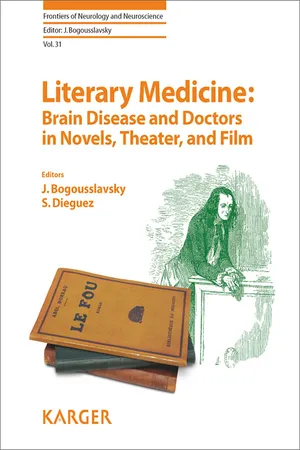
Literary Medicine: Brain Disease and Doctors in Novels, Theater, and Film
- 270 pages
- English
- ePUB (mobile friendly)
- Available on iOS & Android
eBook - ePub
Literary Medicine: Brain Disease and Doctors in Novels, Theater, and Film
About this book
Classical and modern literature is full of patients with interesting neurological, cognitive, or psychiatric diseases, often including detailed and accurate descriptions, which suggests the authors were inspired by observations of real people. In many cases these literary portrayals of diseases even predate their formal identification by medical science. Fictional literature encompasses nearly all kinds of disorders affecting the nervous system, with certain favorites such as memory loss and behavioral syndromes. There are even unique observations that cannot be found in scientific and clinical literature because of the lack of appropriate studies. Not only does literature offer a creative and humane look at disorders of the brain and mind, but just as authors have been inspired by medicine and real disorders, clinicians have also gained knowledge from literary depictions of the disorders they encounter in their daily practice. This book provides an amazing and fascinating look at neurological conditions, patients, and doctors in literature and film in a way which is both nostalgic and novel.
Information
Topic
MedicineBogousslavsky J, Dieguez S (eds): Literary Medicine: Brain Disease and Doctors in Novels, Theater, and Film.
Front Neurol Neurosci. Basel, Karger, 2013, vol 31, pp 77-115 (DOI: 10.1159/000345912)
Front Neurol Neurosci. Basel, Karger, 2013, vol 31, pp 77-115 (DOI: 10.1159/000345912)
______________________
Doubles Everywhere: Literary Contributions to the Study of the Bodily Self1
Sebastian Dieguez
Laboratory for Cognitive and Neurological Sciences, Département de Médecine, Hôpital de Fribourg, Université de Fribourg, Fribourg, Switzerland
______________________
Abstract
The topic of the double is a hallmark of romantic, gothic, and fantastic literature. In the guise of the second self, the alter ego or the doppelgänger, fictional doubles have long fascinated critics, clinicians, and scientists. We review classical approaches to the theme and propose a broad clinical and neurocognitive framework from which to examine major instances of the motif in literature. Based on neurological disorders of the bodily self (including unilateral and whole body illusions and duplications), as well as related experimental approaches, we provide examples of literary depictions of bodily fragmentation and splitting; autoscopic hallucinations; the classical doppelgänger, second self, or heautoscopic double; the feeling of a presence; out-of-body experiences; and so-called neardeath experiences. Examples include works from Guy de Maupassant, E. T. A. Hoffman, Edgar Allan Poe, Robert Louis Stevenson, Fyodor Dostoevsky, Rudyard Kipling, and others. We discuss these literary cases of doubles from a neurocognitive perspective, and suggest that common mechanisms of the bodily self are involved in the emergence of pathological illusory doubles, literary creations of the double, as well as widespread cultural and religious beliefs about the existence of doubles and the soul.
Copyright© 2013 S. Karger AG, Basel
Ein Heiliger sagt: Es stirbt, wer Gott erblickt!
Doch auch wer sich selbst schaut, lässt das Leben!
Franz Werfel (Spiegelmensch, Magische Trilogie, 1920)
Doch auch wer sich selbst schaut, lässt das Leben!
Franz Werfel (Spiegelmensch, Magische Trilogie, 1920)
This chapter provides a wide overview of the literary theme of the double from a neurocognitive point of view. The double in literature is a ubiquitous and age-old motif that became a hallmark of the romantic, gothic, and fantastic genres. In the guise of the second self, the alter ego or the doppelgänger, fictional doubles have long fascinated writers and critics [1-6], as well as medical researchers [7-10]. At the same time, researchers and writers interested in the occult and paranormal phenomena have likewise given a fair share of attention to such phenomena, pinning down the double as a cultural phenomenon. A considerable amount of theorizing has been devoted to this topic from a wide range of perspectives, including attempts to relate pathological instances of illusory doubles with their literary counterparts [7-13].
Here we follow a similar approach, providing examples of different types of literary doubles organized under a scientifically informed taxonomy. We also take a step beyond mere illustration by arguing that specific neuropsychological mechanisms underlie all instances of doubles (literary, psychological, cultural, and pathological), providing the background for the human proclivity to see and produce doubles everywhere [14-17]. We will argue that the motif of the double arises from the action of specific neurocognitive mechanisms involved with bodily awareness, spatial cognition, multisensory integration, and self-other discrimination. All these capacities of the human mind, indeed, seem to converge to provide our species with a phantom companion onto which our actions, beliefs, desires, emotions, and needs can be safely projected and which can serve as a sophisticated simulation device for planning, anticipating, comparing, and fantasizing. In that sense, we all carry one or several doubles within us, but only in specific cases can they appear to ‘leak’ into extrapersonal space (i. e. the real world) and become an illusory autonomous being.
In literature, this idea culminated in the 19th century with the theme of the doppelgänger . Through this literary device, it seems that writers were experimenting with the idea of being located in space and being oneself, a single bodily entity endowed with a sense of ownership and a sense of agency, differentiated from the others, seamlessly integrating widely different sensory information into single and meaningful percepts, and grounding higher-level aspects of cognition upon the bodily senses.
Drawing on literary material serves to outline some historical trends. Here as in several other cases in this volume, fictional characters similar to actual clinical descriptions were reported before medical research formally identified such symptoms. In fact, the great popularity of the literary double and the widespread awareness of cultural beliefs in paranormal instances of doubling phenomena might in the present case have encouraged and guided clinical investigations of similar phenomena. But more specifically, the sheer variety and striking profiles of fictional doubles might be treated as raw data to inform systematic taxonomies and distinguish different underlying mechanisms of clinical doubles. Such an approach, for instance, has proven fruitful for the study of self-portraiture in painting. Whereas visual, disembodied, and corporeal types of self-portraits could be related to autoscopic hallucinations, out-of-body experiences and heautoscopy (doppelgänger-type phenomena) and their underlying neurocognitive mechanisms [18], here we describe a broader range of literary and clinical conditions, including the feeling of a presence and so- called near-death experiences. The approach can be said to take place in the broader field of cultural cognition, tackling the idea that cultural phenomena, including literary creations and paranormal beliefs, are ‘bounded variations within limits set by human cognitive capacities’ [19; see also 15, 20]. Conversely, such an analysis could help explain the wide appeal of stories of the double by showing how they neatly fit and tap into human cognitive architecture and its mechanisms. In this sense, the literary double, together with popular beliefs about paranormal doubles, might be seen as an instance of ‘cultural recycling of cortical maps’ [21].
In the next sections, we provide an overview of the double in literature, its definition, main features, and origins, as well as several explanations, interpretations, and theories developed over the years. We then review principles of cognitive science and clinical syndromes we think are of the utmost relevance to the literary double, including autoscopic phenomena - those syndromes involving the visual duplication in extrapersonal space of the own body, and related conditions. We then proceed to highlighting key examples of literary doubles, attempting to frame them in terms of spatial cognition and bodily awareness, and emphasizing their similarity to clinical syndromes. We conclude with general comments about how literature might enrich and refine current models of the self by delineating those phenomenological features that are shared with ‘real life’ cases and argue for a common origin of literary, cultural and clinical doubles.
The Literary Double, or the Doppelgänger
Definition and Taxonomies
We have already mentioned several times the notion of a ‘literary double’ . Many readers will have spontaneously conjured up images of split- or double-personalities such as The Strange Case of Dr. Jekyll and Mr. Hyde (1886) or Norman Bates, the disturbed motel manager of Hitchcock’s Psycho (1960). Yet the term ‘double’ more usually refers to the encounter with a duplicate of oneself. The double is thus an exteriorized self, and as can be imagined its appearance is rarely good news for the original self from which it emanates. Jean Paul Richter is credited for having coined, in a footnote to his novel Siebenkäs (1796), the term ‘doppelgänger’ which he thusly defined: ‘So heissen Leute, die sich selber sehen’ (this is what people who see themselves are called). A more elaborate definition was provided by Herdman [4]: ‘a second self, or alter ego, which appears as a distinct and separate being apprehensible by the physical senses (or at least, by some of them), but exists in a dependent relation to the original.’
The heyday of this type of double was undoubtedly the 19th century, with classic stories from E. T. A. Hoffman, Edgar Allan Poe, Fyodor Dostoevsky, and Guy de Maupassant. Yet, although the literary double can be more or less readily distinguished from competing fictional entities such as vampires, ghosts, zombies, fairies, or demons [22, 23], its specific contours and features have proven difficult to pin down.
In fact, there is hardly a single author writing on the topic that has not warned right at the outset of conceptual problems plaguing the issue. The concept of the double has been said to provoke ‘confusion’ [24], to be ‘embarrassingly vague’ [25] or ‘destined to vagueness’ [26], and to suffer from ‘lack of any clarification’ and being used indiscriminately ‘for a case of biological twinship and for a case of psychopathic hallucination, with no apparent realization that the two are entirely different things’ [1]. Indeed, too loose a definition would encompass too many cases, if not the entirety of the literary canon. Friends, brothers, enemies, lovers, complementary and antagonistic characters, parallel lives, impostors, disguised characters, good and bad cops, past and future selves - all could under some view be considered instances of the literary double, and this does not even include animals, objects, places, cities, and worlds, all of which have also been ‘literary doubles’ at some point. As Jourde and Tortonese [27] put it: ‘No sooner one starts talking about the double than one sees them everywhere. ‘ Writers of stories of the double themselves have seemed ambivalent about the idea. Dostoevsky’s The Double (1846/1866), often considered the paradigmatic case of the literary doppelgänger, was really for its author a parody of sorts of what he already saw as an overtired literary m...
Table of contents
- Cover Page
- Front Matter
- Madness in Blaise Cendrars’ Novels: Moravagine and Company
- Balzac’s Louis Lambert: Schizophrenia before Kraepelin and Bleuler
- Hysteria in Fin de Siècle French Novels
- The Nadja Case
- The Great Neurosis of Dr. Joseph Gerard
- Psychopathic Characters in Fiction
- Misidentifications in Pirandello’s Plays and Short Stories
- Doubles Everywhere: Literary Contributions to the Study of the Bodily Self1
- Van Gogh’s Disease in the Light of His Correspondence
- Migraine and Metaphor
- Stranger than Fiction: Literary and Clinical Amnesia
- Alcoholism between Fiction and Reality
- Protagonists with Parkinson’s Disease
- Some Movement Disorders
- Epilepsy in Dostoevsky’s Novels
- Theater in Professor Charcot’s Galaxy
- Doctors in Balzac’s Work
- Doctor Chekhov’s Doctors
- Marcel Proust’s Fictional Diseases and Doctors
- Author Index
- Subject Index
Trusted by 375,005 students
Access to over 1.5 million titles for a fair monthly price.
Study more efficiently using our study tools.
Frequently asked questions
Yes, you can cancel anytime from the Subscription tab in your account settings on the Perlego website. Your subscription will stay active until the end of your current billing period. Learn how to cancel your subscription
No, books cannot be downloaded as external files, such as PDFs, for use outside of Perlego. However, you can download books within the Perlego app for offline reading on mobile or tablet. Learn how to download books offline
Perlego offers two plans: Essential and Complete
- Essential is ideal for learners and professionals who enjoy exploring a wide range of subjects. Access the Essential Library with 800,000+ trusted titles and best-sellers across business, personal growth, and the humanities. Includes unlimited reading time and Standard Read Aloud voice.
- Complete: Perfect for advanced learners and researchers needing full, unrestricted access. Unlock 1.5M+ books across hundreds of subjects, including academic and specialized titles. The Complete Plan also includes advanced features like Premium Read Aloud and Research Assistant.
We are an online textbook subscription service, where you can get access to an entire online library for less than the price of a single book per month. With over 1.5 million books across 990+ topics, we’ve got you covered! Learn about our mission
Look out for the read-aloud symbol on your next book to see if you can listen to it. The read-aloud tool reads text aloud for you, highlighting the text as it is being read. You can pause it, speed it up and slow it down. Learn more about Read Aloud
Yes! You can use the Perlego app on both iOS and Android devices to read anytime, anywhere — even offline. Perfect for commutes or when you’re on the go.
Please note we cannot support devices running on iOS 13 and Android 7 or earlier. Learn more about using the app
Please note we cannot support devices running on iOS 13 and Android 7 or earlier. Learn more about using the app
Yes, you can access Literary Medicine: Brain Disease and Doctors in Novels, Theater, and Film by J. Bogousslavsky,S. Dieguez,J., Bogousslavsky,S., Dieguez, Julien Bogousslavsky in PDF and/or ePUB format, as well as other popular books in Medicine & Medical Theory, Practice & Reference. We have over 1.5 million books available in our catalogue for you to explore.