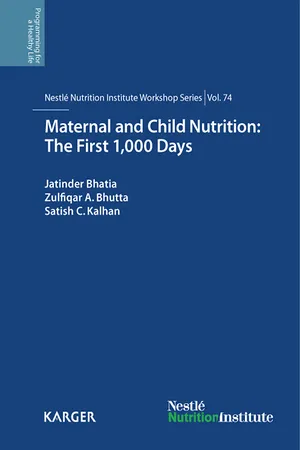
eBook - ePub
Maternal and Child Nutrition: The First 1,000 Days
74th Nestlé Nutrition Institute Workshop, Goa, March 2012
- 256 pages
- English
- ePUB (mobile friendly)
- Available on iOS & Android
eBook - ePub
Maternal and Child Nutrition: The First 1,000 Days
74th Nestlé Nutrition Institute Workshop, Goa, March 2012
About this book
Growth and nutrition during the fetal period and the first 24 months after birth are important determinants of development in early childhood. Optimal nutrition and health care of both the mother and infant during these first 1000 days of an infant's life are closely linked to growth, learning potential and neurodevelopment, in turn affecting long-term outcomes. Children with low birth weight do not only include premature babies, but also those with intrauterine growth restrictions who consequently have a very high risk of developing metabolic syndrome in the future. Epidemiology, epigenetic programming, the correct nutrition strategy and monitoring of outcomes are thus looked at carefully in this book. More specifically, two important nutritional issues are dealt with in depth: The first being the prevention of low birth weight, starting with the health of adolescent girls, through the pre-pregnancy and pregnancy stages and ending with lactation. The second point of focus concerns the nutritional follow-up and feeding opportunities in relation to dietary requirements of children with low birth weight.
Information
Topic
MedicinaSubtopic
Nutrición, dietética y bariatríaEpigenetic Factors before and during Pregnancy
Bhatia J, Bhutta ZA, Kalhan SC (eds): Maternal and Child Nutrition: The First 1,000 Days.
Nestlé Nutr Inst Workshop Ser, vol 74, pp 79-89, (DOI: 10.1159/000348405)
Nestec Ltd., Vevey/S. Karger AG., Basel, © 2013
Nestlé Nutr Inst Workshop Ser, vol 74, pp 79-89, (DOI: 10.1159/000348405)
Nestec Ltd., Vevey/S. Karger AG., Basel, © 2013
______________________
Nutritional Regulation of Fetal Growth
Frank H. Bloomfielda,b,d · Anne L Jaquierya,c,d · Mark H. Olivera,d
aLiggins Institute, bDepartment of Paediatrics, Child and Youth Health, and cWaikato Clinical School, University of Auckland, and dGravida: National Centre for Growth and Development, Auckland, New Zealand
______________________
Abstract
Fetal growth is largely regulated by nutritional supply. The placenta is responsible for fetal nutrient supply for much of pregnancy, but in early pregnancy nutrition is histiotrophic. Both placental size and efficiency, and fetal growth, may be affected by maternal nutritional state before and during very early pregnancy. In contrast, manipulating maternal nutrition during later stages of pregnancy has a smaller than expected effect on fetal growth. Maternal nutrition before and during early pregnancy also has a greater effect on gestation length than maternal nutrition later in pregnancy, suggesting that nutritional status may regulate both fetal growth trajectory and gestation length and that these two outcomes may be linked. Thus, determination of the nutritional factors regulating fetal growth, and potentially postnatal growth and body phenotype, may lie with the maternal nutritional status even before conception.
Copyright © 2013 Nestec Ltd., Vevey/S. Karger AG, Basel
Postnatal growth is largely determined by genetic factors if nutrition is sufficient. In contrast, fetal growth is largely determined by the maternal uterine environment. For example, experimental studies of either cross-breeding or embryo transfer between breeds of different maternal body size have demonstrated that fetal growth is determined largely by factors related to maternal body size [1, 2]. In humans, the paternal genome has a relatively small role in determining birthweight, with the intraclass correlation coefficient for birthweight for maternal half-sibs substantially greater than that for paternal half-sibs (0.58 vs. 0.10) [3]. The maternal influence on fetal growth is termed maternal constraint and is thought predominantly to reflect maternal uterine size and capacity to supply nutrients to the developing fetus. Thus, this concept implies that fetal growth is largely determined by fetal nutritional status, a concept supported by the fact that the major hormonal mediators of fetal growth, the insulin-like growth factors, are also regulated by fetal nutrient supply [4, 5], again in contrast to their postnatal regulation. Although the fetus is dependent upon the mother for nutrient supply, fetal nutrition is quite distinct from maternal nutrition as will be discussed below. In addition, there also is increasing evidence for the role of nutrition in the very early pregnancy period in determining fetal growth, fetal developmental trajectory and the developmental origins of disease.
Fetal Nutrition in Early and Late Gestation – Role of the Placenta
For much of the first trimester, fetal nutrition is histiotrophic rather than hemotrophic, with the conceptus receiving nutrients secreted from uterine glands [6]. Nutrition of the early conceptus is much less well understood than transplacental nutrition and, although the nutrient requirements of the early embryo are tiny, alterations in this environment, probably largely regulated by hormonal signals, do affect fetal development [reviewed in 6]. Maternal placental blood flow, and therefore presumably hemotrophic nutrition, is present towards the end of the first trimester, initially in the periphery of the placenta and later centrally [7]. The placenta then forms the interface between maternal nutrition and fetal nutrition, and a variety of factors affect the transfer of maternal nutrients to the fetus, including placental blood supply on both maternal and fetal sides, placental size and morphology, and nutrient transporter abundance and function. Thus, fetal nutrition is determined not only by maternal nutrition but also by this supply line connecting the mother and fetus [8]. Maternal factors such as maternal disease (e.g. diabetes, pre-existing hypertension) or excessive exercise, and placental factors such as impaired placental development, may have a profound effect on this supply line and thus on fetal nutrient supply.
Nutritional Determinants of Placental Development
The placenta develops from the trophectoderm, which initially forms villi surrounding the whole of the chorionic sac. Villi over the superficial pole then regress, forming the discoid placenta [6]. Maternal undernutrition throughout pregnancy has been reported to impact on placental development [9]. When the nutritional deprivation is in the second half of pregnancy, both placental and fetal weight appear to be affected. In contrast, maternal undernutrition in early pregnancy appears to have a greater effect on placental size and efficiency than on fetal growth, perhaps indicating an adaptive response of the placenta to nutritional signals. Practice in sheep farmers has long been to place ewes on poorer pasture in early pregnancy to increase placental size and, therefore, lamb birthweight [10]. Experimental manipulation of maternal nutrition in sheep, with a period of undernutrition from around the time of placental attachment to mid-pregnancy (28-77 days' gestation), has been shown to result in increased placental size and placental:fetal weight ratio, indicating increased placental efficiency [11]. Elegant studies in rats have demonstrated that a maternal low protein diet (9 vs. 18% casein) only in the peri-implantation period leads to reduced blastocyst cell number, due to decreased proliferation, and alterations in fetal growth [12]. This change in cell number was initially found in the inner cell mass (which forms the embryo) and then in the trophectoderm (which forms the extraembryonic tissues), and was associated with reduced H19 mRNA expression in male embryos [13]. Embryo transfer experiments between dams fed low protein and normal protein diets confirmed that these changes are inherent to the blastocyst rather than the ongoing maternal environment, indicating that the altered maternal nutrition resulted in developmental changes in the embryo [14]. Further investigation of the visceral yolk sac endoderm (VYSE), which is responsible for histiotrophic nutrition of the rat embryo from before placental development but which also makes a nutritional contribution through to term, demonstrated increased VYSE endocytic capacity and upregulated megalin protein expression, a transmembrane protein involved in endocytosis of plasma proteins for fetal growth [14]. Taken together, these experiments suggest that in both small and large mammals, maternal nutritional status in early pregnancy influences placental development, efficiency and fetal growth.
Observational studies suggest that the same is probably true in humans. Women exposed to severe undernutrition in late gestation due to the Dutch Famine of 1944-1945 had babies and placentae of reduced weight, but the placental:birthweight ratio, a measure of placental efficiency, was unaltered [15]. In contrast, women exposed to famine in early pregnancy had increased placental weights without an effect on fetal size, suggesting increased placental efficiency and indicating an adaptation of the placenta in response to early nutritional signals to maintain nutritional supply in late gestation. Data from a cohort of women in India suggest that even longer term indicators of maternal nutrition may affect placental development [16]. In this study, relationships between placental morphometry and markers of various phases of maternal growth (mother's own fetal/early infant growth represented by adult head circumference; mother's own childhood growth represented by adult height, and mother's current nutritional status represented by fat mass) were assessed. Maternal head circumference and maternal fat mass, but not maternal height, were both related to placental size and efficiency (assessed by ratios of various placental measurements to birthweight), suggesting that the mother's nutritional experience as a fetus and also her prepregnancy nutritional status affect placental development [16]. The effects of mothers' nutrition as fetuses may be explained by the fact that a mother's own oocytes develop in early gestation before entering a period of quiescence until puberty implying an intergenerational effect of maternal nutrition on grand-offspring fetal nutrition. Indeed, this appears to be the case, with intergenerational studies from the Dutch Famine reporting effects on birthweight of babies born to mothers who were in utero during the Famine; effects were greatest in women exposed as fetuses to famine in the first trimester of pregnancy [17]. It has been estimated that maternal factors at the time of the pregnancy account for not more than 15% of the variability in fetal growth, whereas the parents' own fetal growth can account for up to 50% in unadjusted analyses and 33% in adjusted analyses [18].
Maternal Nutritional Determinants of Fetal Growth
The concept of the fetal nutrient supply line, the central role of the placenta in fetal nutrient supply and the evidence suggesting that placental size and efficiency may be affected more by maternal nutritional status in early pregnancy help explain the relatively small effect that maternal nutritional status during pregnancy appears to have on fetal size at birth. Meta-analyses of maternal nutritional supplementation during pregnancy have found only small effects on size at birth [weighted mean difference (95% confidence intervals, CI): +37.6 (-0.2 to 75.5) g], even when only trials involving supplementation of undernourished women are considered [weighted mean difference +49.4 (-2.0 to 100.8) g] [19]. Similarly, although documented periods of significant nutritional deprivation, such as the Dutch Famine [17] and seasonal famine in the Gambia [20], do result in reduced birthweight, the effect size is relatively modest.
In contrast to this small effect of maternal nutritional status during pregnancy, maternal prepregnancy weight and body mass index are associated with impaired fetal growth. A recent large meta-analysis found a 50-60% increased risk of low birthweight in women who were underweight before pregnancy (adjusted relative risk 1.64, 95% CI: 1.38-1.94) compared with normal weight women [21]. Artificial reproductive technology (ART), which may involve altered nutrition of the early embryo in the case of in vitro fertilization and, via different hormonal and uterine environments, possibly in ot...
Table of contents
- Cover Page
- Front Matter
- Prevention of Low Birthweight, Epidemiology
- Epigenetic Factors before and during Pregnancy
- Clinical Outcome of Low Birthweight, Long-Term Consequences
- Concluding Remarks
- Subejct Index
Trusted by 375,005 students
Access to over 1.5 million titles for a fair monthly price.
Study more efficiently using our study tools.
Frequently asked questions
Yes, you can cancel anytime from the Subscription tab in your account settings on the Perlego website. Your subscription will stay active until the end of your current billing period. Learn how to cancel your subscription
No, books cannot be downloaded as external files, such as PDFs, for use outside of Perlego. However, you can download books within the Perlego app for offline reading on mobile or tablet. Learn how to download books offline
Perlego offers two plans: Essential and Complete
- Essential is ideal for learners and professionals who enjoy exploring a wide range of subjects. Access the Essential Library with 800,000+ trusted titles and best-sellers across business, personal growth, and the humanities. Includes unlimited reading time and Standard Read Aloud voice.
- Complete: Perfect for advanced learners and researchers needing full, unrestricted access. Unlock 1.5M+ books across hundreds of subjects, including academic and specialized titles. The Complete Plan also includes advanced features like Premium Read Aloud and Research Assistant.
We are an online textbook subscription service, where you can get access to an entire online library for less than the price of a single book per month. With over 1.5 million books across 990+ topics, we’ve got you covered! Learn about our mission
Look out for the read-aloud symbol on your next book to see if you can listen to it. The read-aloud tool reads text aloud for you, highlighting the text as it is being read. You can pause it, speed it up and slow it down. Learn more about Read Aloud
Yes! You can use the Perlego app on both iOS and Android devices to read anytime, anywhere — even offline. Perfect for commutes or when you’re on the go.
Please note we cannot support devices running on iOS 13 and Android 7 or earlier. Learn more about using the app
Please note we cannot support devices running on iOS 13 and Android 7 or earlier. Learn more about using the app
Yes, you can access Maternal and Child Nutrition: The First 1,000 Days by J. Bhatia,Z. A. Bhutta,S. C. Kalhan,J., Bhatia,Z.A., Bhutta,S.C., Kalhan, J. Bhatia, Z. A. Bhutta, S. C. Kalhan in PDF and/or ePUB format, as well as other popular books in Medicina & Nutrición, dietética y bariatría. We have over 1.5 million books available in our catalogue for you to explore.