eBook - ePub
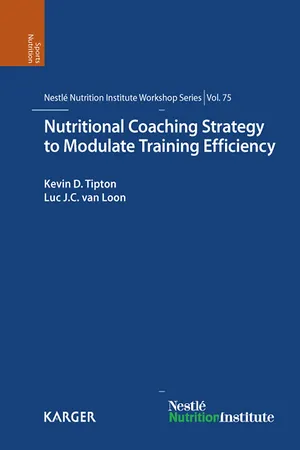
Nutritional Coaching Strategy to Modulate Training Efficiency
75th Nestlé Nutrition Institute Workshop, Mallorca, December 2011
- 160 pages
- English
- ePUB (mobile friendly)
- Available on iOS & Android
eBook - ePub
Nutritional Coaching Strategy to Modulate Training Efficiency
75th Nestlé Nutrition Institute Workshop, Mallorca, December 2011
About this book
Regular training and adequate nutrition are key factors in modulating exercise performance: Optimal performance requires a healthy diet adapted to the specific demands of the individual athlete's training and competition. Research has shown an impact of dietary intervention on the modulation of the skeletal muscle adaptive response to prolonged exercise training. Proper nutritional coaching should therefore not be restricted to the competitive events, but needs to be applied throughout both training and competition, each with its specific requirements regarding nutrient provision. Proper nutritional counseling will thus improve exercise training efficiency and ultimately increase performance capacity. Moreover, dietary counseling to modulate training efficiency is also relevant to the general public and the more frail clinically compromised patient groups. This book provides a solid scientific basis to help the reader define key targets for future interventions and develop new insights into the complex interaction between nutrition and exercise.
Information
Topic
MedicineSubtopic
Nutrition, Dietics & BariatricsTipton KD, van Loon LJC (eds): Nutritional Coaching Strategy to Modulate Training Efficiency.
Nestlé Nutr Inst Workshop Ser, vol 75, pp 27–40, (DOI: 10.1159/000345815)
Nestec Ltd., Vevey/S. Karger AG., Basel, © 2013
Nestlé Nutr Inst Workshop Ser, vol 75, pp 27–40, (DOI: 10.1159/000345815)
Nestec Ltd., Vevey/S. Karger AG., Basel, © 2013
______________________
Influence of Dietary Nitrate Supplementation on Exercise Tolerance and Performance
Andrew M. Jones · Anni Vanhatalo · Stephen J. Bailey
Sport and Health Sciences, College of Life and Environmental Sciences, University of Exeter, Exeter, UK
______________________
Abstract
Several recent studies indicate that supplementation of the diet with inorganic nitrate results in a significant reduction in pulmonary O2 uptake during sub-maximal exercise, an effect that appears to be related to enhanced skeletal muscle efficiency. The physiological mechanisms responsible for this effect are not completely understood but are presumably linked to the bioconversion of ingested nitrate into nitrite and thence to nitric oxide. Nitrite and/or nitric oxide may influence muscle contractile efficiency perhaps via effects on sarcoplasmic reticulum calcium handling or actin-myosin interaction, and may also improve the efficiency of mitochondrial oxidative phosphorylation. A reduced O2 cost of exercise can be observed within 3 h of the consumption of 5-6 mmol of nitrate, and this effect can be preserved for at least 15 days provided that the same ‘dose’ of nitrate is consumed daily. A reduced O2 cost of exercise following nitrate supplementation has now been reported for several types of exercise including cycling, walking, running, and knee extension exercise. Dietary nitrate supplementation has been reported to extend the time to exhaustion during high-intensity constant work rate exercise by 16-25% and to enhance cycling performance over 4, 10, and 16.1 km by 1-2% in recreationally active and moderately trained subjects. Although nitrate appears to be a promising ‘new’ ergogenic aid, additional research is required to determine the scope of its effects in different populations and different types of exercise.
Copyright © 2013 Nestec Ltd., Vevey/S. Karger AG, Basel
The Nitrate-Nitrite-Nitric Oxide Pathway
Nitric oxide (NO) is an important physiological signaling molecule that can modulate skeletal muscle function through its role in the regulation of blood flow, contractility, glucose and calcium homeostasis, and mitochondrial respiration and biogenesis [1]. Until quite recently, it was considered that NO was generated solely through the oxidation of the amino acid L-arginine in a reaction catalyzed by NO synthase (NOS), and that nitrite (NO-2) and nitrate (NO-3) were inert by-products of this process [2]. However, it is now clear that these metabolites can be recycled back into bioactive NO under certain physiological conditions [3, 4]. The reduction of NO-3 to NO-2 and subsequently of NO-2 to NO may be important as a means to increase NO production when NO synthesis by the NOS enzymes is impaired [5] and in conditions of low oxygen availability, as may occur in skeletal muscle during exercise.
Table 1. Nitrate content (mg/100 g fresh weight) of selected vegetables
| Nitrate content | Vegetable |
| Very high (>250) | beetroot, spinach, lettuce, rocket, celery, cress, chervil |
| High (100-250) | celeriac, fennel, leek, endive, parsley |
| Medium (50-100) | cabbage, savoy cabbage, turnip, dill |
| Low (20-50) | broccoli, carrot, cauliflower, cucumber, pumpkin |
| Very low (<20) | asparagus, aubergine, onion, mushroom, pea, pepper, potato, sweet potato, tomato |
In addition to being created through the NOS-catalyzed production of NO from L-arginine, tissue concentrations of NO-3 and NO-2 can be increased by dietary means. Vegetables account for 60-80% of the daily NO-3 intake in a Western diet [6] with green leafy vegetables such as lettuce, spinach and beetroot being particularly rich in NO-3 [7] (table 1). Ingested inorganic NO-3 is rapidly absorbed from the gut and passes into the systemic circulation with peak plasma [NO-3] being observed approximately 60 min after ingestion [4]. While some 60% of the systemic NO-3 is excreted in the urine [4]), 25% passes into the enterosalivary circulation and becomes highly concentrated in the saliva [8]. In the mouth, facultative anaerobic bacteria on the surface of the tongue reduce NO-3 to NO-2 [9]. This NO-2 is swallowed and reduced to NO and other reactive nitrogen intermediates within the acidic environment of the stomach [10, 11]. However, some NO-2 is absorbed to increase circulating plasma [NO-2] with the peak concentration being attained 2-3 h following NO-3 ingestion [8, 12]. Therefore, dietary NO-3 supplementation represents a practical method to increase circulating plasma [NO-2] and thus NO bioavailability. This has been demonstrated after ingestion of sodium nitrate (NaNO-3) [8 and 13-15], potassium nitrate [16], as well as NO-3-rich beetroot juice [17-22]. Interestingly, the characteristic rise in plasma [NO-2] following an oral NO-3 bolus is largely abolished by the use of antibacterial mouthwash [23], indicating that the reduction of NO-3 to NO-2 in humans is critically dependent on the oral bacterial NO-3 reductases.
The final step in the NO-3-NO-2-NO pathway is the one electron reduction of NO-2 to NO. This reaction is potentiated in hypoxic [24] and acidic [25] environments such as those which may exist in skeletal muscle during exercise [26]. The existence of an alternative NO generation pathway is important as it promotes NO synthesis under conditions that would otherwise limit the production of NO from NOS, ensuring that NO synthesis can occur across a wide range of cellular O2 tensions. It is important to note, however, that NO-2 may itself induce physiological effects independent of its reduction to NO [27].
The purpose of this paper is to provide a brief review of the available literature which supports a role for dietary nitrate supplementation in enhancing exercise performance in healthy humans. Given the importance of NO in vascular and metabolic control, there are sound theoretical reasons why augmenting NO bioavailability might be important in optimizing skeletal muscle function during exercise. Recent evidence indicates that elevating plasma [NO-2] through dietary nitrate supplementation is associated with enhanced muscle efficiency, fatigue resistance and performance. The mechanistic bases for this effect are considered and practical recommendations for nitrate supplementation by athletes are provided.
Nitrate and Exercise
In 2007, Larsen et al. [15] reported that 3 days of NaNO-3 supplementation increased plasma [NO-2] and reduced the O2 cost of sub-ma...
Table of contents
- Cover Page
- Front Matter
- Nutritional Strategies to Modulate the Adaptive Response to Endurance Training
- Practical Considerations for Bicarbonate Loading and Sports Performance
- Influence of Dietary Nitrate Supplementation on Exercise Tolerance and Performance
- Nutritional Strategies to Support Adaptation to High-Intensity Interval Training in Team Sports
- Dietary Strategies to Attenuate Muscle Loss during Recovery from Injury
- The New Carbohydrate Intake Recommendations
- Role of Dietary Protein in Post-Exercise Muscle Reconditioning
- Nutritional Support to Maintain Proper Immune Status during Intense Training
- Use of β-Alanine as an Ergogenic Aid
- Vitamin D Supplementation in Athletes
- Weight Management in the Performance Athlete
- Concluding Remarks: Nutritional Strategies to Support the Adaptive Response to Prolonged Exercise Training
- Subject Index
Trusted by 375,005 students
Access to over 1.5 million titles for a fair monthly price.
Study more efficiently using our study tools.
Frequently asked questions
Yes, you can cancel anytime from the Subscription tab in your account settings on the Perlego website. Your subscription will stay active until the end of your current billing period. Learn how to cancel your subscription
No, books cannot be downloaded as external files, such as PDFs, for use outside of Perlego. However, you can download books within the Perlego app for offline reading on mobile or tablet. Learn how to download books offline
Perlego offers two plans: Essential and Complete
- Essential is ideal for learners and professionals who enjoy exploring a wide range of subjects. Access the Essential Library with 800,000+ trusted titles and best-sellers across business, personal growth, and the humanities. Includes unlimited reading time and Standard Read Aloud voice.
- Complete: Perfect for advanced learners and researchers needing full, unrestricted access. Unlock 1.5M+ books across hundreds of subjects, including academic and specialized titles. The Complete Plan also includes advanced features like Premium Read Aloud and Research Assistant.
We are an online textbook subscription service, where you can get access to an entire online library for less than the price of a single book per month. With over 1.5 million books across 990+ topics, we’ve got you covered! Learn about our mission
Look out for the read-aloud symbol on your next book to see if you can listen to it. The read-aloud tool reads text aloud for you, highlighting the text as it is being read. You can pause it, speed it up and slow it down. Learn more about Read Aloud
Yes! You can use the Perlego app on both iOS and Android devices to read anytime, anywhere — even offline. Perfect for commutes or when you’re on the go.
Please note we cannot support devices running on iOS 13 and Android 7 or earlier. Learn more about using the app
Please note we cannot support devices running on iOS 13 and Android 7 or earlier. Learn more about using the app
Yes, you can access Nutritional Coaching Strategy to Modulate Training Efficiency by K. D. Tipton,L. J. C. van Loon,K.D., Tipton,L.J.C., van Loon, K. D. Tipton, L. J. C. van Loon in PDF and/or ePUB format, as well as other popular books in Medicine & Nutrition, Dietics & Bariatrics. We have over 1.5 million books available in our catalogue for you to explore.