eBook - ePub
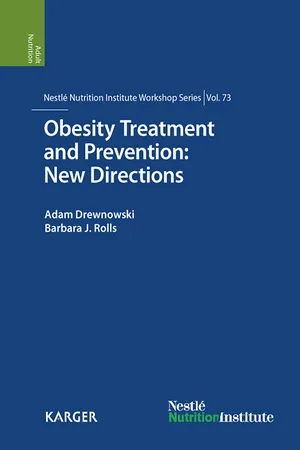
Obesity Treatment and Prevention: New Directions
73rd Nestlé Nutrition Institute Workshop, Carlsbad, Calif., September 2011
- 166 pages
- English
- ePUB (mobile friendly)
- Available on iOS & Android
eBook - ePub
Obesity Treatment and Prevention: New Directions
73rd Nestlé Nutrition Institute Workshop, Carlsbad, Calif., September 2011
About this book
Obesity continues to be a major problem for global public health, affecting not only adults, but increasingly also adolescents and even young children. Moreover, obesity and diabetes are no longer limited to wealthy societies: rates are also rising in low- and middle-income countries. Summarizing some of the key issues in obesity treatment and prevention, this publication promotes novel and interdisciplinary approaches and explores cutting-edge ideas that span child development, nutrition, behavioral sciences, economics, geography and public health. Contributions suggest a sequence of steps that may result in new ways to address obesity at the personal as well as at the population level: First, a clear understanding of who becomes obese, where, and for what reason is needed. Second, the likely contributions to overeating by the brain, biology, economics and the environment need to be identified. Then, based on the understanding of disease etiology and its distribution by geography and by social strata, targeted yet comprehensive strategies for obesity prevention and treatment for both individuals and groups need to be developed.
Information
Topic
MedicineSubtopic
Nutrition, Dietics & BariatricsObesity Treatment: Challenges and Opportunities
Drewnowski A, Rolls BJ (eds): Obesity Treatment and Prevention: New Directions.
Nestlé Nutr Inst Workshop Ser, vol 73, pp 1–20,
Nestec Ltd., Vevey/S. Karger AG., Basel, © 2012
Nestlé Nutr Inst Workshop Ser, vol 73, pp 1–20,
Nestec Ltd., Vevey/S. Karger AG., Basel, © 2012
______________________
Brain Reorganization following Weight Loss
Michael Rosenbaum · Rudolph L. Leibel
Division of Molecular Genetics, Department of Pediatrics, College of Physicians and Surgeons, Columbia University, New York, NY, USA
______________________
Abstract
The long-term stability of bodyweight despite wide variation in energy intake and expenditure suggests that at usual weight energy intake and output are ‘coupled’ to maintain body energy stores. Our model for some of the molecular mechanics of this regulation of energy stores is based on the concept of a neurally encoded ‘threshold’ for minimum body fat, below which compensatory physiology is invoked to restore body fat. The existence of such a centrally encoded threshold is supported by the similarities in response to maintenance of a reduced weight between lean and obese individuals, and the tendency for weight-reduced individuals to regain weight to levels of fat stores similar to those present prior to initial weight loss. Brain responses to food and the observed changes in energy expenditure that occur during maintenance of a reduced weight are largely reversed by the administration of the adipocyte-derived hormone, leptin.
Copyright © 2012 Nestec Ltd., Vevey/S. Karger AG, Basel
Introduction: Evidence That Bodyweight Is Regulated
Obesity has become the most prevalent and costly nutritional problem in the United States, and currently accounts for over 15% of total US health care spending [1]. Modest (10%) weight loss will prevent or ameliorate many of the major medical/metabolic consequences of obesity [2]. While most patients can achieve such weight loss by conventional means, the majority cannot maintain the reduced weight [3] for extended periods of time.
The long-term constancy of bodyweight (the average American adult gains only about 0.5–1.5 kg per year despite ingesting over 900,000–1,000,000 kcal), the 80–85% recidivism rate to previous levels of adiposity following otherwise successful weight loss, the observation that individuals successful at maintaining weight loss engage in dietary restriction and increased physical activity compared to weight-matched controls, and the demonstration that there is similar metabolic opposition to sustained weight loss in both lean and obese individuals all support the view that energy stores are physiologically regulated around an individualized centrally perceived ideal (based on genetics, development, and environment) [4–7]. The long-term persistence of hypometabolism [8] and hyperphagia [9] in weight-reduced individuals compared to themselves prior to weight loss or to individuals ‘naturally’ at the same weight, provides ample evidence for the ‘biological’ basis of the difficulties in sustaining weight loss.
The steadily increasing prevalence of obesity suggests that metabolic ‘defenses’ against gain of fat are inherently weaker than those resisting its loss. One model for the molecular mechanics of this regulation is based on the concept of a centrally encoded ‘threshold’ for minimum body energy stores (fat). The critical role of fat stores in reproduction and survival during periods of undernutrition supports the idea of evolutionary ‘emphasis’ on preserving somatic fat stores [6]. These inferences are consistent with genetic arguments related to the so-called ‘thrifty genotype’ [10] and suggest that the conventional ‘thermostatic’ model of ‘set-point’ regulation of body fat [11] is not correct. More likely, the control system is designed to keep body fat above a critical lower limit or ‘threshold’ against threats of physical or reproductive extinction during times of undernutrition. As a corollary, relative metabolic and behavioral ‘leniency’ regarding increases in body fat would be anticipated for their survival advantage.
The genes and developmental processes that affect bodyweight do so by affecting the molecular and structural components of a CNS system that sense and react to ambient concentrations of leptin, insulin, metabolic substrates, and other molecules that reflect the mass and functional status of somatic fat (energy) stores. This construct operates as a threshold sensor for relevant signals such as leptin. The threshold for any ligand (e.g. leptin) is determined by the functional sensitivity (by virtue of differences in rates of expression or structural/functional integrity) of its central and peripheral molecular components, e.g. leptin, insulin, ghrelin, melanocortin, and melanocyte-concentrating hormone receptors, and various orexigenic and anorexigenic neuropeptides, and other molecules such as AMP-kinase, acetyl CoA-carboxylase, carnitine palmitoyl transfersase-1, malonyl CoA, FoxO1, PI3 kinase, etc. [6, 12].
In this model a major, but not the only, afferent signal is the adipocytederived hormone leptin. Subthreshold circulating and CSF concentrations of leptin invoke changes in energy expenditure and intake that result in regain of bodyweight (fat) [6, 13]. The threshold determines the signal intensity required to affect gene expression, neural connections, other cellular elements (glia) [6]. Both the level at which this threshold is set and the intensity of responses to deviations below this threshold are the result of genetic, developmental, and environmental (e.g. nutritional) factors.
Obese individuals are still frequently perceived as willful agents of their excess adiposity by community [14], health professionals [15], and even by themselves [14]. The inability of most individuals to sustain weight loss is attributed to a psychological lack of ‘will power’ (somehow lean individuals who are unable to sustain even a small degree of weight loss are spared this bias) [15]. In the context of this threshold model, the metabolism and behaviors that make it so difficult for even highly motivated individuals to sustain weight loss are predominantly the predictable biological consequences of CNS-mediated processes that occur as a result of decreased energy stores rather than indications of a pathological lack of willpower that is somehow unique to formerly overweight or obese individuals. The obese and never-obese differ primarily in the level at which this threshold for body fatness is set rather than in response to deviations below that threshold. Obesity is thus a chronic disease that continues to manifest itself through persistent metabolic and behavioral opposition to sustaining a reduced bodyweight even after the physical and comorbid manifestations of the illness may have been ‘cured’ by weight reduction [5–9].
Energy Intake and Expenditure during Reduced-Weight Maintenance
In both never-obese and obese subjects, maintenance of a 10% or greater reduction in bodyweight is associated with reductions in energy expenditure adjusted for metabolic mass, circulating concentrations of bioactive thyroid hormones, sympathetic nervous system (SNS) tone, and satiety, and increases in parasympathetic nervous system (PNS) tone and skeletal muscle work efficiency that act together to favor restoration of body energy stores [5–7]. Thus, attempts to sustain weight loss are ‘opposed’ by alterations in metabolism, neuroendocrine function, autonomic function, and behavior that ‘conspire’ to favor the regain of lost weight. Most of these changes, which are discussed below, are reversed by repletion of the adipocyte-derived hormone leptin following weight loss [5–7, 13, 16, 17]. Both the effects of weight loss and leptin repletion are largely predictable from what is known about leptin action in the CNS.
In humans, maintenance of a 10% or greater decline in bodyweight (approximately 70% of this loss is fat mass) lowers energy expenditure per unit of remaining metabolic mass by ~22%, which represents a reduction of about 15% (300–400) kcal below that predicted based on changes in body composition [5]. Twenty-four hour energy expenditure (TEE) is the sum of resting energy expenditure (REE: cardiorespiratory muscle work and the biochemical work of maintaining transmembrane ion gradients at rest; ~60% of TEE), the therm...
Table of contents
- Cover Page
- Front Matter
- Brain Reorganization following Weight Loss
- Physical Activity and Weight Loss
- Dietary Strategies for Weight Management
- Targeting Adipose Tissue Inflammation to Treat the Underlying Basis of the Metabolic Complications of Obesity
- Summary Discussion on Obesity Treatment: Challenges and Opportunities
- The Gut Microbiome and Obesity
- Starting Early: Obesity Prevention during Infancy
- The Economics of Food Choice Behavior: Why Poverty and Obesity Are Linked
- The Importance of the Food and Physical Activity Environments
- The Importance of Systems Thinking to Address Obesity
- Summary Discussion on New Directions for Prevention
- Concluding Remarks
- Subject Index
Trusted by 375,005 students
Access to over 1.5 million titles for a fair monthly price.
Study more efficiently using our study tools.
Frequently asked questions
Yes, you can cancel anytime from the Subscription tab in your account settings on the Perlego website. Your subscription will stay active until the end of your current billing period. Learn how to cancel your subscription
No, books cannot be downloaded as external files, such as PDFs, for use outside of Perlego. However, you can download books within the Perlego app for offline reading on mobile or tablet. Learn how to download books offline
Perlego offers two plans: Essential and Complete
- Essential is ideal for learners and professionals who enjoy exploring a wide range of subjects. Access the Essential Library with 800,000+ trusted titles and best-sellers across business, personal growth, and the humanities. Includes unlimited reading time and Standard Read Aloud voice.
- Complete: Perfect for advanced learners and researchers needing full, unrestricted access. Unlock 1.5M+ books across hundreds of subjects, including academic and specialized titles. The Complete Plan also includes advanced features like Premium Read Aloud and Research Assistant.
We are an online textbook subscription service, where you can get access to an entire online library for less than the price of a single book per month. With over 1.5 million books across 990+ topics, we’ve got you covered! Learn about our mission
Look out for the read-aloud symbol on your next book to see if you can listen to it. The read-aloud tool reads text aloud for you, highlighting the text as it is being read. You can pause it, speed it up and slow it down. Learn more about Read Aloud
Yes! You can use the Perlego app on both iOS and Android devices to read anytime, anywhere — even offline. Perfect for commutes or when you’re on the go.
Please note we cannot support devices running on iOS 13 and Android 7 or earlier. Learn more about using the app
Please note we cannot support devices running on iOS 13 and Android 7 or earlier. Learn more about using the app
Yes, you can access Obesity Treatment and Prevention: New Directions by A. Drewnowski,B. J. Rolls,A., Drewnowski,B.J., Rolls, A. Drewnowski, B. J. Rolls in PDF and/or ePUB format, as well as other popular books in Medicine & Nutrition, Dietics & Bariatrics. We have over 1.5 million books available in our catalogue for you to explore.