Recently, a breakthrough in understanding the pathogenesis of atopic dermatitis (AD) has been made with studies successfully linking loss-of-function mutations in the genes encoding the epidermal structure protein filaggrin with the subsequent risk of developing AD. Another area of AD research apparently points us to the importance of the increased exposure to various environmental agents - in particular those deprived of microbial stimuli - which is known as the 'hygiene hypothesis'. Other studies suggest specific mechanisms in AD whereby innate immune responses are functionally defective. Also, the sweating disturbance in AD has recently received increasing attention. Nevertheless, the most common emergent theme has been the role of adaptive immunity in providing cytokines and chemokines that sustain the recruitment, retention and activation of allergen-specific T cells, dendritic cells, eosinophils, basophils and mast cells in the involved tissues. The key message of this book is to address the questions raised by dermatologists, pediatricians, practicing physicians, basic immunologists, biologists, pharmacologists and medical students on the pathogenesis, management and therapies of AD. To this end, virtually all chapters have been authored by original investigators who have contributed significantly to the establishment of current concepts.
- 178 pages
- English
- ePUB (mobile friendly)
- Available on iOS & Android
eBook - ePub
Pathogenesis and Management of Atopic Dermatitis
About this book
Information
Topic
MedizinSubtopic
ImmunologieShiohara T (ed): Pathogenesis and Management of Atopic Dermatitis.
Curr Probl Dermatol. Basel, Karger, 2011, vol 41, pp 1-34
Curr Probl Dermatol. Basel, Karger, 2011, vol 41, pp 1-34
______________________
Atopic Dermatitis and the Hygiene Hypothesis Revisited
Carsten Flohr • Lindsey Yeo
Department of Paediatric Dermatology, St. John’s Institute of Dermatology, Guy’s and St. Thomas’ Hospital NHS Foundation Trust and King’s College London, London, UK
______________________
Abstract
Background: We published a systematic review on atopic dermatitis (AD) and the hygiene hypothesis in 2005. Since then, the body of literature has grown significantly. Objectives: We therefore repeated our systematic review to examine the evidence from population-based studies for an association between AD risk and specific infections, childhood immunizations, the use of antibiotics and environmental exposures that lead to a change in microbial burden. Methods: Medline was searched from 1966 until June 2010 to identify relevant studies. Results: We found an additional 49 papers suitable for inclusion. There is evidence to support an inverse relationship between AD and endotoxin, early day care, farm animal and dog exposure in early life. Cat exposure in the presence of skin barrier impairment is positively associated with AD. Helminth infection at least partially protects against AD. This is not the case for viral and bacterial infections, but consumption of unpasteurized farm milk seems protective. Routine childhood vaccinations have no effect on AD risk. The positive association between viral infections and AD found in some studies appears confounded by antibiotic prescription, which has been consistently associated with an increase in AD risk. Conclusions: There is convincing evidence for an inverse relationship between helminth infections and AD but no other pathogens. The protective effect seen with early day care, endotoxin, unpasteurized farm milk and animal exposure is likely to be due to a general increase in exposure to non-pathogenic microbes. This would also explain the risk increase associated with the use of broad-spectrum antibiotics. Future studies should assess skin barrier gene mutation carriage and phenotypic skin barrier impairment, as gene-environment interactions are likely to impact on AD risk.
Copyright © 2011 S. Karger AG, Basel
There has been a dramatic increase in the prevalence of atopic dermatitis (AD) over past decades, currently affecting around 20% of children in developed countries [1]. Although family history plays an important role in AD susceptibility, probably at least partly explained by skin barrier gene mutation carriage, genetics alone cannot explain the increase in AD prevalence [2, 3]. Epidemiological research has therefore focused on identifying possible environmental and lifestyle-related factors that are associated with an increased AD risk. For instance, AD is more common in urban than in rural communities [4]. In addition, migrant studies have demonstrated that immigrants take on the risk of the community to which they move, with AD being more prevalent in western industrialized countries than developing nations [5, 6]. The risk of developing AD is also higher in children growing up in smaller families and families of higher socio-economic status [7-9]. All this strongly suggests an environmental aetiology.
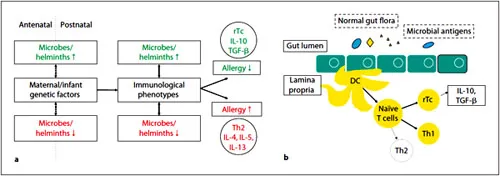
The so-called ‘hygiene hypothesis’ was formulated in the late 1980s, based on the observation that AD and hay fever were noted to be less common among UK children growing up with larger numbers of older siblings [10]. At the time, this was thought to be due to a higher exposure to certain viral and bacterial pathogens in larger families. The hygiene hypothesis has stimulated a large body of both epidemiological and immunological research. For instance, there is evidence from animal models that allergic disease occurs when the developing immune system is deprived of the obligatory stimulation through certain microbial antigens, especially when this happens directly postnatally or even already in utero [11]. Immunologically, this seems partly due to an imbalance between type 1 and type 2 T helper cells and their cytokines. However, the immunological processes ultimately leading to allergic disease are more complex than this. The current hypothesis is that regulatory T cells and anti-inflammatory cytokines such as interleukin 10 and transforming growth factor ß play an important role in the protection against clinical allergy, possibly induced by microbial stimulation of dendritic cells via Toll-like receptors at the level of the gastrointestinal mucosa or other lymphoid tissues (fig. 1a, b) [12-15].
Since our original systematic review on AD and the hygiene hypothesis in 2005, the body of literature has grown significantly, and we therefore decided to revisit this fascinating topic for a second time [16]. We performed a systematic Medline search from inception until June 2010 to address the following questions at the population level: (1) Is there any evidence that the risk of AD is related to environmental exposures that alter microbial burden? (2) Which specific infections have been associated with a reduced AD risk? (3) Is there a link between immunizations, use of antibiotics and AD risk? The online search strategy is available on request from the corresponding author and was supplemented by an extensive hand search of the literature through references identified from retrieved articles. Overall, we identified 49 new studies suitable for inclusion. All studies were analysed qualitatively, and results are presented in summary tables. Where appropriate, we also conducted meta-analyses, namely for pet and antibiotic exposure.
The Link between AD and Environmental Exposures That Can Alter Microbial Burden
Basic hygiene, day care attendance, anthroposophic lifestyle, living on a farm and pets have all been examined as potential risk factors for allergic disease, including AD, since they at least theoretically increase exposure to microbes.
Fig. 1. a Microbial and helminth exposure in utero and postnatally is likely to play an important role in the development of AD. In this model, high exposure burden, probably in interaction with maternal and infant genetic factors, reduces AD risk, whereas AD risk increases if the fetal and/or infantile immune system is deprived of microbial stimulation. The gut mucosa is likely to be a key site for the priming of the immune system (see b). rTc = Regulatory T cells; Th2 = type 2 T helper cells; IL = interleukin;TGF-ß = transforming growth factor ß. b The postulated link between allergic disease and the gut microflora. Chronic stimulation of gut-associated lymphoid tissue through normal gut flora and other non-/pathogenic microbial antigens might ensure the development of a Th1/regulatory T cell-dominated cytokine milieu and therefore prevent clinical expression of allergic disease. Regulatory T cells may have a role in this by the production of anti-inflammatory cytokines, such as IL-10 and TGF-ß. DC = Dendritic cell; Th = T helper cell; rTc = regulatory T cell.
Basic Hygiene
Only one large birth cohort study, the Avon Longitudinal Study of Parents and Children, has so far addressed the question whether cleanliness in terms of general hygiene measures, such as frequency of washing, is associated with an increase in AD risk. Children were seen at 6 and 30-42 months of age, and a moderate increase in AD risk was found with higher levels of personal hygiene, measured as an empirical hygiene score from 1 to 14 (baseline adjusted odds ratio, adj. OR = 1.04, 95% confidence interval, CI = 1.01-1.07; table 1) [17].
Day Care
Three birth cohort studies, one from the USA, one from Denmark and one from Germany, found an inverse relationship between day care attendance and AD, with risk reductions up to 88% (German study adj. OR = 0.12, 95% CI = 0.04-0.31) [18-20]. One ...
Table of contents
- Cover Page
- Front Material
- Preface
- Atopic Dermatitis and the Hygiene Hypothesis Revisited
- Loss-of-Function Mutations within the Filaggrin Gene and Atopic Dermatitis
- FcεRI-Toll-Like Receptor Interaction in Atopic Dermatitis
- The Antimicrobial Skin Barrier in Patients with Atopic Dermatitis
- Defective Sweating Responses in Atopic Dermatitis
- The Role of Cytokines/Chemokines in the Pathogenesis of Atopic Dermatitis
- Contribution of Interleukin 18 to the Development of Infection-Associated Atopic Dermatitis
- Innate Immunity in Atopic Dermatitis
- The Role of Regulatory T Cells in Atopic Dermatitis
- Increased Susceptibility to Cutaneous Viral Infections in Atopic Dermatitis: The Roles of Regulatory T Cells and Innate Immune Defects
- Biomarkers for Itch and Disease Severity in Atopic Dermatitis
- Practical Issues on Interpretation of Scoring Atopic Dermatitis: SCORAD Index, Objective SCORAD, Patient-Oriented SCORAD and Three-Item Severity Score
- Systemic Therapy of Atopic Dermatitis in Children and Adults
- Author Index
- Subject Index
Trusted by 375,005 students
Access to over 1.5 million titles for a fair monthly price.
Study more efficiently using our study tools.
Frequently asked questions
Yes, you can cancel anytime from the Subscription tab in your account settings on the Perlego website. Your subscription will stay active until the end of your current billing period. Learn how to cancel your subscription
No, books cannot be downloaded as external files, such as PDFs, for use outside of Perlego. However, you can download books within the Perlego app for offline reading on mobile or tablet. Learn how to download books offline
Perlego offers two plans: Essential and Complete
- Essential is ideal for learners and professionals who enjoy exploring a wide range of subjects. Access the Essential Library with 800,000+ trusted titles and best-sellers across business, personal growth, and the humanities. Includes unlimited reading time and Standard Read Aloud voice.
- Complete: Perfect for advanced learners and researchers needing full, unrestricted access. Unlock 1.5M+ books across hundreds of subjects, including academic and specialized titles. The Complete Plan also includes advanced features like Premium Read Aloud and Research Assistant.
We are an online textbook subscription service, where you can get access to an entire online library for less than the price of a single book per month. With over 1.5 million books across 990+ topics, we’ve got you covered! Learn about our mission
Look out for the read-aloud symbol on your next book to see if you can listen to it. The read-aloud tool reads text aloud for you, highlighting the text as it is being read. You can pause it, speed it up and slow it down. Learn more about Read Aloud
Yes! You can use the Perlego app on both iOS and Android devices to read anytime, anywhere — even offline. Perfect for commutes or when you’re on the go.
Please note we cannot support devices running on iOS 13 and Android 7 or earlier. Learn more about using the app
Please note we cannot support devices running on iOS 13 and Android 7 or earlier. Learn more about using the app
Yes, you can access Pathogenesis and Management of Atopic Dermatitis by T. Shiohara, P. Itin,G. B. E. Jemec in PDF and/or ePUB format, as well as other popular books in Medizin & Immunologie. We have over 1.5 million books available in our catalogue for you to explore.