The aim of the International Stereotactic Radiosurgery Society (ISRS) is to promote technical developments in stereotactic radiosurgery on the highest level of clinical experience based on clinical investigations. In this volume, high-quality peer-reviewed papers from the 8th International Stereotactic Radiosurgery Society meeting held in San Francisco 2007 are presented. The reports include new studies on physics, imaging and radiobiology in radiosurgery as well as the latest research in the field of cranial radiosurgery on benign tumors, malignant tumors and vascular malformations. Further articles cover new investigations in the practice on spinal and body radiosurgery.This publication is of special interest to neurosurgeons, radiation oncologists and medical physicists who require precise information to keep up to date with the important developments on the use of stereotactic radiosurgery.

eBook - ePub
Radiosurgery
8th International Stereotactic Radiosurgery Society Meeting, San Francisco, June 2007
- 436 pages
- English
- ePUB (mobile friendly)
- Available on iOS & Android
eBook - ePub
Radiosurgery
8th International Stereotactic Radiosurgery Society Meeting, San Francisco, June 2007
About this book
The Jacob I. Fabrikant Memorial Address
McDermott MW (ed): Radiosurgery. Basel, Karger, 2010, vol 7, pp 1–17
...........................
Raising Questions and Answering Them: A Personal Approach to Radiosurgery. The 2007 Jacob I. Fabrikant Award Lecture
The 2007 Jacob I. Fabrikant Award Lecture
Douglas Kondziolka
Departments of Neurological Surgery and Radiation Oncology, University of Pittsburgh, and the Center for Image-Guided Neurosurgery, UPMC Presbyterian, Pittsburgh, Pa., USA
An academic career provides the opportunity for a physician to have a leadership role in the advance of a specialty. Investigation and publication are the cornerstones of this effort. What is learned must be shared. Over the past two decades, I have had the opportunity to see a specialty develop from its earliest forms, and to participate in that progress with many hard-working and talented colleagues. Since my first introduction to radiosurgery at the Harvard Cyclotron Unit with Dr. Raymond Kjellberg in 1984, and after my arrival at the University of Pittsburgh in 1989 to learn from Drs. Lunsford, Coffey and Flickinger, I have been influenced by investigators who asked questions. Asking a question and working to come up with a reasonable answer is the foundation of what we do as academic physicians. Dr. Jack Fabrikant worked in such a way, and instilled enthusiasm for research in his trainees. It is an honor to receive this award named for him.
Radiosurgery is perhaps the most ‘minimally invasive’ technique currently applied for the surgical treatment of brain disease and the first widely adopted form of ‘biologic neurosurgery’ [37, 38, 40, 45]. Radiosurgery allows the surgeon to operate at a macromolecular level, via ‘cutting’ of nucleic acids strands, or affecting protein biosynthesis [91]. Because radiosurgery causes differential cellular effects, it has wide application to a variety of cerebral disorders (table 1) [69].
If we are to be biologic surgeons..
What are the effects of a single radiation dose to the brain?
What are the effects of different doses, over time, and in different brain locations?
Our understanding of how radiosurgery should be used will determine how techniques will evolve. Multiple isocenters using narrow radiation beams, or multiple delivery angles, are used to create a three-dimensional radiation volume that matches the imaging-defined tumor margin (i.e. conformality) [18]. Over the last two decades and despite the efforts of many, we have not learned that much about brain and cranial nerve tolerance. We have much work to do. There remains ‘dogma’ about appropriate doses for different cranial nerves or the brainstem. We should remember that many of these concepts were founded on very little data, and should be questioned. Because many targets are adjacent to critical brain and cranial nerve structures, conformal radiosurgery remains crucial to maintain low morbidity rates with high tumor control rates. In 2008, we should work to keep our radiation localized to the target disease, and keep it out of surrounding normal tissue. Devices such as the Perfexion model of the Gamma Knife® use elegant robotics to perform efficient work (fig. 1). Some argue that fractionated stereotactic irradiation is of value [4, 7], and we agree if the planned treatment volume encompasses normal cranial nerves or brain tissue. It should not be a replacement for conformal radiosurgery which provides effective and efficient treatment to the tumor or vascular malformation. Pharmacologic radio-protection with drugs that help mediate radiation injury will be important in the future [21, 50].
What about tumor or AVM doses, in models closer to humans, over longer periods of time?
Radiobiological studies in a sub-human primate model (baboon) were performed at the University of Pittsburgh using an 8-mm collimator and maximum doses of 20, 50, or 150 Gy. The longest-term studies were conducted in animals that received 20 Gy and were followed for 2 years. In these animals, no histologic effects were seen in normal brain, indicating the tolerance of the brain to such a dose commonly delivered to the margin of tumors in humans. Such a study provided evidence for the safety profile of human tumor and AVM radiosurgery.
Table 1. Gamma Knife® radiosurgery at the University of Pittsburgh, 1987-2007 (n = 8,200)
Clinical indication | Procedures n |
Arteriovenous malformation | 1,132 |
Cavernous malformation | 126 |
Arteriovenous fistula | 31 |
Vestibular schwannoma | 1,252 |
Trigeminal schwannoma | 36 |
Other schwannoma | 43 |
Meningioma | 1,126 |
Pituitary tumor | 255 |
Craniopharyngioma | 63 |
Hemangioblastoma | 41 |
Hemangiopericytoma | 32 |
Glomus tumor | 19 |
Pineocytoma | 16 |
Malignant pineal tumor | 13 |
Chordoma | 27 |
Chondrosarcoma | 19 |
Choroid plexus papilloma | 10 |
Hemangioma | 8 |
Glioblastoma multiforme | 305 |
Anaplastic astrocytoma | 122 |
Astrocytoma | 39 |
Oligodendroglioma | 19 |
Pilocytic astrocytoma | 71 |
Ependymoma | 62 |
Medulloblastoma | 21 |
CNS lymphoma | 11 |
Hypothalamic hamartoma | 4 |
Brain metastasis | 2,382 |
Malignant skull base tumor | 44 |
Other tumor | 20 |
Trigeminal neuralgia | 721 |
Sphenopalatine neuralgia | 7 |
Cluster headache | 5 |
Thalamotomy for tremor | 78 |
Mesial temporal lobe epilepsy | 3 |
Obsessive compulsive disorder | 3 |
Cancer pain | 2 |
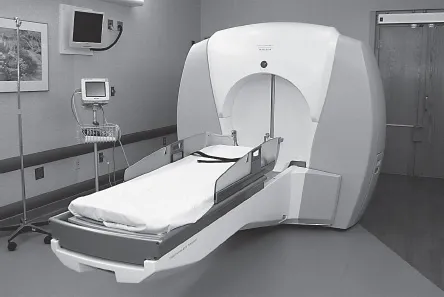
Fig. 1. The Perfexion model of the Leksell Gamma Knife®, University of Pittsburgh Medical Center.
Skull Base Tumors
Stereotactic radiosurgery has changed the role of the neurosurgeon in the management of cranial base tumors such as meningiomas, schwannomas, pituitary adenomas, craniopharyngiomas, and other lesions [9, 25, 30, 32, 66, 83]. Rather than simply recommending a resection (complete or partial), observation (with an unclear natural history), or fractionated radiation therapy (with limited long-term data except for pituitary tumors)), the surgeon can now provide radiosurgery as primary or in some cases as adjuvant care [90]. Initially, radiosurgery was attractive to patients who were elderly or medically infirm, but later was offered to patients of all ages [2-5] eligible for stereotactic frame fixation. We have found that results have been consistent in both children and adults [16, 17].
How do we maintain cranial nerve function inpatients with acoustic neuromas?
To date we have managed over 1,200 patients with vestibular schwannomas using Gamma Knife® radiosurgery. Initially, patients had radiosurgery as an alternative to microsurgical resection due to one or more of the following criteria: advanced patient age, poor medical condition for surgery, recurrent or residual tumor after prior surgery, neurofibromatosis type II, or patient preference [16, 18, 42, 87]. Symptoms before radiosurgery included hearing loss (92%), balance symptoms or ataxia (51%), tinnitus (43%), or other neurologic deficit (19.5%). 34% had useful hearing (253 total), Gardner-Robertson grade I (speech discrimination score ≥70%; pure tone average ≤30 dB) or grade II (speech discrimination score ≥50%; pure tone average ≤50 dB). Over the last 15 years, the average dose to the tumor margin was 13 Gy.
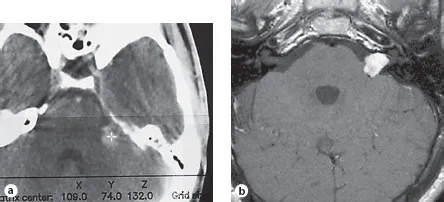
Fig. 2. Axial CT image of a left vestibular schwannoma in a 36-year-old man at radio-surgery (a), and at 20 years (b), showing long-term tumor regression.
In two separate outcomes evaluations, we found that the clinical tumor control rate (no requirement for surgical intervention) was 98% at 5-10 years [16, 42]. The key to good outcomes included magnetic resonance imaging (MRI)-based planning, use of multiple isocenters with smaller radiation beams, and a tumor margin dose in the range of 12-13 Gy [18]. We think that an evaluation of middle ear structures will be important to improve outcomes further. Our typical margin dos...
Table of contents
- Cover Page
- Front Matter
- Raising Questions and Answering Them: A Personal Approach to Radiosurgery. The 2007 Jacob I. Fabrikant Award Lecture
- Stereotactic Orthogonal Films Can Be Used as an Indication of Linear Accelerator Ageing
- Routine Dosimetric Verification of Stereotactic Treatments Using Monte Carlo Methods in a Distributed Computing Environment
- Three-Dimensional Gel Dosimetry for Dose Volume Histogram Verification in Stereotactic Radiosurgery
- Dose Distribution Comparison for the Treatment of Spinal Metastases Using CyberKnife® versus IMRT Stereotactic Body Radiotherapy Using Linac/CT-on-Rails Unit
- Miniature Ion Chamber for Output Calibration of Stereotactic Radiosurgery Units
- Functional Relationship between the Volume of a Near-Target Peripheral Isodose Line and Its Isodose Value for Gamma Knife® Radiosurgery
- Monte Carlo Simulation Dose Calculation for Intensity Modulated Radiosurgery
- Relationship between Radiosurgery Conformity Indices and Acoustic Neuroma Tumor Volume
- Failure of Arteriovenous Malformation Radiosurgery and Its Prevention Using True Image Fusion of Rotation CINE Angiograms in Integrated Multiplanar Imaging
- Observation of Shift Phenomena when Using 3T MRI Scanners in Stereotactic Radiosurgery
- Diffusion-Tensor Imaging Tractography of the Corticospinal Tract for Evaluation of Motor Fiber Tract Radiation Exposure in Gamma Knife® Radiosurgery Treatment Planning
- Acoustic Neuroma Radiosurgery: Lessons Learned
- Radiosurgery of Intracranial Schwannomas: Comparative Study of Follow-Up Evaluation
- Treatment of a Large Acoustic Tumor with Fractionated Stereotactic Radiotherapy
- Current Treatment Strategy of Gamma Knife® Surgery for Vestibular Schwannoma: Image-Guided and Robotized Microradiosurgery
- Non-Surgical Management of Meningiomas Involving the Cavernous Sinus
- Long-Term Follow-Up of 32 Meningiomas of the Clivus and Foramen Magnum Subjected to Stereotactic Radiosurgery
- Safety and Efficacy of Fractionated Stereotactic Radiotherapy in the Treatment of Skull Base Tumors: An Evidence-Based Approach
- Image-Guided Micro Gamma Knife® Surgery for Skull-Base Tumors to Avoid Underlying Dysfunction of the Surrounding Vital Structures Using CISS with Gadolinium Enhancement
- Endocrine Issues Related to Stereotactic Radiosurgery in the Vicinity of the Pituitary Gland
- Simultaneously Integrated Boost to Multiple Brain Metastases during Whole Brain Radiation Therapy-Hippocampal Avoidance
- Gamma Knife® Radiosurgery Alone for One to Four Brain Metastases. Is Prophylactic Whole-Brain Radiation Therapy Really Necessary?
- Linac Stereotactic Radiosurgery of the Resection Cavity following Surgical Removal of Brain Metastasis: A Brief Report
- Radiosurgery as Salvage Therapy for Primary Central Nervous System Lymphoma
- Survival following Stereotactic Radiosurgery for Newly Diagnosed and Recurrent Glioblastoma Multiforme: A Multicenter Experience
- Arteriovenous Malformation Radiosurgery: Realities from a Twenty-Year Perspective
- Dynamic Definition of Critical Zones for Radiosurgery in AVMs
- Gamma Knife® Radiosurgical Strategy for Pediatric High-Grade Arteriovenous Malformations: Advantages of Staged Radiosurgery Prior to Targeting Nidus Proximal to the Drainer
- Hyperbaric Oxygen in the Management of Brain Edema Associated with Stereotactic Radiosurgery
- Gamma Knife® Radiosurgery of the Trigeminal Nerve and Sphenopalatine Ganglion for Cluster Headache
- Impact of Dose Rate on Outcomes of Gamma Knife® Radiosurgery in Patients with Face Pain
- Comparisons of Novalis and CyberKnife® Spinal Stereotactic Body Radiotherapy Treatment Planning Based on Physical and Biological Modeling Parameters
- Preliminary Results of Stereotactic Radiotherapy for Spinal Lesions using the Novalis System
- Imaging Resolver Localization for Whole-Body Stereotaxy Using TomoTherapy
- Utilization of Image-Guided Radiation Therapy Equipment to Enhance Stereotactic Body Radiation Therapy Commissioning
- Use of Platinum Embolization Coils for Targeting Liver Lesions in Stereotactic Body Radiotherapy/Radiosurgery
- Author Index
- Subject Index
Trusted by 375,005 students
Access to over 1.5 million titles for a fair monthly price.
Study more efficiently using our study tools.
Frequently asked questions
Yes, you can cancel anytime from the Subscription tab in your account settings on the Perlego website. Your subscription will stay active until the end of your current billing period. Learn how to cancel your subscription
No, books cannot be downloaded as external files, such as PDFs, for use outside of Perlego. However, you can download books within the Perlego app for offline reading on mobile or tablet. Learn how to download books offline
Perlego offers two plans: Essential and Complete
- Essential is ideal for learners and professionals who enjoy exploring a wide range of subjects. Access the Essential Library with 800,000+ trusted titles and best-sellers across business, personal growth, and the humanities. Includes unlimited reading time and Standard Read Aloud voice.
- Complete: Perfect for advanced learners and researchers needing full, unrestricted access. Unlock 1.5M+ books across hundreds of subjects, including academic and specialized titles. The Complete Plan also includes advanced features like Premium Read Aloud and Research Assistant.
We are an online textbook subscription service, where you can get access to an entire online library for less than the price of a single book per month. With over 1.5 million books across 990+ topics, we’ve got you covered! Learn about our mission
Look out for the read-aloud symbol on your next book to see if you can listen to it. The read-aloud tool reads text aloud for you, highlighting the text as it is being read. You can pause it, speed it up and slow it down. Learn more about Read Aloud
Yes! You can use the Perlego app on both iOS and Android devices to read anytime, anywhere — even offline. Perfect for commutes or when you’re on the go.
Please note we cannot support devices running on iOS 13 and Android 7 or earlier. Learn more about using the app
Please note we cannot support devices running on iOS 13 and Android 7 or earlier. Learn more about using the app
Yes, you can access Radiosurgery by M. W. McDermott, P. K. Sneed,M. W. McDermott,L. Ma,K. Huang,R. L. Jensen,I. Paddick in PDF and/or ePUB format, as well as other popular books in Medicine & Neurology. We have over 1.5 million books available in our catalogue for you to explore.