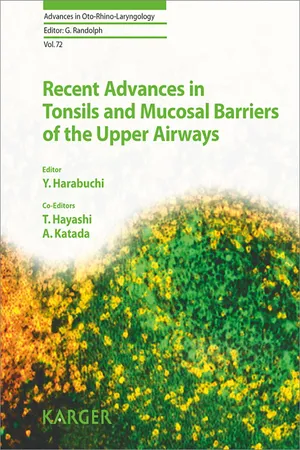
Since 1987, the most recent issues on tonsils and mucosal immunity have been discussed regularly at the 'International Symposiums on Tonsils and Mucosal Barriers of the Upper Airways' (ISTMB). This book is a summary of the topics presented during the 7th ISTMB covering both basic and clinical research on tonsils and upper airways. Presented are issues such as immunology and mucosal defense systems, bacteriology and virology, mucosal vaccine for upper airway infections, MALT, NALT and LALT, clinical manifests and pathogenesis of tonsil-related diseases such as IgA nephropathy, palmoplantal pustulosis, reactive arthritis diseases, and more related disorders. Further contributions reflect the association of tonsils with otitis media, allergic diseases in the upper airways, obstructive sleep apnea syndrome, and medical and surgical treatments for tonsil diseases. Otolaryngologists, pediatricians and immunologists who seek to unravel the mystery of the tonsil will find this volume of great assistance on their way to accomplish this task.
eBook - ePub
Recent Advances in Tonsils and Mucosal Barriers of the Upper Airways
7th International Symposium on Tonsils and Mucosal Barriers of the Upper Airways, Asahikawa, July 2010: Proceedings
- 246 pages
- English
- ePUB (mobile friendly)
- Available on iOS & Android
eBook - ePub
Recent Advances in Tonsils and Mucosal Barriers of the Upper Airways
7th International Symposium on Tonsils and Mucosal Barriers of the Upper Airways, Asahikawa, July 2010: Proceedings
About this book
Information
Topic
MedicineSubtopic
ImmunologyViral Infection of Tonsil and Upper Airways
Harabuchi Y (ed): Recent Advances in Tonsils and Mucosal Barriers of the Upper Airways.
Adv Otorhinolaryngol. Basel, Karger, 2011, vol 72, pp 157-159
Adv Otorhinolaryngol. Basel, Karger, 2011, vol 72, pp 157-159
______________________
A Novel Immune Evasion Mechanism of LMP-1,
an EBV-Primary Oncogene, in Nasopharyngeal Carcinoma
Tomokazu Yoshizaki
Division of Otolaryngology, Head and Neck Surgery, Graduate School of Medical Science, Kanazawa University, Takaramachi,Kanazawa, Japan
______________________
Abstract
Nasopharyngeal carcinoma is an Epstein-Barr virus (EBV)-associated tumor. Viruses that are associated with malignant transformation have evolved unique mechanisms to interfere with this interaction to evade antiviral T cell responses. EBV exploits many immune evasive strategies to successfully establish a latent infection in B cells. CD8+ T cell responses to LMP-1 are generally very low and rarely detected in healthy virus carriers. Activation of the NF-kB pathway by EBV-LMP-1 leads to an upregulation of the MHC class I antigen-processing pathway. Paradoxically, LMP-1 itself induces a subdominant CD8+T cell response and appears to have evolved to avoid immune recognition. An expression of LMP-1 in human cells enhanced the trans-presentation of CD8+ T cell epitopes; however, cis-presentation of LMP-1-derived epitopes was severely impaired. Deletion of the first transmembrane domain of LMP-1, which prevented self-aggregation, significantly enhanced the cis-presentation of T cell epitopes from this protein, whereas it lost its ability to upregulate transpresentation. These results delineate a novel mechanism of immune evasion, which renders a virally encoded oncogene inaccessible to the conventional MHC class I pathway limiting its cis-presentation.
Copyright © 2011 S. Karger AG, Basel
Epstein-Barr virus (EBV) exploits many immune evasive strategies to successfully establish a latent infection in B cells and epithelial malignant tumors such as nasopharyngeal carcinoma (NPC). Analysis of the role of individual EBV latent antigens in the regulation of antigen-processing genes indicated that latent membrane protein-1 (LMP-1) was sufficient to upregulate the expression of transporters associated with antigen processing and trans-presentation of MHC class I-restricted epitopes in B cells [1]. Subsequent studies demonstrated that the immunomodulatory effects of LMP-1 are mediated through C-terminal activator regions (CTAR1 and CTAR2), which are involved in the induction of nuclear factor-kB (NF-kB). At the same time, LMP-1 promotes invasion and metastasis through these intracellular activation domains [2-4]. Paradoxically, the population of CD8+ T cells that responded to LMP-1 is generally very low and rarely detected in healthy virus carriers, suggesting that LMP-1 may limit its cis-presentation through the MHC class I pathway. We have delineated a mechanism by which LMP-1 limits its self-presentation without compromising its ability to modulate trans-presentation of the CD8+T cell epitope [5, 6].
To assess trans-presentation of LMP-1, we transfected multiple LMP-1 sequences to epithelial cell lines. Although all LMP-1 variants upregulated the expression of MHC class I on a human epithelial cell line, C33A, considerable activation of LMP-1-specific T cells was only evident after incubation with peptide-sensitized cells. In contrast, LMP-1 expression in C33A cells enhanced trans-presentation of CD8+ T cell epitopes from another EBV-encoded membrane protein, LMP-2A. Collectively, these results suggested that, despite its capacity to upregulate trans-presentation via the MHC class I pathway, LMP-1 limits its self-presentation to CD8+ T cells.
Much of the data presented are based on either stable or transient expression of LMP-1. To confirm these observations, we assessed the endogenous presentation of LMP-1 epitopes in EBV-transformed LCLs. Although activation of LMP-2A-specific T cells was evident after incubation with HLA-matched LCLs, very low levels of activation of T cells specific for multiple LMP-1-encodedpeptide epitopes was observed. Activation of LMP-1-specific T cells could be detected after incubation with peptide-sensitized LCLs.
To investigate the mechanism for this immune evasion, we tested a series of LMP-1 expression vectors with mutations in the CTAR1 and/ or CTAR2 domain as well as a deletion mutant commencing at the second methionine of LMP-1 (∆1-43LMP-1-GFP), which removes the first trans-membrane domain. This domain has been shown to have an immunomodulatory effect, and ∆1-43LMP-1 has been used for expanding LMP-1-specific T cells. Although mutations within the CTAR domains had no impact on the presentation of LMP-1 epitopes, deletion of the first trans-membrane domain enhanced endogenous presentation of HLA class I-restricted epitopes. Consistent with previous studies, intracellular localization analysis using fluorescent microscopy revealed that, although full-length LMP-1 and its CTAR mutants formed large aggregates in the perinuclear region, ∆1-43LMP-1-GFP lost its ability to aggregate. This enhanced presentation was not the result of increased expression of ∆l-43LMP-1-GFP compared with full-length LMP-1. These observations indicate that, although the NF-kB signaling domains had no impact on the cis-presentation of LMP-1 epitopes, aggregation of this protein (a critical requirement for transpresentation) limits its accessibility to the MHC class I processing machinery.
The data presented in this meeting indicate that, in addition to constraining its cis-presentation through aggregation, epitopes encoded within LMP-1 protein are most probably destroyed by cellular proteasomes, providing a dual strategy by which LMP-1 limits self-presentation to CD8+ T cells [7].
Acknowledgement
In addition to the author, this work was contributed by Corey Smith, Naohiro Wakisaka and Rajiv Khanna.
References
1 Rowe M, Khanna R, Jacob CA, et al: Restoration of endogenous antigen processing in Burkitt's lymphoma cells by Epstein-Barr virus latent membrane protein-1: coordinated up-regulation of peptide transporters and HLA-class I antigen expression. Eur J Immunol 1995;25:1374-1384.
2 Yoshizaki T, Sato H, Furukawa M, Pagano J: The expression of matrix metalloproteinase 9 is enhanced by Epstein-Barr virus latent membrane protein 1. Proc Natl Acad Sci USA 1998;95:3621-3626.
3 Wakisaka N, Kondo S, Yoshizaki T, Murono S, Furukawa M, Pagano JS: Epstein-Barr virus latent membrane protein 1 induces synthesis of hypoxia-inducible factor 1 {alpha}. Mol Cell Biol 2004;24:5223-5234.
4 Kondo S, Seo SY, Yoshizaki T, Wakisaka N, Furukawa M, Joab I, Jang KL, Pagano JS: EBV latent membrane protein 1 up-regulates hypoxia-inducible factor 1alpha through Siah1-mediated down-regulation of prolyl hydroxylases 1 and 3 in nasopharyngeal epithelial cells. Cancer Res 2006:66: 9870-9877.
5 Khanna R, Burrows SR: Role of cytotoxic T lymphocytes in Epstein-Barr virus-associated diseases. Annu Rev Microbiol 2000;54:19-48.
6 Smith C, Cooper L, Burgess M, et al: Functional reversion of antigen-specific CD8+ T cells from patients with Hodgkin lymphoma following in vitro stimulation with recombinant polyepitope. J Immunol 2006; 177:4897-4906.
7 Smith C, Wakisaka N, Crough T, Peet J, Yoshizaki T, Beagley L, Khanna R: Discerning regulation of cis- and trans-presentation of CD8+ T-cell epitopes by EBV-encoded oncogene LMP-1 through self-aggregation. Blood 2009;113:6148-6152.
Tomokazu Yoshizaki
Division of Otolaryngology, Head and Neck Surgery
Graduate School of Medical Science, Kanazawa University
13-1 Takaramachi
Kanazawa 920-8641 (Japan)
E-Mail [email protected]
Division of Otolaryngology, Head and Neck Surgery
Graduate School of Medical Science, Kanazawa University
13-1 Takaramachi
Kanazawa 920-8641 (Japan)
E-Mail [email protected]
Otitis Media and Upper Airways
Harabuchi Y (ed): Recent Advances in Tonsils and Mucosal Barriers of the Upper Airways.
Adv Otorhinolaryngol. Basel, Karger, 2011, vol 72, pp 160-163
Adv Otorhinolaryngol. Basel, Karger, 2011, vol 72, pp 160-163
______________________
Otitis Media and Tonsils – Role of Adenoidectomy in the Treatment of Chronic Otitis Media with Effusion
Keehyun Park
Department of Otolaryngology, Ajou University School of Medicine, Suwon, South Korea
______________________
Abstract
Innate immunity involves the first line of the mucosal defense system. Homeostatic defense of the middle ear and Eustachian tube is maintained in part by molecules related to the innate immunity. The middle ear and ton- sils are the organs related to the innate immunity. Recent attention has focused on the possibility that chronic otitis media and adenotonsillitis may represent a chronic infec- tive state such as evidenced in conditions secondary to biofilms or small colony variants. The role of biofilms in the persistence of chronic mucosal-based ENT-related infec- tions was first recognized in otitis media and adenoton- sillitis. The efficacy of adenotonsillectomy on otitis media with effusion (OME) has been demonstrated by several randomized and controlled studies. It was speculated that tonsil and adenoid may play a role as an infectious focus to OME. In summary, patients suffering from recurrent or chronic OME may benefit from adenoidectomy due to the removal of an infectious source in the nasopharynx rather than the removal of a large adenoidal mass.
Copyright © 2011 S. Karger AG, Basel
Otitis media is one of the most common diseases in childhood. The three major pathogens respon- sible for acute otitis media and otitis media with effusion (OME) are Streptococcus pneumoniae, Haemophilus influenzae and Moraxella catarrha- lis. Nasopharyngeal colonization of these patho- gens is associated with the development of otitis media. Three requirements are needed for otitis media to take place: bacterial adherence on the na- sopharynx, bacterial entry to the middle ear via the Eustachian tube, and bacterial replication in the middle ear.
This chapter about the relationship between otitis media and tonsil was reviewed according to the following points:
1 The tonsil and middle ear are the organs related to the innate immunity.
2 Chronic adenotonsillitis and otitis media are a biofilm infection.
3 The adenoid leads to mechanical or infla- mmatory obstruction of the Eustachian tube: the role of adenoidectomy in the management of chronic OME.
Tonsil and Middle Ear as the Organs Related to the Innate Immunity
Homeostatic defenses of the middle ear and Eustachian tube ...
Table of contents
- Cover Page
- Front Matter
- Clinical Manifestations and Pathogenesis of Tonsillar Focal Diseases: IgA Nephropathy and Palmoplantar Pustulosis
- Moving Towards a New Era in the Research of Tonsils and Mucosal Barriers
- Immune Functions of Nasopharyngeal Lymphoid Tissue
- Elicitation of Mucosal Immunity by Proteins of Streptococcus pneumoniae
- Mucosal Immune Barrier and Antigen-Presenting System in Human Nasal Epithelial Cells
- Craniofacial Mucosal Immune System: Importance of Its Unique Organogenesis and Function in the Development of a Mucosal Vaccine
- Tonsillectomy with Steroid Pulse: A Curative Therapy for IgA Nephropathy
- Recent Advances in IgA Nephropathy The Glomerulopodocytic-Tubular Communication
- Immunomodulatory Agents against IgA Nephropathy
- Indication Criteria for Tonsillectomy in IgA Nephropathy Patients
- Periodontal and ENT Therapy in the Treatment of Pediatric Henoch-Schönlein Purpura and IgA Nephropathy
- Tonsillectomy Combined with Steroid Pulse Therapy Induces Clinical Remission of IgA Nephropathy
- Aberrant Glycosylation of IgA1 and Anti-Glycan Antibodies in IgA Nephropathy: Role of Mucosal Immune System
- Reevaluation of the Mucosa-Bone Marrow Axis in IgA Nephropathy with Animal Models
- IgA Nephropathy and Aberrant Glycosylation of Tonsillar, Serum and Glomerular IgA1
- Abnormalities of Glycogenes in Tonsillar Lymphocytes in IgA Nephropathy
- Microarray Analysis of Tonsils of IgA Nephropathy Patients
- Reactive Arthritis Induced by Tonsillitis: A Type of ‘Focal Infection’
- Tonsil-Related Skin Diseases and Possible Involvement of T Cell Co-Stimulation in Chronic Focal Infection
- Clinical Outcome of Tonsillectomy for Palmoplantar Pustulosis and Etiological Relationship between Palmoplantar Pustulosis and Tonsils
- Triggering Role of Focal Infection in the Induction of Extra-Palmoplantar Lesions and Pustulotic Arthro-Osteitis Associated with Palmoplantar Pustulosis
- Role of Biofilms in Chronic Inflammatory Diseases of the Upper Airways
- Regulation of Microbiota by Antimicrobial Peptides in the Gut
- Evidence of the Local Immune Status in the Human Larynx
- Short Review on Sublingual Immunotherapy for Patients with Allergic Rhinitis: from Bench to Bedside
- Differential Properties of Mucous Glycoproteins Produced by Allergic Inflammation and Lipopolysaccharide Stimulation in Rat Nasal Epithelium
- Nasal-Associated Lymphoid Tissue Immunity and Vaccine Development
- Intranasal Therapy with CpG DNA Alone for the Control of Allergic Rhinitis
- Airway Bacterial Interactions and Impact on Host Immune Responses
- Protection of Pneumococcal Infection by Maternal Intranasal Immunization with Pneumococcal Surface Protein A
- Heat-Shock Protein CIpL/HSP100 Increases Penicillin Tolerance in Streptococcus pneumoniae
- Immunologic Impact of Tonsillopharyngitis Associated with Group A Streptococci
- Influence of Waldeyer's Ring Hypertrophy on Snoring and Sleep Apnea
- Tonsils Diseases, Past, Present and Future and the Impact in Clinical Practice in Brazil
- Clinical Scoring System of Acute Pharyngotonsillitis
- Clinical Guideline on Adenotonsillectomy: The Italian Experience
- Diversity of Mucosal Immune Responses in Upper Respiratory Organs and Its Application for Mucosal Vaccine
- Nasal Submucosal Administration of Antigen-Presenting Cells Induces Effective Immunological Responses in Cancer Immunotherapy
- Respiratory Syncytial Virus Infection and the Tight Junctions of Nasal Epithelial Cells
- A Novel Immune Evasion Mechanism of LMP-1, an EBV-Primary Oncogene, in Nasopharyngeal Carcinoma
- Otitis Media and Tonsils – Role of Adenoidectomy in the Treatment of Chronic Otitis Media with Effusion
- Otitis Media and Immunological Alterations of Waldeyer’s Ring
- Role of Nontypeable Haemophilus influenzae in Otitis Media and Chronic Obstructive Pulmonary Disease
- Recent Changes in Nasopharyngeal Flora of Children in Japan
- Mucosal Defense Mechanism and Vaccine
- Author Index
- Subject Index
Trusted by 375,005 students
Access to over 1.5 million titles for a fair monthly price.
Study more efficiently using our study tools.
Frequently asked questions
Yes, you can cancel anytime from the Subscription tab in your account settings on the Perlego website. Your subscription will stay active until the end of your current billing period. Learn how to cancel your subscription
No, books cannot be downloaded as external files, such as PDFs, for use outside of Perlego. However, you can download books within the Perlego app for offline reading on mobile or tablet. Learn how to download books offline
Perlego offers two plans: Essential and Complete
- Essential is ideal for learners and professionals who enjoy exploring a wide range of subjects. Access the Essential Library with 800,000+ trusted titles and best-sellers across business, personal growth, and the humanities. Includes unlimited reading time and Standard Read Aloud voice.
- Complete: Perfect for advanced learners and researchers needing full, unrestricted access. Unlock 1.5M+ books across hundreds of subjects, including academic and specialized titles. The Complete Plan also includes advanced features like Premium Read Aloud and Research Assistant.
We are an online textbook subscription service, where you can get access to an entire online library for less than the price of a single book per month. With over 1.5 million books across 990+ topics, we’ve got you covered! Learn about our mission
Look out for the read-aloud symbol on your next book to see if you can listen to it. The read-aloud tool reads text aloud for you, highlighting the text as it is being read. You can pause it, speed it up and slow it down. Learn more about Read Aloud
Yes! You can use the Perlego app on both iOS and Android devices to read anytime, anywhere — even offline. Perfect for commutes or when you’re on the go.
Please note we cannot support devices running on iOS 13 and Android 7 or earlier. Learn more about using the app
Please note we cannot support devices running on iOS 13 and Android 7 or earlier. Learn more about using the app
Yes, you can access Recent Advances in Tonsils and Mucosal Barriers of the Upper Airways by Y. Harabuchi,T. Hayashi,A. Katada, Patrick J. Bradley in PDF and/or ePUB format, as well as other popular books in Medicine & Immunology. We have over 1.5 million books available in our catalogue for you to explore.