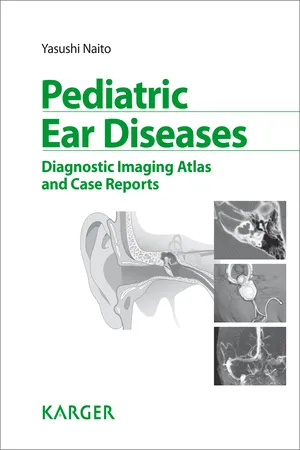
Due to the complex anatomical structure of the temporal bone, imaging diagnosis requires a very high degree of expertise. This atlas is not only helpful to assess pediatric ear disorders accurately, but also provides a treasure trove to experts. It consists of a pediatric temporal bone imaging atlas followed by case reports of typical pediatric ear diseases. In the first part complete contiguous temporal bone CT sections of an infant and an older child are shown along with a detailed listing of anatomical names of the structures. It further presents developmental changes in size, shape, location and orientation of the primary components of the temporal bone. The second part contains case images in combination with reference illustrations of a healthy child in the same age range allowing the reader to identify the key findings of the disorder with only one reference book at hand. Further images illustrate the posttreatment follow-up. This publication which is translated from the successful Japanese edition (2011) will be essential for otorhinolaryngologists and pediatricians particularly interested in pediatric ear diseases. Its unique layout makes it also a very effective tool for students learning image diagnosis.
The foundation for temporal bone imaging diagnosis lies in obtaining a thorough understanding of the ear’s normal anatomical structures and their three-dimensional relationship. Through repeated comparison and identification of the details of normal structures and the anatomical terms that describe them, one gradually forms a mental image of the temporal bone’s overall three-dimensional orientation. When one concurrently views clinical case images, one’s eyes are drawn naturally to those forms that differ from the norm, which can then be compared to various known disease findings to arrive at an accurate diagnosis. This process also applies to pediatric cases but, with the exception of minor ailments such as otitis media, encounters with infant diseases in everyday clinical practice are infrequent, and examples of imaging diagnosis even rarer. Consequently, pediatric images are usually interpreted with normal adult anatomy in mind. However, the temporal bone of infants in particular differs from that of an adult’s with respect to the sizes and relative ratios of each component, so caution is required in reading and interpreting findings.
This chapter displays a complete series of serial cross-section and descriptive images, without omission, of temporal bone CT axial sections and coronal sections from both infants and older children. By examining the images from infants and older children, first separately and then in comparison,...
Table of contents
Cover Page
Front Matter
Chapter 1 Normal CT Images of the Temporal Bone
Chapter 2 Postnatal Growth of the Temporal Bone
Chapter 3 Congenital Anomalies
Chapter 4 Inflammatory Diseases of the Middle Ear
Chapter 5 Other Ear Disorders
Index
Author & Acknowledgments
Trusted by 375,005 students
Access to over 1.5 million titles for a fair monthly price.
Study more efficiently using our study tools.
Frequently asked questions
Yes, you can cancel anytime from the Subscription tab in your account settings on the Perlego website. Your subscription will stay active until the end of your current billing period. Learn how to cancel your subscription
No, books cannot be downloaded as external files, such as PDFs, for use outside of Perlego. However, you can download books within the Perlego app for offline reading on mobile or tablet. Learn how to download books offline
Perlego offers two plans: Essential and Complete
Essential is ideal for learners and professionals who enjoy exploring a wide range of subjects. Access the Essential Library with 800,000+ trusted titles and best-sellers across business, personal growth, and the humanities. Includes unlimited reading time and Standard Read Aloud voice.
Complete: Perfect for advanced learners and researchers needing full, unrestricted access. Unlock 1.5M+ books across hundreds of subjects, including academic and specialized titles. The Complete Plan also includes advanced features like Premium Read Aloud and Research Assistant.
Both plans are available with monthly, semester, or annual billing cycles.
We are an online textbook subscription service, where you can get access to an entire online library for less than the price of a single book per month. With over 1.5 million books across 990+ topics, we’ve got you covered! Learn about our mission
Look out for the read-aloud symbol on your next book to see if you can listen to it. The read-aloud tool reads text aloud for you, highlighting the text as it is being read. You can pause it, speed it up and slow it down. Learn more about Read Aloud
Yes! You can use the Perlego app on both iOS and Android devices to read anytime, anywhere — even offline. Perfect for commutes or when you’re on the go. Please note we cannot support devices running on iOS 13 and Android 7 or earlier. Learn more about using the app
Yes, you can access Pediatric Ear Diseases by Y. Naito,Y., Naito in PDF and/or ePUB format, as well as other popular books in Medicina & Medicina de oído, nariz y garganta. We have over 1.5 million books available in our catalogue for you to explore.