- 224 pages
- English
- ePUB (mobile friendly)
- Available on iOS & Android
eBook - ePub
About this book
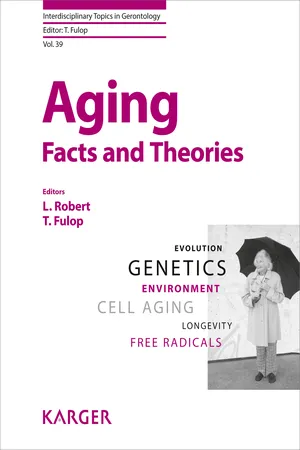
Aging inspired a large number of theories trying to rationalize the aging process common to all living beings. In this publication the most important environmental and intrinsic mechanisms involved in the aging process and in its pathological consequences are reviewed. Furthermore theoretical and experimental evidence of the most important theoretical elements based on Darwinian evolution, cellular aging, role of cell membranes, free radicals and oxidative processes, receptor-mediated reactions, the extracellular matrix and immune functions as well as the most important environmental and intrinsic mechanisms involved in the aging process and in its pathological consequences are discussed. These presentations of theories and related experimental facts give a global overview of up to date concepts of the biology of the aging process and are of essential reading not only for specialists in this field but also for practitioners of scientific, medical, social and experimental sciences.
Information
Topic
MédecineSubtopic
CardiologieRobert L, Fulop T (eds): Aging: Facts and Theories. Interdiscipl Top Gerontol. Basel, Karger, 2014, vol 39, pp 86-107 DOI: 10.1159/000358901
______________________
Oxidative Stress, Mitochondrial Dysfunction and the Mitochondria Theory of Aging
Yahui Kong · Sally E. Trabucco · Hong Zhang
Department of Cell and Developmental Biology, University of Massachusetts Medical School, Worcester, Mass., USA
______________________
Abstract
Aging is characterized by a progressive decline in cellular function, organismal fitness and increased risk of age-associated diseases and death. One potential cause of aging is the progressive accumulation of dysfunctional mitochondria and oxidative damage with age. Considerable efforts have been made in our understanding of the role of mitochondrial dysfunction and oxidative stress in aging and age-associated diseases. This chapter outlines the interplay between oxidative stress and mito-chondrial dysfunction, and discusses their impact on senescence, cell death, stem cell function, age-associated diseases and longevity.
© 2014 S. Karger AG, Basel
Aging is a complex process of progressive decline in overall physiological functions, resulting in a diminished capacity to withstand internal and external damage and an increased susceptibility to diseases and risk of death. The process of aging is controlled by many factors including genetic and environmental influences, and many theories have been proposed to explain the phenomenon of aging. Recent studies have implicated mitochondrial dysfunction and oxidative stress in the aging process and in the pathogenesis of age-associated diseases. It is hypothesized that damage to mitochondria including mitochondrial DNA (mtDNA) caused by the production of reactive oxygen species (ROS) during cellular respiration is one of the drivers of aging. These theories (the free radical theory and the mitochondrial vicious cycle theory of aging) provide an important conceptual framework and have led to interventions aimed at decreasing the level of ROS for health benefits. However, there is an increasing body of evidence challenging these theories, which has led to the emergence of new hypotheses on how age-associated mitochondrial dysfunction may lead to aging. The gradual ROS response theory of aging proposes that ROS act as signaling molecules to induce endogenous defense mechanisms to promote stress resistance and longevity, which provides a new interpretation of studies previously found to have a conceptual conflict with the mitochondrial and free radical theories of aging. In this chapter, we provide an overview of the relationship between ROS-induced damage, mitochondria dysfunction and aging.
Reactive Oxygen Species
ROS are highly reactive molecules that include superoxide anion, hydroxyl radical and hydrogen peroxide. ROS are produced as by-products of aerobic metabolism in cells, and mitochondria are the major sites of ROS generation. In humans, more than 90% of oxygen is consumed by mitochondria, and 1-5% of the consumed oxygen is transformed into superoxide because of electron leakage of the electron transport chain (ETC). Superoxide generated in mitochondria is then converted to hydrogen peroxide either spontaneously or catalyzed by superoxide dismutase (SOD) [1]. Hydrogen peroxide is membrane permeable and diffusible. It can either be broken down into water by glutathione peroxidase, thioredoxin peroxidase and catalase, or undergo Fenton's reaction in the presence of divalent cations such as Fe2+ and Cu2+ to produce more aggressive hydroxyl radicals [2, 3]. In addition to mitochondria, peroxi-somes also participate in ROS generation and scavenging. Peroxisomes are involved in several metabolic functions that use oxygen. Oxygen consumption in the peroxi-somes leads to hydrogen peroxide production, which is then used to oxidize a variety of molecules [4]. Apart from being generated during cellular metabolism, ROS can be produced by excessive stimulation of nicotinamide adenine dinucleotide phosphate oxidases [5] or in response to different environmental stimuli such as growth factors, inflammatory cytokines, ionizing radiation, UV, chemical oxidants, toxins, chemotherapeutics, hyperoxia, and transition metals [6-20].
Depending on their types and cellular levels, ROS can act as either crucial biological or deleterious agents. Under physiologically low or moderate concentrations, ROS exert their effects as mediators of inter- and intracellular signaling through redox regulation of protein phosphorylation, ion channels, and transcription factors [21, 22]. ROS are involved in various signaling cascades including those in response to growth factor stimulation and inflammatory signaling [23], and participate in the regulation of many cellular processes including differentiation, proliferation, senescence, apoptosis, cytoskeletal regulation, migration and contraction [24, 25]. In addition, ROS can function in host defense and biosynthetic processes [25, 26]. However, under pathophysiological conditions, overproduction of ROS can interact with DNA, RNA, lipids and proteins, leading to destruction or irreversible alteration of the functions of the targeted molecules. Consequently, ROS are identified as major contributors of cellular damage. ROS-induced DNA damage, including single- or double-strand DNA breaks, DNA cross-links and modifications of purine, pyrimidine or deoxyribose, can result in alterations in transcription and signal transduction, replication errors, and genomic instability [27, 28]. The most extensively studied DNA lesion is 8-hydroxyguanine (8-OH-G) or its deoxynucleoside equivalent (8-OH-dG). These lesions are highly mutagenic resulting in G:C to T:A transversions, and are widely accepted as biomarkers of oxidative damage [29].
Mammalian cells have a sophisticated defense system consisting of various antioxidant enzymes and low-molecular-weight antioxidants to dispose of endogenous and exogenous ROS, thus limiting the cellular damage caused by ROS. These antioxidant enzymes include copper/zinc SOD (Cu/ZnSOD), manganese SOD (MnSOD), catalase, thioredoxin peroxidase, glutathione peroxidase, and glutathione reductase. Antioxidant scavengers are predominantly of dietary origin including hydrophilic radical scavengers such as ascorbate (vitamin C), urate and glutathione, and lipophilic radical scavengers such as a-tocopherols (vitamin E), flavonoids, carotenoids and ubiquinol [30, 31]. In addition, cells have developed DNA repair mechanisms to specifically combat endogenous DNA modifications and prevent the dire consequences of ROS. The base excision repair pathway is primarily responsible for the repair of small nonhelix distorting lesions and DNA single-strand breaks to restore the integrity of the genome [32]. Furthermore, the proteasomes rapidly degrade oxidized proteins to prevent the formation of damaged protein aggregates [33]. Aging can alter the defense systems so that a fraction of ROS may escape destruction and become transformed to more reactive and deleterious form [34]. When the free radical production exceeds the capacity of antioxidant defenses, oxidative stress occurs to create oxidative damage, which is involved in numerous pathophysiological processes.
Accumulation of Oxidative Damage in Mitochondria with Age
Accumulation of ROS and oxidative damage is one of the cellular hallmarks of aging. In the 1950s, Denham Harman proposed the free radical theory of aging, which postulates that the production of intracellular ROS and its deleterious effects on various cellular components are the major determinants of life span [35]. This landmark theory initiates the molecular era of aging research. In addition to being a main sou...
Table of contents
- Cover Page
- Front Matter
- The Commitment of Human Cells to Senescence
- Evolutionary Theories of Aging Can Explain Why We Age
- Control of Cell Replication during Aging
- Cell Senescence: Role in Aging and Age-Related Diseases
- Aging of Cell Membranes: Facts and Theories
- Oxidative Stress, Mitochondrial Dysfunction and the Mitochondria Theory of Aging
- Aging of Connective Tissues: Experimental Facts and Theoretical Considerations
- Aging of Cell Communication: Loss of Receptor Function
- On the Immunological Theory of Aging
- Aging of the Brain, Dementias, Role of Infectious Proteins: Facts and Theories
- Aging as Alteration
- Longevity and Its Regulation: Centenarians and Beyond
- Subject Index
Trusted by 375,005 students
Access to over 1.5 million titles for a fair monthly price.
Study more efficiently using our study tools.
Frequently asked questions
Yes, you can cancel anytime from the Subscription tab in your account settings on the Perlego website. Your subscription will stay active until the end of your current billing period. Learn how to cancel your subscription
No, books cannot be downloaded as external files, such as PDFs, for use outside of Perlego. However, you can download books within the Perlego app for offline reading on mobile or tablet. Learn how to download books offline
We are an online textbook subscription service, where you can get access to an entire online library for less than the price of a single book per month. With over 1.5 million books across 990+ topics, we’ve got you covered! Learn about our mission
Look out for the read-aloud symbol on your next book to see if you can listen to it. The read-aloud tool reads text aloud for you, highlighting the text as it is being read. You can pause it, speed it up and slow it down. Learn more about Read Aloud
Yes! You can use the Perlego app on both iOS and Android devices to read anytime, anywhere — even offline. Perfect for commutes or when you’re on the go.
Please note we cannot support devices running on iOS 13 and Android 7 or earlier. Learn more about using the app
Please note we cannot support devices running on iOS 13 and Android 7 or earlier. Learn more about using the app
Yes, you can access Aging by L. Robert,T. Fulop,L., Robert,T., Fulop, Tamàs Fülöp,Tamàs, Fülöp in PDF and/or ePUB format, as well as other popular books in Médecine & Cardiologie. We have over 1.5 million books available in our catalogue for you to explore.