- 108 pages
- English
- ePUB (mobile friendly)
- Available on iOS & Android
eBook - ePub
About this book
The demographic shift in the average age of the population worldwide calls for careful attention to the nutritional and health needs of the elderly. Frailty has been associated with increased disability, postsurgical complications and increased mortality; in a frail state, older adults are at greater risk for adverse outcomes, including falls and admissions to hospital and nursing homes. Despite the strong associations between frailty and subsequent poor outcomes, limited attention to this common geriatric condition has been paid in clinical settings. Emerging evidence suggests that both behavioral (nutrition and physical activity) and pharmacologic interventions may be effective in the treatment and prevention of the frailty syndrome. The papers in this book address our current understanding of the biological basis, clinical presentation and therapeutic interventions that target frailty. They highlight the transitional nature of research on the frailty syndrome and identified key unmet needs and areas for future investigation in this expanding field.
Information
Topic
MedicineSubtopic
Nutrition, Dietics & BariatricsBiological Base of Frailty
Fielding RA, Sieber C, Vellas B (eds): Frailty: Pathophysiology, Phenotype and Patient Care.
Nestlé Nutr Inst Workshop Ser, vol 83, pp 1-10, (DOI: 10.1159/000382052)
Nestec Ltd., Vevey/S. Karger AG., Basel, © 2015
Nestlé Nutr Inst Workshop Ser, vol 83, pp 1-10, (DOI: 10.1159/000382052)
Nestec Ltd., Vevey/S. Karger AG., Basel, © 2015
______________________
Connecting Age-Related Biological Decline to Frailty and Late-Life Vulnerability
Jeremy D. Walston
Division of Geriatric Medicine and Gerontology, Department of Medicine, Older Americans Independence Center, Johns Hopkins University School of Medicine, Baltimore, MD, USA
______________________
Abstract
Frailty is an important construct in aging which allows for the identification of the most vulnerable subset of older adults. At least two conceptual models of frailty have been developed that have in turn facilitated the development of multiple frailty screening tools. This has enabled the study of populations of frail and nonfrail older adults, and facilitated the risk assessment for adverse health outcomes. In addition, using the syndromic approach to frailty, numerous biological hypotheses have been tested, which have identified chronic inflammatory pathway activation, hypothalamic-pituitary-adrenal axis activation, and sympathetic nervous system activity as important in the development of frailty. In addition, age-related molecular changes related to autophagy, mitochondrial decline, apoptosis, senescent cell development, and necroptosis likely contribute to the heterogeneous phenotype of frailty. The recent development of a frail mouse model with chronic inflammatory pathway activation has helped to facilitate further whole organism biological discoveries. The following article attempts to create an understanding of the connections between these age-related biological changes and frailty.
© 2015 Nestec Ltd., Vevey/S. Karger AG, Basel
Introduction
Frailty has long been recognized by health care providers as a syndrome of vulnerability that marks a subset of older adults as being at high risk for adverse health care outcomes, such as functional decline, disability, worsening chronic illnesses, and mortality. Over the past several years, research interest in frailty has grown exponentially as has the interest in integrating frailty into clinical practice models. In addition, marked progress in understanding age-related biological changes has helped to unravel the biology that likely underlies frailty and related biological vulnerability. The purpose of this chapter is to provide a state-of-the-art conceptual overview of frailty and to describe the known physiological and molecular changes that associate with and drive the development of frailty. Further research in this area will help to (1) identify those older adults at highest risk of adverse outcomes, (2) facilitate improved understanding of the biological underpinnings of frailty-related vulnerability, and (3) foster the development of improved preventive and intervention strategies aiming to improve health outcomes and quality of life of older adults.
Frailty Conceptualization
Over the past 20 years, the definitions of frailty have evolved from generalized observations by clinicians that frail individuals were vulnerable, weak, and failing to multiple definitions that have helped to bring scientific rigor to the field of frailty research. At present, two major conceptualizations of frailty have emerged in the literature. The most commonly utilized conceptualization is that frailty is an age-related syndrome with a deep biological basis that becomes manifest during periods of stress [1]. This concept has been further refined into a cycle of decline in energy, skeletal muscles and nutrition that can be triggered by disease, medications, or environmental stressors (fig. 1). This cycle of decline, further influences medical illnesses, mobility, functionality, and cognition. Importantly, this conceptualization has been operationalized into the most commonly utilized frailty screening tool [1] and has allowed for hypothesis testing related to etiology and for intervention development period.
In addition to this biological conceptualization, a cumulative burden conceptualization of frailty has evolved. In this model, frailty is defined by a number of related and unrelated health, biological, social, functional, and cognitive variables that are tallied in an index. Those that are most frail are those with the highest tally of variables [2]. This model has been widely tested for predictive validity and has been shown to capture vulnerability as well as the biological model described above. However, frailty index was not constructed with an underlying biological theory in mind, and hence has not been extensively utilized to test biological hypotheses [2]. Further, because it was not conceptualized around a potential etiology, targeted preventive and intervention strategies have not been developed or tested to date using this model.
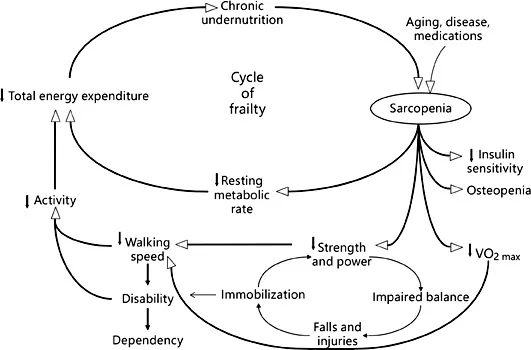
Fig. 1. Cycle of frailty that underlies one of the primary conceptualizations of frailty, demonstrating a reinforcing downward physiological spiral that facilitates the development of adverse health outcomes. Reproduced with permission from Walston and Fried [26].
Frailty Measurement
Dozens of studies have been published over the past two decades that detail specific frailty measurement tools [3]. The vast bulk of these tools have been developed to study the risk of adverse outcomes in populations of older adults, and for the most part were developed utilizing aggregate measures of physical function, fatigue, and activity [3]. To date, no clear gold standard for the measurement of frailty has emerged and it is becoming increasingly apparent that none of these tools is adequate for all of the emerging clinical practice, risk assessment, biological research, and intervention development purposes that require frailty screening tools [4]. To date, most of the tools that have been developed can be divided into two groups that match the conceptualization of frailty articulated in the section above, i.e. either tools that attempt to capture essence of a biologically based, syndromic frailty or those that work to capture a tally of deficits or problems that in sum define a level of frailty. A brief summary of commonly utilized measurement tools are discussed below.
Fried et al. [1] previously developed a screening tool that consists of measured grip strength, walking speed, and weight loss along with subjective reporting of activity and fatigue levels. A score of 0-5 is generated based on a series of cutoff points for each measure, with 0 being robust, 1-2 being prefrail, and 3-5 being frail. This tool and adaptations to this tool have been used in population studies of community dwelling older adults to determine demographic information about older adults, and to identify individuals that are at significantly higher risk of adverse health outcomes such as disability, hospitalization, functional decline, and mortality compared to age-matched nonfrail individuals. In addition to this commonly utilized tool, many others have been developed that have a similar construct around syndromic frailty with weight loss, physical function, and skeletal muscle weakness measures most often included in these adaptations. While many have been validated by their ability to predict adverse outcomes in older adults, few have been utilized to test biological hypotheses or interventions.
A second common approach to detecting and measuring frailty comes from Rockwood and Mitnitski [2]. Building on the conceptualization of frailty as a condition that arises from cumulative declines, the tool consists of up to 71 measures of function, illness, cognition, and social mobility. A tally is taken, and those with the highest number of tallies are deemed most frail, and those with the lowest number of tallies are deemed least frail. This tool or similar indexing approaches do not require de novo measurements as information can be abstracted from medical records. Hence, it has been most commonly utilized to assess the risk of an adverse outcome, especially mortality in older adults. Importantly, numerous studies have attempted to include social or cognitive variables into screening tools in order to better capture frailty and its incumbent risk for adverse outcomes in broader population contexts. This will continue to be an important area of development in frailty research [5].
The Biology That Underlies Frailty
In order to better understand the etiology of frailty and late-life vulnerability, and in order to facilitate the development of treatment and prevention strategies, an improved understanding of the connections between age-related biological changes and frailty is required. As mentioned above, the most commonly utilized frailty construct was conceptualized around age-related biological and physiological changes with potential influence from poor nutrition and medical conditions [1]. In older adults, it is apparent that these changes do not exist in isolation; rather they exist together in a variety of constellations, which in sum contribute to frailty and the inherent biological vulnerability observed in frail, older adults [6]. We and others have helped to develop model pathways that have helped to conceptualize the interconnections between age-related biological changes, physiological system changes, and disease states with frailty and adverse outcomes [6]. The following sections detail studies of chronic disease, physiology, and biology that have been performed related to frailty.
Disease States and Frailty
Multiple investigators have attempted to identify important relationships between disease states and frailty in older adults. Early work identified a strong correlation between glucose intolerance and type 2 diabetes mellitus and frailty in older adults [7]. In addition, vascular disease, especially congestive heart failure, has been shown to be highly related to frailty in older adults [8]. Although associations between frailty and disease states do not prove causality, they suggest that a common underlying biological mechanism ties some diseases and frailty together. For example, an important biological commonality that has been identified in frailty and chronic disease is the chronic activation of inflammatory pathways and the strong relationship between inflammation and frailty as detailed below. Other studies have shown heightened activation of clotting pathways and more clotting events in frail older adults, further supporting biological commodity [7, 9]. Many studies demonstrate a substantial overlap between inflammation, frailty, and chronic disease states, including congestive heart failure, hypertension, and diabetes mellitus [7, 8, 10].
Physiological System Dysregulation and Frailty
Dysfunction in multiple physiological systems is thought to play an important role in late-life vulnerability. As biological understanding rapidly evolved, the distinction between physiological and molecular biological sys...
Table of contents
- Cover Page
- Front Matter
- Biological Base of Frailty
- Clinical Phenotype of Frailty
- Interventions for Frailty
- Subject Index
Trusted by 375,005 students
Access to over 1.5 million titles for a fair monthly price.
Study more efficiently using our study tools.
Frequently asked questions
Yes, you can cancel anytime from the Subscription tab in your account settings on the Perlego website. Your subscription will stay active until the end of your current billing period. Learn how to cancel your subscription
No, books cannot be downloaded as external files, such as PDFs, for use outside of Perlego. However, you can download books within the Perlego app for offline reading on mobile or tablet. Learn how to download books offline
Perlego offers two plans: Essential and Complete
- Essential is ideal for learners and professionals who enjoy exploring a wide range of subjects. Access the Essential Library with 800,000+ trusted titles and best-sellers across business, personal growth, and the humanities. Includes unlimited reading time and Standard Read Aloud voice.
- Complete: Perfect for advanced learners and researchers needing full, unrestricted access. Unlock 1.5M+ books across hundreds of subjects, including academic and specialized titles. The Complete Plan also includes advanced features like Premium Read Aloud and Research Assistant.
We are an online textbook subscription service, where you can get access to an entire online library for less than the price of a single book per month. With over 1.5 million books across 990+ topics, we’ve got you covered! Learn about our mission
Look out for the read-aloud symbol on your next book to see if you can listen to it. The read-aloud tool reads text aloud for you, highlighting the text as it is being read. You can pause it, speed it up and slow it down. Learn more about Read Aloud
Yes! You can use the Perlego app on both iOS and Android devices to read anytime, anywhere — even offline. Perfect for commutes or when you’re on the go.
Please note we cannot support devices running on iOS 13 and Android 7 or earlier. Learn more about using the app
Please note we cannot support devices running on iOS 13 and Android 7 or earlier. Learn more about using the app
Yes, you can access Frailty: Pathophysiology, Phenotype and Patient Care by R. A. Fielding,C. Sieber,B. Vellas,R.A., Fielding,C., Sieber,B., Vellas, R. A. Fielding, C. Sieber, B. Vellas in PDF and/or ePUB format, as well as other popular books in Medicine & Nutrition, Dietics & Bariatrics. We have over 1.5 million books available in our catalogue for you to explore.