eBook - ePub
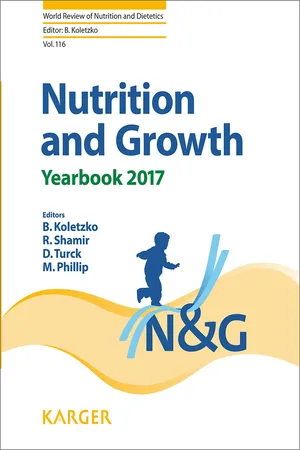
Nutrition and Growth
Yearbook 2017
- 188 pages
- English
- ePUB (mobile friendly)
- Available on iOS & Android
eBook - ePub
Nutrition and Growth
Yearbook 2017
About this book
Adequate nutrition is a crucial component for child growth. Under- or malnutrition may not only affect present and future growth, but also a child's ability to develop skills. Tremendous efforts are being made to try and understand the mechanisms leading to stunted growth, proper diet composition, and an appropriate rehabilitation diet for children suffering from under- or malnutrition in all age groups during the growth period. In this publication, specialists in nutrition and growth present some of the best studies from peer-reviewed journals published between July 2015 and June 2016. Each paper is briefly summarized and supplemented with editorial comments which evaluate the clinical importance of each article and discuss its application. This 'Yearbook' is an important tool for practicing physicians, including pediatricians, subspecialists in pediatric gastroenterology, metabolism and nutrition, and endocrinology. Nutritionists and dieticians, as well as other health professionals involved in the care of children, will also find this to be a useful resource.
Information
Topic
MedicinaKoletzko B, Shamir R, Turck D, Phillip M (eds): Nutrition and Growth: Yearbook 2017.
World Rev Nutr Diet. Basel, Karger, 2017, vol 116, pp 16-51 (DOI: 10.1159/000452185)
World Rev Nutr Diet. Basel, Karger, 2017, vol 116, pp 16-51 (DOI: 10.1159/000452185)
______________________
Obesity, Metabolic Syndrome, and Nutrition
Shlomit Shalitin1, 2 · Tadej Battelino3 · Luis A. Moreno4
1The Jesse Z. and Sara Lea Shafer Institute of Endocrinology and Diabetes, National Center for Childhood Diabetes, Schneider Children's Medical Center of Israel, Petach Tikva, Israel; 2Sackler Faculty of Medicine, Tel Aviv University, Tel Aviv, Israel; 3UMC-University Children's Hospital, Medical Faculty, University of Ljubljana, Ljubljana, Slovenia; 4GENUD (Growth, Exercise, Nutrition and Development) Research, University School of Health Sciences, University of Zaragoza, Zaragoza, Spain
The prevalence of obesity is increasing alarmingly to epidemic proportions in children and adolescents in both developed [1] and developing countries [2]. Obesity is known to occur as a result of genetic, environmental, lifestyle, and behavioral influences [3]. Early life may be a "critical period" when appetite and regulation of energy balance is programmed, with lifelong consequences for obesity risk. Childhood obesity is widely recognized as a risk factor for development of comorbidities such as type 2 diabetes, hypertension, dyslipidemia, coronary heart disease, and metabolic syndrome in childhood or later life.
Dietary energy intake is a major environmental risk factor which has been the focus of numerous studies. The studies reviewed below have reported that promoting longer breastfeeding duration in high birth weight newborns may decrease their risk of developing obesity, and that the consumption of high volumes of cow milk in late infancy may increase the risk for later obesity. Research has also shown that the content of food in later life, such as protein, salt, and dietary fiber intake, can influence the tendency to become obese. Therefore, interventions in early feeding practices may help prevent childhood obesity.
Another study reported that the fat mass and obesity-associated (FTO) genotype effects can be attenuated with lower protein intake. Some of the studies evaluated the impact of meals and frequency of snack consumption on the risk of adiposity, and also evaluated the dietary patterns and dietary quality associated with a higher cardiometabolic risk. Few studies have revealed an association of hypovitaminosis D with cardiometabolic risk factors.
Finally, unhealthy eating behavior and obesity have been related to a sedentary lifestyle, particularly screen time. With increased consumption of "screen media" and social networking especially among adolescents, it seems that there is an association between the use of social networking sites and unhealthy eating behavior. This chapter reviews a selection of important articles published between July 2015 and June 2016 focused on the relation between nutrition, obesity, and metabolic syndrome in childhood and in young adults.
Key articles reviewed for this chapter
Longer breastfeeding duration reduces the positive relationships among gestational weight gain, birth weight and childhood anthropometrics
Zhu Y, Hernandez LM, Dong Y, Himes JH, Hirschfeld S, Forman MR
J Epidemiol Community Health 2015;69:632-638
Effects on childhood body habitus of feeding large volumes of cow or formula milk compared with breastfeeding in the latter part of infancy
Hopkins D, Steer CD, Northstone K, Emmett PM
Am J Clin Nutr 2015;102:1096-1103
Associations between human milk oligosaccharides and infant body composition in the first 6 mo of life
Alderete TL, Autran C, Brekke BE, Knight R, Bode L, Goran MI, Fields DA
Am J Clin Nutr 2015;102:1381-1388
The effect of a pro-breastfeeding and healthy complementary feeding intervention targeting adolescent mothers and grandmothers on growth and prevalence of overweight of preschool children
Schwartz R, Vigo A, de Oliveira LD, Justo Giugliani ER
PLoS One 2015;10:e0131884
Usual dietary energy density distribution is positively associated with excess body weight in Mexican children
Aburto TC, Cantoral A, Hernández-Barrera L, Carriquiry AL, Rivera JA
J Nutr 2015;145:1524-1530
Associations of reward sensitivity with food consumption, activity pattern, and BMI in children
De Decker A, Sioen I, Verbeken S, Braet C, Michels N, De Henauw S
Appetite 2016;100:189-196
Clustering of lifestyle behaviours and relation to body composition in European children. The IDEFICS study
Santaliestra-Pasías AM, Mouratidou T, Reisch L, Pigeot I, Ahrens W, Mårild S, Molnár D, Siani A, Sieri S, Tornatiris M, Veidebaum T, Verbestel V, De Bourdeaudhuij I, Moreno LA
Eur J Clin Nutr 2015;69:811-816
A high-protein breakfast prevents body fat gain, through reductions in daily intake and hunger, in "breakfast skipping" adolescents
Leidy HJ, Hoertel HA, Douglas SM, Higgins KA, Shafer RS
Obesity (Silver Spring) 2015;23:1761-1764
High salt intake: independent risk factor for obesity?
Ma Y, He FJ, MacGregor GA
Hypertension 2015;66:843-849
Dietary fiber intake and its association with indicators of adiposity and serum biomarkers in European adolescents: the HELENA study
Lin Y, Huybrechts I, Vereecken C, Mouratidou T, Valtueña J, Kersting M, González-Gross M, Bolca S, Wärnberg J, Cuenca-García M, Gottrand F, Toti E, Gomez-Martinez S, Grammatikaki E, Labayen I, Moreno LA, Sjöström M, Van Camp J, Roccaldo R, Patterson E, Manios Y, Molnar D, Kafatos A, Widhalm K, De Henauw S
Eur J Nutr 2015;54:771-782
Impact of an early-life intervention on the nutrition behaviours of 2-y-old children: a randomized controlled trial
Fangupo LJ, Heath AL, Williams SM, Somerville MR, Lawrence JA, Gray AR, Taylor BJ, Mills VC, Watson EO, Galland BC, Sayers RM, Hanna MB, Taylor RW
Am J Clin Nutr 2015;102:704-712
An early feeding practices intervention for obesity prevention
Daniels LA, Mallan KM, Nicholson JM, Thorpe K, Nambiar S, Mauch CE, Magarey A
Pediatrics 2015;136:e40-e49
Dietary intake, FTO genetic variants, and adiposity: a combined analysis of over 16,000 children and adolescents
Qi Q, Downer MK, Kilpeläinen TO, Taal HR, Barton SJ, Ntalla I, Standl M, Boraska V, Huikari V, Kiefte-de Jong JC, Körner A, Lakka TA, Liu G, Magnusson J, Okuda M, Raitakari O, Richmond R, Scott RA, Bailey ME, Scheuermann K, Holloway JW, Inskip H, Isasi CR, Mossavar-Rahmani Y, Jaddoe VW, Laitinen J, Lindi V, Melén E, Pitsiladis Y, Pitkänen N, Snieder H, Heinrich J, Timpson NJ, Wang T, Yuji H, Zeggini E, Dedoussis GV, Kaplan RC, Wylie-Rosett J, Loos RJF, Hu FB, Qi L
Diabetes 2015;64:2467-2476
Changes in dietary intake during puberty and their determinants: results from the GINIplus birth cohort study
Harris C, Flexeder C, Thiering E, Buyken A, Berdel D, Koletzko S, Bauer CP, Brüske I, Koletzko B, Standl M; GINIplus Study Group
BMC Public Health 2015;15:841
Decreasing the number of small eating occasions (<15% of total energy intake) regardless of the time of day may be important to improve diet quality but not adiposity: a cross-sectional study in British children and adolescents
Murakami K, Livingstone MB
Br J Nutr 2016;115:332-341
Stabilization of overweight prevalence and improvement of dietary habits in French children between 2004 and 2008
Carriere C, Langevin C, Déti EK, Barberger-Gateau P, Maurice S, Thibault H
Public Health Nutr 2015;18:1883-1889
Identification of a dietary pattern associated with greater cardiometabolic risk in adolescence
Appannah G, Pot GK, Huang RC, Oddy WH, Beilin LJ, Mori TA, Jebb SA, Ambrosini GL
Nutr Metab Cardiovasc Dis 2015;25:643-650
Dietary glycaemic index and glycaemic load among Australian children and adolescents: results from the 2011-2012 Australian Health Survey
Jones M, Barclay AW, Brand-Miller JC, Louie JC
Br J Nutr 2016;116:178-187
Healthy eating index and metabolically healthy obesity in U.S. adolescents and adults
Camhi SM, Whitney Evans E, Hayman LL, Lichtenstein AH, Must A
Prev Med 2015;77:23-27
Low serum vitamin D levels are associated with increased arterial stiffness in youth with type 2 diabetes
Jha P, Dolan LM, Khoury PR, Urbina EM, Kimball TR, Shah AS
Diabetes Care 2015;38:1551-1557
Vitamin D status is associated with cardiometabolic markers in 8-11-year-old children, independently of body fat and physical activity
Petersen RA, Dalskov S-M, Sørensen LB, Hjorth MF, Andersen R, Tetens I, Krarup H, Ritz C, Astrup A, Michaelsen KM, Mølgaard C, Damsgaard CT
Br J Nutr 2015;114:1647-1655
Associations between the use of socia...
Table of contents
- Cover Page
- Front Matter
- The Physiology and Mechanism of Growth
- Obesity, Metabolic Syndrome, and Nutrition
- Term and Preterm Infants
- Cognition
- Nutrition and Growth in Chronic Disease
- Early Nutrition and Its Effect on Growth, Body Composition, and Later Obesity
- Malnutrition and Catch-Up Growth during Childhood and Puberty
- Pregnancy: Impact of Maternal Nutrition on Intrauterine Fetal Growth
- Stunting in Developing Countries
- Author Index
- Subject Index
- Back Cover Page
Trusted by 375,005 students
Access to over 1.5 million titles for a fair monthly price.
Study more efficiently using our study tools.
Frequently asked questions
Yes, you can cancel anytime from the Subscription tab in your account settings on the Perlego website. Your subscription will stay active until the end of your current billing period. Learn how to cancel your subscription
No, books cannot be downloaded as external files, such as PDFs, for use outside of Perlego. However, you can download books within the Perlego app for offline reading on mobile or tablet. Learn how to download books offline
We are an online textbook subscription service, where you can get access to an entire online library for less than the price of a single book per month. With over 1.5 million books across 990+ topics, we’ve got you covered! Learn about our mission
Look out for the read-aloud symbol on your next book to see if you can listen to it. The read-aloud tool reads text aloud for you, highlighting the text as it is being read. You can pause it, speed it up and slow it down. Learn more about Read Aloud
Yes! You can use the Perlego app on both iOS and Android devices to read anytime, anywhere — even offline. Perfect for commutes or when you’re on the go.
Please note we cannot support devices running on iOS 13 and Android 7 or earlier. Learn more about using the app
Please note we cannot support devices running on iOS 13 and Android 7 or earlier. Learn more about using the app
Yes, you can access Nutrition and Growth by B. Koletzko,R. Shamir,D. Turck,M. Phillip,B., Koletzko,R., Shamir,D., Turck,M., Phillip, Berthold Koletzko,Berthold, Koletzko in PDF and/or ePUB format, as well as other popular books in Medicina & Nutrizione, dietetica e bariatria. We have over 1.5 million books available in our catalogue for you to explore.