- 234 pages
- English
- ePUB (mobile friendly)
- Available on iOS & Android
eBook - ePub
About this book
Tattooing breaches the skin and can, therefore, cause a variety of complications. This book covers the full spectrum of issues clinical practitioners may encounter when treating affected patients. Introductory chapters include educational information on methods for tattooing, types of tattoos, tattoo inks, and tattoo ink toxicology. The focus is on the diagnosis and classification of tattoo complications. In this regard, a comprehensive atlas of acute and chronic complications serves as a valuable tool. Further chapters summarize available therapies, their rationale, and indication. This includes various medical and surgical treatments with a review of dermatome shaving. Lastly, tattoo removal by gold standard YAG lasers and the more recent pico-second lasers is discussed with the optimal therapeutic outcome in mind. Dermatologists, plastic surgeons, general practitioners, laser surgeons, and other specialists treating tattoo complications will find this book to be an indispensable resource. It also includes information relevant for a broad range of stakeholders in the tattoo business, including authorities and regulators.
Information
Topic
MédecineSubtopic
DermatologieIndex of Cases
145 | Bacterial Tattoo Infection with Staphylococci on the Patient’s Own Skin |
146 | Bacterial Tattoo Infection with Staphylococci from the Tattoo Ink Bottle |
147 | Bacterial Tattoo Infection with a Reused Tattoo Ink Bottle as the Suggested Source of Infection |
148 | Bacterial Tattoo Infection in a Patient with Type 1 Diabetes |
149 | Allergic Reaction in a Red Tattoo: Type Plaque Elevation |
155 | Allergic Reaction in the Red Part of a Multicolored Tattoo: Type Plaque Elevation |
156 | Allergic Reaction in the Bordeaux Part of a Multicolored Amateur Tattoo with Atypical Nodular Appearance |
157 | Allergic Reaction in a Red Tattoo: Type Excessive Hyperkeratosis |
161 | Allergic Reaction in a Red Tattoo: Type Excessive Hyperkeratosis in a Case Predisposed to Hyperkeratotic Response to Physical Stimuli |
162 | Allergic Reaction in a Red Tattoo: Type Excessive Hyperkeratosis, Acneiform Variant with Epidermoid Cysts |
163 | Allergic Reaction in a Red Tattoo: Type Excessive Hyperkeratosis, Acneiform Variant with Epidermoid Inclusions |
164 | Allergic Reaction Provoked by Sun in Two Red Tattoos Made with Different Red Inks |
165 | Allergic Reaction in a Red Tattoo: Type Plaque Elevation with Cross-Sensitivity Reactions in Other Red Tattoos Hitherto Tolerated |
166 | Allergic Reaction in a Red Tattoo Triggering a Cross-Sensitivity Reaction in a Number of Red Tattoos Acquired in the Past |
167 | Allergic Reaction in a Red Tattoo Triggering an Allergic Cross-Reaction in Other Red Tattoos as well as in a Green Tattoo |
168 | Allergic Reaction in a Red Tattoo: Type Excessive Hyperkeratosis-Uncomplicated Dermatome Shaving |
169 | Allergic Reaction in a Red Tattoo: Type Excessive Hyperkeratosis, Acneiform Variant - Dermatome Shaving Followed by Epidermoid Growth and Prolonged Healing |
170 | Aggressive Necrosis in a Multicolored Tattoo with Successive Amputations of the Leg, Chronically Impaired Wound Healing, and Generalized Dermopathy |
172 | Allergic Reaction in a Red Tattoo: Type Ulceronecrotic Reaction, Severe |
173 | Allergic Reaction in a Blue Tattoo Parallel to Spontaneous Color Shift in the Direction of Green |
174 | Allergic Reaction in a Blue Tattoo with Pigment Blowout |
175 | Allergic Reaction in the Lilac Part of a Multicolored Tattoo: Type Plaque Elevation |
176 | Allergic Reaction in a Lilac Tattoo: Type Excessive Hyperkeratosis with Parallel Reaction in Lymph Nodes |
177 | Allergic Eczema in a Cover-Up Tattoo with Progression into the Surrounding Skin |
178 | Generalized Allergic Eczema after a New Tattoo Caused by Primary Sensitization to Nickel |
179 | Generalized Allergic Eczema due to Primary Sensitization by Tattooing: Allergen Not Identified |
180 | Generalized Allergic Eczema the Day after Tattooing due to Preexisting Strong Allergy to Nickel |
181 | Generalized Dermatitis after Sensitization to Parabens from the Tattoo Ink |
182 | Allergic Eczema in a Patient with a Tattoo Reaction and Known Hair Dye Allergy with the Rash Possibly Elicited by a PPD Analogue |
183 | Henna Tattoo Reaction with Generalized Dermatitis: Is PPD Allergy Also a Potential Risk with Permanent Tattooing? |
184 | Reaction in a Black Tattoo:Type Papulonodular Reaction |
185 | Pigment Overload Reaction in a Black Tattoo: Type Papulonodular Reaction Treated with Surgical Excision |
186 | Pigment Overload with Mild Papulonodular Reaction and Sensitivity to Sun |
187 | Pimples after Tattooing with Black Ink |
188 | Black Tattoo with Pigment Blowout |
189 | Black Tattoo with Pigment Blowout to the Surrounding Skin with a Halo Nearby the Tattoo |
190 | Black Tattoo with Pigment Blowout to Underlying Structures, Subcutaneous Inflammation, and Painful Shoulder |
191 | Sarcoidosis Locally in a Black Tattoo with a Papulonodular Reaction |
192 | Sarcoidosis in Black and Brown Tattoos with Erythema Nodosum |
193 | Sarcoidosis in a Black Tattoo Associated with Scar Sarcoidosis and Erythema Nodosum |
194 | Sarcoidosis in Black Tattoos with Enlarged Regional Lymph Nodes and Associated Iridocyclitis |
196 | Sarcoidosis in Black Tattoos Accompanied by Erythema Nodosum, Joint Affection, and Involvement of the Lungs with the Tattoo Reaction as the Clue to Diagnosis |
197 | Sarcoidosis in Black Tattoos Manifested as a Rush Phenomenon |
198 | Sarcoidosis in Black Tattoos Starting Abruptly as a Rush Phenomenon in Every Black Tattoo |
200 | Sarcoidosis in Black Tattoos with Associated Rush Phenomenon in Other Black Tattoos and Affection of the Ankle Joints |
202 | Sarcoidosis in Black Tattoos with Rush Phenomenon and Pulmonary Affection |
204 | Neurosensitive Tattoo Reaction in a Red Tattoo with Constant Itch and Pain |
205 | Neurosensitive Tattoo Reaction Associated with Exercise Addiction Threatening the General Health |
206 | Neurosensory Complaints and Color Change after Bacterial Tattoo Infection |
207 | Neurosensitive Reaction in a Blue Tattoo in a Case with Known Urticaria |
208 | Disturbed Sensitivity and Urticarial Reaction in a Red Tattoo |
209 | Basal Cell Carcinoma in a Tattoo by Coincidence |
210 | Keratoacanthoma(s) in a Tattoo with Spontaneous Recovery |
212 | Paraneoplastic Reaction in a Multicolored Tattoo Provoked by Malignant Lymphoma |
213 | Köbner Provocation of Psoriasis in a Recent Tattoo |
214 | Köbner Provocation of Psoriasis in a Tattoo with a Papulonodular Reaction in Black Pigment Maintaining Local Psoriatic Activity around the Tattoo |
215 | Tattoo Needle Trauma of the Skin Followed by Abnormal Healing of the Tattoo |
216 | Traumatic Tattooing with Severe Local Damage and Chronic Sequels |
218 | Tattoo Inflammation of a Newly Acquired Tattoo from Physicochemical Insult |
219 | Amateur Tattoo of the Oral Mucosa with Unintended Tattooing of the Lip |
220 | Tattoo and Risk of Keloid |
221 | Keloid following Dermatome Shaving on the Chest, a Region Predisposed to Abnormal Scarring |
222 | Laser Removal of a Tattoo Followed by Scarring and Chronic Itch and Pain |
223 | Laser Removal of a Tattoo in an Amateur Setting Causing Laser Burn and a Chronic Papulonodular Reaction |
224 | Laser Removal of a Tattoo with Poor Outcome and Followed by Scarring and Urticaria Factitia in the Treated Field |
225 | Tattoo Removal by Laser with Yellow, Green, and Blue Pigment Resistance to Treatment |
226 | Tattoo Removal by a Caustic Product Causing a Scar |
227 | Caustic Tattoo Removal with Lactic Acid Causing a Scar and Psychological Complications |
228 | Caustic Tattoo Removal with Lactic Acid Followed by a Disfiguring Scar |
229 | Caustic Tattoo Removal with Lactic Acid in a Person Predisposed to Abnormal Scarring |
Bacterial Tattoo Infection with Staphylococci on the Patient’s Own Skin
History
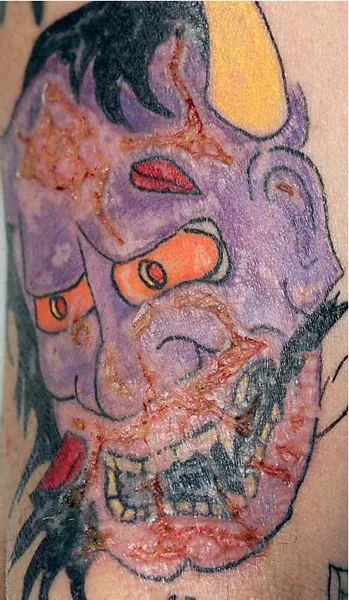
After 1 day, a new tattoo on the arm started to develop painful swelling and oozing involving most of the tattoo. The tattoo parlor was professional and gloves as well as single-use needles were used; the disinfection routine was unknown. The general practitioner started treatment with penicillin and fusidic acid cream. The patient had a history of abscess, paronychia, and other cutaneous infections on 3 occasions with documented staphylococci as the causative microorganism. His history also included a previous tattoo with bacterial infection of the surrounding skin.
Comment
The photo shows the tattoo infection in the state of healing, with crusts and oozing in the sites of the tattoo where the infection was severe. The sites of the tattoo that already healed, i.e. lilac parts, show pigment loss, which will also happen in additional sites presently covered with crusts. It is common that pyogenic infections destroy the color of tattoos, with massive pigment escape to the surface during infection while the skin barrier is temporarily open. Infection may also induce color change, for example from blue to greenish.
Treatment
Treatment was oral antibiotics with a combination including penicillinase-resistant penicillin. The patient was screened for staphylococci including MRSA in sites of predilection.
Bacterial Tattoo Infection with Staphylococci from the Tattoo I...
Table of contents
- Cover Page
- Front Matter
- From Technique of Tattooing to Biokinetics and Toxicology of Injected Tattoo Ink Particles and Chemicals
- Individual Risk and Prevention of Complications: Doctors’ Advice to Persons Wishing a New Tattoo
- Tattoo Infections, Personal Resistance, and Contagious Exposure through Tattooing
- Diagnostic Tools for Doctors’ Evaluation of Tattoo Complications
- How to Diagnose and Classify Tattoo Complications in the Clinic: A System of Distinctive Patterns
- Medical Treatment of Tattoo Complications
- Surgical Treatment of Tattoo Complications
- Laser Treatment of Tattoos: Basic Principles
- Removal of Tattoos by Q-Switched Nanosecond Lasers
- New and Advanced Picosecond Lasers for Tattoo Removal
- Laser Surgeon, Client Education, and Satisfaction with Tattoo Removal
- Guide to Treatment of Tattoo Complications and Tattoo Removal
- Atlas of Illustrative Cases of Tattoo Complications
- Index of Cases
- Author Index
- Subject Index
- Back Cover Page
Trusted by 375,005 students
Access to over 1.5 million titles for a fair monthly price.
Study more efficiently using our study tools.
Frequently asked questions
Yes, you can cancel anytime from the Subscription tab in your account settings on the Perlego website. Your subscription will stay active until the end of your current billing period. Learn how to cancel your subscription
No, books cannot be downloaded as external files, such as PDFs, for use outside of Perlego. However, you can download books within the Perlego app for offline reading on mobile or tablet. Learn how to download books offline
Perlego offers two plans: Essential and Complete
- Essential is ideal for learners and professionals who enjoy exploring a wide range of subjects. Access the Essential Library with 800,000+ trusted titles and best-sellers across business, personal growth, and the humanities. Includes unlimited reading time and Standard Read Aloud voice.
- Complete: Perfect for advanced learners and researchers needing full, unrestricted access. Unlock 1.5M+ books across hundreds of subjects, including academic and specialized titles. The Complete Plan also includes advanced features like Premium Read Aloud and Research Assistant.
We are an online textbook subscription service, where you can get access to an entire online library for less than the price of a single book per month. With over 1.5 million books across 990+ topics, we’ve got you covered! Learn about our mission
Look out for the read-aloud symbol on your next book to see if you can listen to it. The read-aloud tool reads text aloud for you, highlighting the text as it is being read. You can pause it, speed it up and slow it down. Learn more about Read Aloud
Yes! You can use the Perlego app on both iOS and Android devices to read anytime, anywhere — even offline. Perfect for commutes or when you’re on the go.
Please note we cannot support devices running on iOS 13 and Android 7 or earlier. Learn more about using the app
Please note we cannot support devices running on iOS 13 and Android 7 or earlier. Learn more about using the app
Yes, you can access Diagnosis and Therapy of Tattoo Complications by J. Serup,W. Bäumler,J., Serup,W., Bäumler, P. Itin,G. B. E. Jemec,P., Itin,G.B.E., Jemec in PDF and/or ePUB format, as well as other popular books in Médecine & Dermatologie. We have over 1.5 million books available in our catalogue for you to explore.