eBook - ePub
Pediatric Epidemiology
- 156 pages
- English
- ePUB (mobile friendly)
- Available on iOS & Android
eBook - ePub
Pediatric Epidemiology
About this book
Pediatric epidemiology differs substantially from general epidemiology especially when it comes to ethical, developmental and societal aspects. This unique book addresses biological considerations and ethical and legal questions in dealing with pediatric and adolescent populations. Classic topics, such as how to recruit representative samples, how to deal with confounding variables, and how to work with genetic information are the core areas of the book are also in focus. Last but not the least, this volume adds to the current understanding of global trends in occurrence, transmission, and control of epidemic pediatric diseases. This book not only serves as a textbook for epidemiologists, pediatricians, geneticists, and child and public health specialists but is also a key reference for those embarking on pediatric cohort studies and epidemiological studies involving the pediatric population.
Tools to learn more effectively

Saving Books

Keyword Search

Annotating Text

Listen to it instead
Information
Kiess W, Bornehag C-G, Gennings C (eds): Pediatric Epidemiology.
Pediatr Adolesc Med. Basel, Karger, 2018, vol 21, pp 113–142 (DOI: 10.1159/000481328)
Pediatr Adolesc Med. Basel, Karger, 2018, vol 21, pp 113–142 (DOI: 10.1159/000481328)
______________________
Basic Epidemiology, Statistics, and Epidemiology Tools and Methods
Mandy Vogel · Tanja Poulain · Anne Jurkutat · Ulrike Spielau · Wieland Kiess
Hospital for Children and Adolescents, Center for Pediatric Research, and LIFE Research Center for Civilization Diseases, LIFE Child, University of Leipzig, Leipzig, Germany
______________________
Abstract
The present chapter aims to assist young scientists in preparing the different steps necessary to conduct a study. The description of different study designs and data sources as well as the presentation of different ways of data analysis represent key points of this chapter. Furthermore, we give an overview of available statistical software and provide information on data protection and standardization.
© 2018 S. Karger AG, Basel
Whenever you start a scientific project, there is a need to plan ahead and a number of basic considerations have to be thought about. Not everything presented as science in publications is compliant to good scientific practice. This is particularly the case for publications on the Internet. In this chapter, we offer basic information on how to get started. The following pages also provide an outline of the most important aspects that need to be considered when planning a cohort study, an epidemiological project, or the statistical analysis of a clinical trial.
Hypotheses
Studies can be exploratory or hypothesis-driven. In exploratory studies, many variables are correlated with the effect of interest. Some of the variables may show a more or less pronounced effect that could be of relevance and meaning. It is a bit like fishing. In contrast, if you plan a study, you should have clearly expressed hypotheses and research questions, for one obvious reason: without a hypothesis, you cannot plan a study because you do not know whom to ask or what to ask for.
A hypothesis must be stated in a testable way. Exposure and outcome variables have to be exactly specified, and the expected results have to be clearly expressed. An example: you are interested to know more about the relationship that exists between daily exercises and fat mass. Then your hypothesis would be something like this:
Higher daily physical activity decreases fat mass.
But wait, it is not possible to measure daily exercises as well as fat mass directly. So you have to decide on how to measure exposure and outcome. You may ask the study participants about their daily exercise patterns, or you can measure their activity using an accelerometer. What would be the more precise way? What is feasible for you and your institution? The same is true for body fat mass: how to measure it? You can use height and weight measurements and calculate the body mass index (BMI) as a proxy for body fat mass; you may use skinfold measurements or bioimpedance analysis. Again, the question is: what is the best measure that is feasible for you? The decision depends not only on the available resources but also on the study subjects of interest. Some methods are more suitable for application in adults and cannot be used in small children, and questionnaires may have to be modified and validated for different age groups. Therefore, in most cases, it is necessary to focus on a confined age group:
Higher daily physical activity (measured by accelerometry) decreases BMI and skinfold thickness (as a measure of body fat mass) in young adults (aged 16–18).
The hypothesis states that the activity has a direct influence on BMI. To show such an influence, an experimental study has to be conducted and this needs a lot of time, a number of staff, and, consequently, much money. So if you do not have the time and the money, you may have to change the hypothesis again:
Higher daily physical activity (measured by accelerometry) relates to decreased BMI and skinfold thickness (as measures of body fat mass) in young adults (aged 16–18).
The next question to answer is whether or not there are any known or suspected influencing factors. These so-called confounders have to be taken into account and, therefore, the related data have to be collected. Common confounding variables are age and gender, race, medical history, socioeconomic background, history of smoking and alcohol consumption, and so on. In the case of children and adolescents, the puberty status might also be taken into account.
Review of Literature
As you can see, the generation of hypotheses is not a trivial task. Before you can specify the measures of exposure and outcome, the confounders and the expected results, an extensive and systematic literature review has to be done: explore the current literature with regard to the state of knowledge, contradictory reports, used methods and approaches, and the final results; do not confine your literature to articles that support your hypotheses.
To collect, organize, and annotate your literature you should use a reference manager from the very beginning. It helps you to store all your knowledge sources (research articles, websites, books, etc.) in a sustainable and well-arranged manner; plugins for MS Office, LibreOffice, similar word processors, or LaTeX provide easy ways of referring to any literature during the writing process. You will be able to find a list of reference managers and a comparison of their capabilities on the following web page: https://en.wikipedia.org/wiki/Comparison_of_reference_management_software. We recommend the use of a free software tool with network functionality like Zotero (https://www.zotero.org/) because its use is not limited to the time you are working at a particular university or research institution and it is independent of the usage of a particular device. In addition, it supports collaboration and the sharing of literature.
To search (and find) scientific literature, academic search engines are indispensable. One of the most important search engines within the biomedical sciences is PubMed (www.ncbi.nlm.nih.gov/pubmed/); it is a free search engine, provided by U.S. National Library of Medicine. Other examples are Web of Science or Google Scholar. A more extensive list can be found on the following web page: https://en.wikipedia.org/wiki/List_of_academic_databases_and_search_engines.
Study Design
The design of a study aims to describe how data is collected. It comprises the methods and procedures of collecting and analyzing data, the definition of exposure, outcome, and confounding variables, data collection strategies, the time schedule, the definition of the target population, the method of blinding (if applicable), the specification of intervention (if applicable), and so on.
Design Types
Medical research can be classified into basic (research without a focus on application) and applied research (problem-oriented). We will focus on the basic types of study design in applied research. Figure 1 outlines the most important design types. The main subtypes are descriptive and analytical studies. Examples of descriptive studies are sample surveys or the census that aim to assess the status of a population with regard to certain properties; they can provide baseline data and generate hypotheses for further investigations. On the other hand, analytical studies try to investigate cause-effect relationships or associations and follow one of 2 strategies: observation (e.g., cohort study, case-control study) or intervention (e.g., clinical trial, field trial). The main difference between these 2 strategies is that observational studies observe naturally occurring events, whereas interventional or experimental studies involve actions to change the natural course of events. We will focus on designs of observational studies and only briefly address interventional studies.
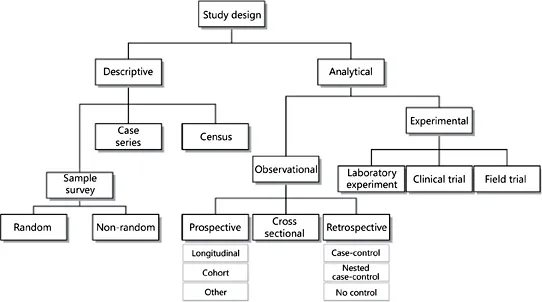
Fig. 1. Various types of study designs. Adapted from Indrayan [1], 2012.
One of the most basic forms of observational studies are aggregate or ecologic studies. They collect and analyze data at an aggregated level. Outcome, exposure, and confounders are observed in groups of individuals as aggregated value. Therefore, no individual data will be collected. The units of observation can be institutions like kindergartens, schools, classes, or whole populations. Data are typically provided by the unit ...
Table of contents
- Cover Page
- Front Matter
- Ethical Issues in Paediatric Epidemiology
- Epidemiological Studies of Child Maltreatment: Difficulties and Possibilities
- Legislation on Genetic Testing in Different Countries
- The Dilemma Associated with Incidental Findings
- Challenges and Opportunities in Conducting Research in Developing Countries
- How to Recruit a Representative Sample and How to Look for It?
- The Epidemiology of Global Child Health
- How to Deal with Proxy-Reports
- Biology at a Young Age Differs from Biology at Later Ages: Developmental Aspects of Growth and Body Functions in Children and Young Adults
- Basic Epidemiology, Statistics, and Epidemiology Tools and Methods
- How to Deal with Confounding
- Author Index
- Subject Index
- Back Cover Page
Frequently asked questions
Yes, you can cancel anytime from the Subscription tab in your account settings on the Perlego website. Your subscription will stay active until the end of your current billing period. Learn how to cancel your subscription
No, books cannot be downloaded as external files, such as PDFs, for use outside of Perlego. However, you can download books within the Perlego app for offline reading on mobile or tablet. Learn how to download books offline
Perlego offers two plans: Essential and Complete
- Essential is ideal for learners and professionals who enjoy exploring a wide range of subjects. Access the Essential Library with 800,000+ trusted titles and best-sellers across business, personal growth, and the humanities. Includes unlimited reading time and Standard Read Aloud voice.
- Complete: Perfect for advanced learners and researchers needing full, unrestricted access. Unlock 1.4M+ books across hundreds of subjects, including academic and specialized titles. The Complete Plan also includes advanced features like Premium Read Aloud and Research Assistant.
We are an online textbook subscription service, where you can get access to an entire online library for less than the price of a single book per month. With over 1 million books across 990+ topics, we’ve got you covered! Learn about our mission
Look out for the read-aloud symbol on your next book to see if you can listen to it. The read-aloud tool reads text aloud for you, highlighting the text as it is being read. You can pause it, speed it up and slow it down. Learn more about Read Aloud
Yes! You can use the Perlego app on both iOS and Android devices to read anytime, anywhere — even offline. Perfect for commutes or when you’re on the go.
Please note we cannot support devices running on iOS 13 and Android 7 or earlier. Learn more about using the app
Please note we cannot support devices running on iOS 13 and Android 7 or earlier. Learn more about using the app
Yes, you can access Pediatric Epidemiology by W. Kiess,C. -G. Bornehag,C. Gennings,W., Kiess,C.-G., Bornehag,C., Gennings, Wieland Kiess,Wieland, Kiess in PDF and/or ePUB format, as well as other popular books in Medicine & Epidemiology. We have over one million books available in our catalogue for you to explore.