![]()
1
The State Capitol
The village of Olympia was founded in 1850 by Edmund Sylvester. So sudden was the migration that within three years the area boasted a newspaper, customs house, steamboat landing and mercantile community, and was the largest town on Puget Sound. Sylvester had an even greater vision, though. In 1853 when Washington territory was established, Sylvester platted the town and donated twelve acres of land on the hill overlooking what is now Budd Inlet for construction of a state capitol building.
There seemed to be no dispute that the first territorial Legislature would meet in Olympia. They used a frame building later known as the Gold Bar Restaurant near Capitol Way and Second Street. In 1856, thanks to a $5,000 appropriation from Congress, a small wooden structure was built on the present site of the capitol to serve as a temporary seat of government.
In 1889 Washington became the forty-second state in the Union, and voters chose Olympia as the site of the state capital. In his proclamation of statehood, President Harrison also announced the donation of 132,000 acres of federal land, to use the income for construction of a state capitol. In 1893 a competition was held to pick a design for a permanent capitol structure. Ernest Flagg of New York was selected from 188 entries, and excavation and foundation work was begun in 1894. However, work soon stopped due to a lack of funds and continued jealousy by the cities of Yakima, Ellensburg, Vancouver and Tacoma over the location of the state capital.
In 1901 the state took advantage of Thurston County’s financial woes and purchased the grand but unfinished courthouse at Legion Way and Washington Street, currently the offices of the superintendent of public instruction, and added a wing to house the Legislature. The building was still viewed as too small, however, and was only a temporary solution. It served as the state capitol from 1905 until 1928. In 1909 the Legislature authorized completion of the Flagg design for the capitol building on Sylvester’s donated twelve acres but appropriated no funds. It did, however, authorize construction of the governor’s mansion, still in use today.
Following another competition to complete the Flagg design, in 1911 New York architects Walter R. Wilder and Harry K. White were chosen. They followed the classical Roman architectural style and the “City Beautiful” movement of the time. The challenge as they viewed it was “how to split the usual massive Capitol Building up into six or more components without diminishing each part so as to make it seem comparatively insignificant.” (American Architect, November 1915.)
The Temple of Justice was the first building completed (except for the exterior facing). Governor Ernest Lister’s Inaugural Ball was held there in 1913. Work on the current Legislative Building (the capitol) resumed in 1919. Wilder and White enlarged the old footings and designed a dome twice the height of Flagg’s original concept. They first considered making the dome 307 feet, the same height as the national capitol in Washington, D.C., but settled instead on 287 feet as the correct proportion to the other buildings and, perhaps, out of deference to the central government.
The Insurance Building was the second of the group to be completed, in 1921. The Legislative Building was completed third, in 1928; the Institutions Building, not part of the original plan and clearly of a different architectural style, was completed in 1934; the Public Lands Building, now named the John A. Cherberg Building, was finished in 1937; and the Public Health Building, now called the John L. O’Brien Building, was completed in 1940. Senate committee meetings and staff are currently located in the Cherberg Building, and House committee meetings and staff are in the O’Brien Building. A sixth structure, identical to the Insurance Building, was planned for the west side of the Legislative Building where the governor’s mansion sits, but has not yet been built.
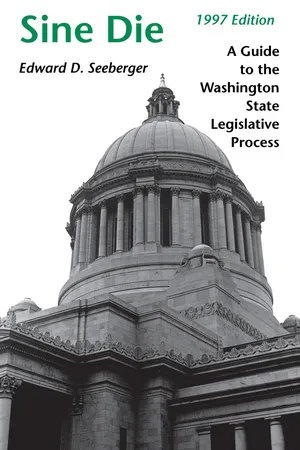
The Legislative Building is the central structure in the capitol design and dominates the entire region. It is the equivalent of twenty-eight stories at its highest point and, at the time of completion, was the fourth highest dome in the world. The arched dome is a rarity in that it contains no steel reinforcements. It is built entirely of 1,400 cut stones taken from a quarry about forty miles east of Olympia. None of the stones has a straight line on any edge or face. The stones are cut so precisely that upon completion on October 13, 1926, there was exactly three-eighths of an inch projection on all sides, just as is called for in the architectural drawings. The building has six massive bronze external doors, weighing 2,000 pounds each, depicting various scenes from Washington early history.
Major earthquakes occurred in 1949 and in 1965 but did little serious damage to the capitol building. As a precaution, however, following the 1949 quake, workers built an inclined railway to the top of the dome, took the lantern apart piece by piece (1,500 pieces), redesigned them and put them back together in order to lighten the load from 180 to 110 tons. Following the 1965 quake, twenty-two of the thirty windows in the colonnade were filled with reinforced concrete to give the dome more rigidity.
Washington State’s capitol campus is one of the most beautiful in the world. Not only did early leaders show vision in planning on such a grand scale, but subsequent leaders showed resolve in maintaining the area in such a manner as to show the magnificent buildings in their best light. One of the features that sets Olympia apart from many other capitals is the luxuriant spacing between the buildings.
John A. Cherberg, who served thirty-two years as lieutenant governor and much of that time as chair of the State Capitol Committee, believed that the wide expanses of green lawn and trees did as much to enhance the beauty of the campus as the buildings. He resisted attempts to place various state offices near the capitol inside the original campus. Thanks to Cherberg and other leaders of vision, the grounds today are broad and spacious, interspersed only with tasteful memorials to war dead and commemorative plaques and gardens.
The current capitol campus runs from Capitol Lake east to Jefferson Street, bounded on the north by 11th Street and on the south by 15th and Maple Park. There are over 1,700 trees, 900 rose bushes, and 26,000 shrubs and bushes located on over 33 acres. Many of the trees and bushes have been donated in memory of various dignitaries and historic figures. For example, there is the Dixy Lee Ray tree donated by Dolph Price of Kelso and dedicated in 1980 in honor of the state’s first woman governor. Her tree is actually a Dawn Redwood from China. It is the only redwood tree that is deciduous.
A grove of Yoshino cherry trees was donated by Mitsuo Mutai, head of the Shimbun newspapers in Tokyo, in 1984. The trees are located on lawns between the Cherberg and O’Brien buildings and the capitol and are just coming to maturity. Their blossoms are a delicate whitish pink. More famous was the grove of Kwanzan cherry trees planted in 1932 that grew to form a canopy stretching from both sides over Water Street between the capitol and the Insurance Building. They were remarkable for their lush deep pink double-ruffle blooms that would carpet the street and sidewalk west of the capitol in early spring. Unfortunately, they had to be removed in 1995 due to disease, but new ones have been planted for the enjoyment of future generations.
There are plans to add thirty-four additional acres of land stretching from behind the Temple of Justice, down the wooded slope, around Capitol Lake, to Budd Inlet. Called Heritage Park, it would complete the capitol campus plan envisioned eighty-five years earlier.
Early spring in Olympia is generally cold and wet and gray. But in some years nature will surprise with a gift of sun and blue sky. When that occurs, the variegated pink flowering cherry trees, joined by yellow daffodils and purple magnolias set against the familiar green conifers, create a scene of beauty that is only outdone when the flaming red rhododendrons bloom a few weeks later.
The Saucer Magnolia tree outside the southeast entrance to the Legislative Building was dubbed the “sine die tree” by Jack Pyle, long-time correspondent for the Tacoma News Tribune, during the 1960s. It is often mistaken for a tulip tree because of its large tulip-like white flowers. It usually blooms in early March, thus coinciding with the end of the sixty-day session. Pyle insinuated that when the tree blooms, it is nature’s way of signaling time for the legislators to finish their business and go home. A new sidewalk was built in 1975 and the original sine die tree was cut down by mistake. Senators Gordon Sandison (D-Port Angeles) and Charles Newschwander (R-Tacoma) felt so strongly that the tradition should not die that a new tree was found and planted. It continues to bloom to this day, although its signal for the end of session is usually ignored.
The interior of the Legislative Building is predominantly faced with light gray Tokeen and Gravina marble from Alaska. A five-ton Tiffany-made bronze chandelier dangles 185 feet down from the interior of the dome. Beneath it in the center of the rotunda is the four-foot polished brass Great Seal of the state of Washington featuring George Washington encircled by oak leaves. The location of the state seal on the floor was a concern since people could and did walk on it. According to a 1929 letter from E. L. Gale to A. C. Martin, Secretary of the Capitol Committee, “George Washington’s nose is already badly worn off by thousands having walked over his face.” In the late 1930s, Governor Hartley had a rope enclosure installed around the seal, which remains today.
The Legislative Building is home to a number of state offices including the governor, secretary of state, auditor, and treasurer, all on the second floor. However, the largest rooms are the legislative chambers and despite the presence of these other important officials, there is little doubt that the primary function and design of this magnificent building is to accommodate a bicameral legislature.
The first things one notices on entering the House chamber are the ninety-eight walnut desks standing stiffly at attention before an ornately hand-carved mahogany two-step elevated rostrum. The desks are in pairs, with the rows slightly rounded and there is an aisle down the center, roughly separating members of the two political parties. The floor is carpeted in gray with a rhododendron pattern and trillium background. There is a slight rise in elevation from the rostrum to the rear of the chamber. Above the rostrum is a large electronic voting machine. The walls are lined with French Escalette marble, with a background of cream and veins of yellow, pink and red. It is warmer and cheerier than the gray Alaskan marble in the rotunda. Columns separate the chamber itself from aisles along the two sides, with heavy goldish-pink drapes that are sometimes closed during late-evening sessions to keep out the noise.
The Senate chamber is located on the opposite side of the rotunda on the third floor. It is the same size as the House chamber but seems more spacious since there are only forty-nine desks (of mahogany rather than walnut), each sitting singly. There is a second row of columns in the Senate, creating a ten-foot antechamber on each side between the chamber proper and the aisle. Like the House chamber, the Senate, too, is divided by an aisle which separates members of the two parties and faces an ornate, hand-carved, tiered mahogany rostrum. The wall marble in the Senate is German Rose Formosa with graded tones from almost black to pearly gray and veins of rose and yellow. There is more of a patrician feeling coming off the darker shading in the Senate as opposed to the populist lighter hue in the House. There is no electronic voting machine in the Senate, but small electronic signboards sit incongruously in front and to the side of the rostrum to indicate the business at hand.
Between the chambers is the state reception room described by Wilder as “intended to be the most ornate in the building.” It is faced with Bresche Violet marble from Italy with a cream background and veining of red, lavender and green. There is a fireplace at each end of the room (blocked off). The room is finished with teak floors and two Tiffany chandeliers from Czechoslovakia. There is a seven-foot-diameter table in the center of the room and heavy lined velvet drapes with matching valances and silk tasseled ties at the large floor-to-ceiling windows.
Recessed visitor galleries above the chambers can be entered from the fourth floor and face down from both sides. Gallery pews, wainscoting and most of the furniture is a dark highly polished mahogany.
At the rear of both chambers are massive double doors. When opened wide, the presiding officers on the respective rostrums can see one another across the rotunda. It is a long-standing tradition that the final act of a legislative session occurs when the two officers simultaneously bang their gavels and announce they are now adjourned sine die; that is, without setting a time to reconvene.
A person entering the chambers cannot help but be awed at the surroundings, a feeling similar to that on entering a great cathedral or museum. The effect is surely deliberate. It is to remind those selected by their fellow citizens to sit on the floor of these chambers of the importance of their actions and responsibilities. In almost sixty years of legislative meetings inside these chambers, there have been incidents of unruliness and alcohol abuse and intemperance and boorishness, but these have been relatively rare. The norm is a feeling of honor for having been chosen by the people for this high office, of respect for the institution and its traditions, and of courteousness toward others involved in the important process of making laws.
The Washington State Capitol Building and grounds are open to the public most of the year. Information is available from the State Capitol Tour Office, the Secretary of State’s Office, the Washington State Capital Museum, or the Washington Room of the Washington State Library, all located in Olympia.
![]()
2
Legislative Sessions
REGULAR AND SPECIAL
Under the original state Constitution, regular sessions of the Washington State Legislature after the first one were to be held for up to sixty days every odd-numbered year. The first legislative session in 1889 took 143 days and legislators needed to come back in 1890 for another nine days. But for the next fifty-eight years, from 1890 through 1948, there were only five special sessions, despite two world wars and the Great Depression.
The Constitution specifically exempted the first legislative session from the sixty-day provision. It also provided that the first session would begin on the first Wednesday after the first Monday in January, not on the second Monday of January as was later decided.
According to the official records in the Journals of the House and of the Senate, regular sessions in every odd-numbered year from 1891 through 1979 lasted exactly sixty days. But that was only officially. Unofficially, sessions could last days and even weeks longer. For example, the 1935 session actually lasted sixty-six days; the 1937 session lasted sixty-one days; the 1939 session went sixty-three; the 1941 session lasted sixty-two; the 1943 session ended at five hours past midnight of the sixtieth day; in 1945 the session lasted sixty-four days; and in 1949, the Regular Session wasn’t adjourned until 2:30 P.M. on Sunday, March 3, the seventieth day. But one must read the newspapers from those days to determine the actual count. Officially, according to the Journals of the House and of the Senate, all these sessions lasted exactly sixty days.
Sometimes the Speaker of the House or the President of the Senate would literally stop the clock at midnight on the sixtieth day. Members would occasionally poke fun at the presiding officer. Here is an exchange from the Senate Journal, March 9, 1961, p. 1192:
Senator Riley: “Mr. President, would you please give me the time on your wrist watch?”
The President: “Senator Riley, my watch is wrong. My timing has been bad for years!”
Senator Riley: “According to my time, it is exactly midnight on Thursday, March 9, 1961.”
The President: “The President believes you are pretty close.”
The Senate then continued to work on a variety of matters that took several more hours before it finally adjourned sine die.
Beginning in 1949, special sessions became more frequent and lasted longer. Between 1949 and 1979, when the Constitution was changed to provide for annual sessions, there were special sessions in all but five of the nineteen two-year legislative cycles.
In 1972 the Supreme Court addressed the question of the length of sessions in Distilled Spirits Institute v. Kinnear, 80 Wn. 2d 175 (1972). The Distilled Spirits Institute objected to Substitute Senate Bill 897, which raised liquor taxes, on the ground (among others) that the bill was passed after the sixtieth day of a special session. Since regular sessions are constitutionally limited to sixty days, they reckoned that the same applies to special sessions. There were Attorney General Opinions on both sides of the question.
The court unanimously held that “inherent in the power to enact laws is the power to deliberate, and deliberation necessarily requires time.” The court held that since there was no specific constitutional limitation on special sessions, the court would not imply one. Therefore, once a special session is called by the governor, it has no time limit. By implication, this same decision seems to say that where there is ...