eBook - ePub
Available until 23 Dec |Learn more
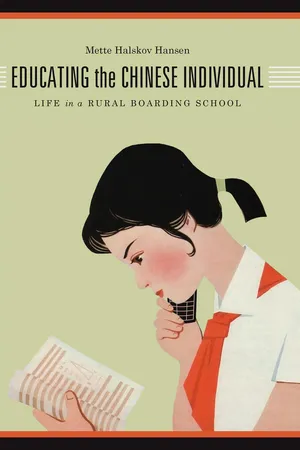
Educating the Chinese Individual
Life in a Rural Boarding School
This book is available to read until 23rd December, 2025
- 240 pages
- English
- ePUB (mobile friendly)
- Available on iOS & Android
eBook - ePub
Available until 23 Dec |Learn more
About this book
In twenty-first-century China, socialist educational traditions have given way to practices that increasingly emphasize the individual. This volume investigates that trend, drawing on Hansen's fieldwork in a rural high school in Zhejiang where students, teachers, and officials of different generations, genders, and social backgrounds form what is essentially a miniature version of Chinese society. Hansen paints a complex picture of the emerging "neosocialist" educational system and shows how individualization of students both challenges and reinforces state control of society.
Frequently asked questions
Yes, you can cancel anytime from the Subscription tab in your account settings on the Perlego website. Your subscription will stay active until the end of your current billing period. Learn how to cancel your subscription.
No, books cannot be downloaded as external files, such as PDFs, for use outside of Perlego. However, you can download books within the Perlego app for offline reading on mobile or tablet. Learn more here.
Perlego offers two plans: Essential and Complete
- Essential is ideal for learners and professionals who enjoy exploring a wide range of subjects. Access the Essential Library with 800,000+ trusted titles and best-sellers across business, personal growth, and the humanities. Includes unlimited reading time and Standard Read Aloud voice.
- Complete: Perfect for advanced learners and researchers needing full, unrestricted access. Unlock 1.4M+ books across hundreds of subjects, including academic and specialized titles. The Complete Plan also includes advanced features like Premium Read Aloud and Research Assistant.
We are an online textbook subscription service, where you can get access to an entire online library for less than the price of a single book per month. With over 1 million books across 1000+ topics, we’ve got you covered! Learn more here.
Look out for the read-aloud symbol on your next book to see if you can listen to it. The read-aloud tool reads text aloud for you, highlighting the text as it is being read. You can pause it, speed it up and slow it down. Learn more here.
Yes! You can use the Perlego app on both iOS or Android devices to read anytime, anywhere — even offline. Perfect for commutes or when you’re on the go.
Please note we cannot support devices running on iOS 13 and Android 7 or earlier. Learn more about using the app.
Please note we cannot support devices running on iOS 13 and Android 7 or earlier. Learn more about using the app.
Yes, you can access Educating the Chinese Individual by Mette Halskov Hansen in PDF and/or ePUB format, as well as other popular books in Social Sciences & Inclusive Education. We have over one million books available in our catalogue for you to explore.
Information
CHAPTER 1
DISCIPLINE AND AGENCY
Quests for Individual Space
Young people who grow up in rural areas in China, where most people seek employment in cities far from their home towns, are increasingly disembedded from both the constraints and the security provided by their families. Many of the students at Number Two High saw their parents only a few times a year; students would stay with grandparents, be alone in their parents’ houses from Friday evening to Sunday afternoon, or have meals with other relatives, spending their free time with friends. Most of their time, with holidays the only exception, was spent in school.
The stereotypical image of a Chinese high school is of a cohort of young people buried in books and individual homework, driven by immense pressure from parents and teachers, obsessed with scoring well in the national university entrance exam, and trying to live up to their parents’ and society’s expectations. There is some truth to this image, as publications, documentaries, and media reports have testified. Yet not all Chinese students are willing participants in the race for educational success; and even when they are, students create loopholes and time and space for alternative individual and collective social activities. Schoolteachers and school leaders experience different kinds of pressure from students and parents; they respond not simply by enforcing discipline, but also by employing creative modification and adjustment of their ways of correcting and advising students, often based on their own intuition and experiences as well as on state-approved educational planning.
Students’ ways of challenging the organization of time and space in school to create more opportunity for themselves are reflective of the broader processes of individualization in Chinese society. Students, as well as the youngest of their teachers, have been brought up in a post-Mao moral landscape in which the very meaning of life has been redefined through the shift away from collective moral experiences of responsibility toward an emphasis on individualistic rights and responsibilities (Kleinman 2011b, 10). In Gaoshan, the profound socioeconomic changes since the early 1980s have resulted in new strategies of child rearing that both reflect on and reinforce the disembedding from family, the transformation of personhood, and the quests for individual space that are among the characteristics of an individualizing society.
Within the school structure, there is limited room for students to exert influence on any aspect of the organization of their lives and studies. However, students find subtle and sometimes effective means of demonstrating agency to create room for individual interests and establish communities among themselves. These actions should not be interpreted as a direct form of resistance to education or educational authorities, but rather as a means of negotiating self and self-interests within the context of the tightly organized state school. Disharmony between ethical aspirations and moral actions is a common experience of many Chinese people today, but individuals are not “heroes” who reform their local worlds because of such disharmony (Kleinman 2011b, 26–27); nor do morally based forms of protest and resistance necessarily grow out of a hatred of authorities or deep political discontent. Likewise, students’ ways of creating and negotiating space for individual agency within the confines of the state boarding school were not framed as anti-authoritarian actions with intended political outcomes. Rather, students were implicitly challenging educational authorities without putting themselves at too great a risk. This subtle challenging of authority may have far-ranging consequences, because it allows students to build collective networks while strengthening their ability to acquire space and promote change.
STUDENTS’ BACKGROUNDS AND PARENTS’ STRATEGIES
Like a growing number of children and young people in Zhejiang, approximately 80 percent of students at Number Two High had lived in boarding schools or teachers’ homes since the beginning of junior secondary school, when they were around thirteen years old, and 18 percent had lived for some period of their junior secondary education in private teachers’ homes. Of the 1,123 students in Number Two High in 2012,1 17.7 percent, or almost one out of five, had lived for one or several years in teachers’ homes already during primary school. Those children who grew up in mountain villages had no choice but to board at their schools, but even parents who were not compelled to send their children to boarding school (including teachers who were parents) would sometimes chose to do so. Thus, parental strategies related to children’s education and parents’ own work situations had profound consequences for the remaking of the rural family as a social unit and for the disembedding of rural youth from it. Students did not lose contact or emotional bonding with their closest family members by living away from home, but, according to my interviews and conversations, many were not able to discuss, on a regular basis, matters of concern in their daily lives or pressing issues relating to their future with their parents or siblings.
My survey from 2012 of the total student body,2 combined with a survey of two classes in 2008 and numerous interviews with school administrators and homeroom teachers (banzhuren) who were familiar with the backgrounds of their students, reveals that only a small fraction, fewer than 3 percent, of the students in Number Two High had parents with educations beyond high school. Mothers had slightly lower education than fathers; 85 percent of the mothers and 75 percent of the fathers had a maximum of nine years of junior secondary education. Thirty-nine percent of fathers were shopkeepers (kai dian) and 29 percent were manual laborers (dagong); among mothers the equivalent figures were 35 percent and 25 percent respectively. The third most common job among parents was in agriculture, with approximately 7 percent of mothers as well as fathers working in this sector. Generally in Gaoshan, as in other rural areas of China, it was common that people who worked outside the state sector had multiple job experiences, including part-time work in agriculture, some years of employment in a company before opening a private shop or business, some years in a factory, or combination of several part-time jobs, such as taking care of children and selling private insurance. Sometimes mothers did not work at all, or worked part time in order to care for younger children or older relatives at home. Nine percent of the mothers and fewer than 2 percent of the fathers did not work at all at the time of the survey. Approximately 43 percent of the students’ fathers lived in Gaoshan or nearby, and these students saw their fathers every weekend or more often, while 58 percent of students saw their mothers during weekends or more often. The rest of the students saw one of their parents between one and six times a year, and more than 25 percent of students’ parents lived outside the province.
Only a minority of 21 percent of students in Number Two High were singletons; 62 percent had one sibling; 13 percent had two; and 3 percent had three siblings. Since the late 1970s China has practiced a family policy restricting the number of children of each couple. While this policy has become known abroad as the “one-child policy,” members of ethnic minorities have always been allowed to have at least two children, and in areas such as Gaoshan, parents with rural household registrations are now allowed to have two children if the first is a girl. It was well known in Gaoshan, and frequently mentioned by students, that couples would go through many ordeals, such as paying fines or having abortions, to secure at least one son in the family. It was also common, though a breach of regulations, that couples would have several children even if the firstborn were a son. People in Gaoshan talked rather openly about this and did not make a great deal out of it. Students had no problems saying that they had more than one sibling, and there seemed to be a high degree of social tolerance toward people who broke these regulations. This was quite unlike the situation reported among urban citizens where policies of birth control have been much more strictly enforced, but maybe also to higher extent internalized or at least accepted (Milwertz 1996; Fong 2011, 159; Greenhalgh 2010, 48).3 It was even considered a sign of strength in Gaoshan to have more children. Because I have three daughters, people would often joke with me, asking when I would have a son, or whether they could somehow help me get one.4 On one such occasion in 2008, when I was chatting with a group of neighbors, some of the men started to tell me how “most people” in Gaoshan wanted two or three children, though normally not more than that. “It is easy,” one successful businessman explained. “You just pay ¥16,000 for number two and ¥30,000 for number three!” “Oh yes, indeed,” another man added grumpily. “Those who have a lot of money can indeed manage to get more children!” “Or,” another neighbor interjected, “you just have to be a party secretary!” He pointed to the local party secretary in the group and laughingly explained that this man was so powerful that he had been able to have four children and still get this political position. While everybody was still laughing, another man joined in, saying, “Yes indeed, he has four children, but it is not because he is a party secretary that he managed this; he became the party secretary because he has four children!” This comment was greatly applauded, and the talk continued about how it was a sign of both masculine and financial strength that a man in rural China could bring four children into the world and raise them properly without getting into trouble with the birth control authorities. A man like this deserved a position with power, the group laughingly agreed.
It was expensive, though, in Gaoshan as elsewhere in China, to have several children. A child needed education; a son should preferably own a house or flat before getting married; and a daughter had to bring gifts and money into her marriage. Nevertheless, people in Gaoshan with several children and at least one son were considered to be fortunate. In this respect parents in Gaoshan were no different from parents in other rural areas of China (with some ethnic minority areas as the exception): the wish to have a boy remains strong, as the demographic statistics on gender balance in China have long confirmed.5 However, in conversations many people in Gaoshan emphasized the social and emotional advantages of having at least one daughter. Daughters were supposed to be more affectionate, well behaved (guai), concerned about their parents, and better than boys at adapting to the schools’ demands for diligence, obedience, and patience (see also, e.g., Fong and Kim 2011, 336–337; Johnson 2004).
Such gender comparisons were often brought up in people’s discussions about the prospective futures of their children, and the advantages and disadvantages of having children going into businesses and taking financial risks or becoming white-collar workers with more job security but lower income. One of the best scenarios that a pragmatic couple with no higher education themselves could realistically hope for, many parents and teachers told me, was to have a daughter who attended college and got a secure (wending) job in the state sector (usually as a teacher), and at least one son who was in business (zuo shengyi). This combination of different career paths for children of different genders was regarded as advantageous, for some even ideal, not just because of parents’ wishes to secure financial support for themselves at an old age but because they were worried about the futures of their daughters. Many would vividly tell stories about local girls who had jumped into marriages with lazy or incapable men or had been left alone with children and no steady income. People in Gaoshan whose children or grandchildren had not yet married were often worried about the changes in society that suggested a growth in “naked marriages” (luohun), wherein young people would marry without first having secured themselves materially.6 There were also deep concerns about the rising divorce rates and the risk of unemployment for young people. Parents saw these phenomena as being socially and financially more risky for daughters than for sons. The best way to secure a daughter’s future in this rapidly changing social environment, many people in Gaoshan thought, was to give her an education and encourage her to continue into a job that provided long-term security and a basic income. A job as a teacher was ideal, and its cumulative effects considerable. In addition to financial security, it provided status and face (mianzi) in Gaoshan, and it was believed that a teacher in the family would later help children to be more successful in education than their parents. With a son in business, the family would hope to secure a higher income and greater financial benefits to the entire family.
One of the main concerns for Gaoshan people who did not have comprehensive educations seemed to be ensuring that their children would not follow in their own educational paths. Indeed, by being in a regular high school, most students in Number Two High were attaining higher education than did their parents, and they were, in principle, already en route to different careers. In reality, after graduation from high school or college, many of them might enter the same professions as their parents or even accept insecure or low-paying jobs. Nonetheless, for a period of time, while students were attending regular high school and preparing for the national university entrance exam, they were at the center of their parents’ hope that they would be able to get higher educations, better jobs, and higher social status.
Consulting fortune-tellers was a popular way for parents to predict and, they hoped, secure their children’s success. Fortune-tellers in Gaoshan were mostly blind men who were making hundreds of yuan every day (people paid on a voluntary basis) predicting whether a business deal would be beneficial, whether a marriage would be successful, or which rituals to perform at which hour at the opening of a new store. According to interviews with some of the most successful among an abundance of fortune tellers in Gaoshan, the most frequent questions asked by people—including even teachers and government officials—was whether or not a child would be successful in an upcoming exam and which job he or she might eventually be able to find after completion of school. There was no doubt in the fortune-tellers’ minds that Gaoshan parents’ aspirations for their children’s successful education were strong, and every year when children started to prepare for the examinations, fortune-tellers were kept busy searching for clues about how their customers’ children would fare.
Consulting fortune tellers was just one of several strategies to take precautions in order to predict and hopefully secure children’s success. At the end of the school year, I observed in Number Two High hopeful parents trying to mobilize whatever personal connections (guanxi) they had with people in the education administration in the hope of increasing their children’s chances for enrollment. Parents whose children scored relatively well on the high school entrance exam but not well enough to secure free admittance to the regular high school were willing to pay fees of up to ¥20,000 to purchase places in the school. To the embarrassment of some teachers, parents would sometimes bring them fruit or other snacks, using any occasion to mention the name of their sons or daughters. This was a fairly innocent way of approaching teachers by parents who had neither sufficient financial or social capital to really “use the backdoor” (zou houmen) or “pull connections” (la guanxi). However, everyone inside and outside of the education system was highly aware that the combination of parents’ strategies to promote their children’s education and the limited number of seats in the most popular regular high schools created serious cases of corruption and irregular admission of students.
While parents wanted their children to have an education, many also needed someone to take care of their children while they were working out of town. Gaoshan was a rural town with long business traditions and was relatively affluent. Many people could afford to integrate their own work practices with strategies to enhance their children’s chances to succeed in education, and this laid the groundwork for the surge in the late 1990s of a private market for children boarding in homes of teachers.7 This practice was both a reflection of, and served to further reinforce, the transformation of the meaning and functioning of the family that takes place under the process of individualization (Yan 2003, 2009). Rural people ages thirty to fifty had changed their perceptions of members of the older generation, who used to be regarded as the natural caretakers of children when parents were away, but who were now seen as inadequate for this primarily because of their lack of formal education.8 One of the teachers who had been among the first to establish a private boarding home for schoolchildren in Gaoshan, explained the reason behind his expanding business success: “Grandparents are of no use anymore!” He meant that most grandparents were unable to help their grandchildren do homework, and he noted that many parents were explicitly looking for teachers who were also able to teach their children discipline, not the least self-discipline. Although most parents, in this teacher’s experience, were looking for someone who would make sure that their children spent most of their time studying, quite a few others were merely using this argument to cover over the fact that they, or the grandparents, were unable to keep their children under control themselves. Parents who worked far away, he claimed, often spoiled their children, and grandparents did not understand the psychology and needs of children in today’s society.
The choice of parents to send their children to the homes of teachers may be interpreted as an expression of strong educational desires, but it was also related to practical needs for organizing family life in new ways because of the changing demands of the labor market. What started in Gaoshan as an isolated phenomenon of a few teachers taking children of relatives or friends into their homes to provide a solution to parents who worked far away had ten years later developed into a large private market, with teachers and families competing for boarding students and pupils below the high school level. In 2008, when I first came to Gaoshan, most teachers who had children boarding in their homes did this privately, without public advertising. Only a handful of teachers had put up signs outside their houses, openly offering their services of full- or part-time boarding (quantuo bantuo), and academic assistance to children of all ages, including preschool. However, in 2009, about 18 percent of students in Number Two High had lived in teachers’ or retired teachers’ homes, either during primary or junior secondary school; and by 2012 a quick walk through the main streets of Gaoshan revealed more than twenty signs of different sizes and colors, all designed to attract new customers. Some teachers had up to forty, or in a few cases fifty, children lodging in houses furnished especially for the purpose, hiring helpers to cook and wash. Others had only a couple of children boarding with them, doing the housework themselves or having a spouse or relative doing the cooking and organizing the daily life for children. Parents were paying around ¥7,000 per semester for full-time boarding and lodging in 2008, and around ¥10,000 per semester in 2012. It was impossible for me to ascertain the full scope of this phenomenon, simply because there were so many individual teachers (mostly retired ones) who were engaged in the business but did not openly advertise it or want to talk about it. The increasingly negative publicity given to this kind of business in provincial media, and the local government’s attempts to limit the practice to retired teachers only, were deterrents to such openness.
However, I did visit two teachers, each of whom had more than ten students living in their houses, and I stayed for several weeks with a retired primary school teacher who for several years had between two and six junior secondary students boarding with her. She explained that she had not advertised, but like many retired teachers, she had been approached by relatives or villagers who knew her as a diligent and hardworking person “with education and good manners” (suzhi). People trusted her to take good care of their children. It added further to her credentials that her own son had become a teacher in the best junior high school in town, and after several requests she agreed to board students. In her own explanation, her motivation for taking children into her home was, first of all, that she, like other female teachers, had been forced to retire at the age of fifty-five, and she was looking for something useful to do. In addition, having her own income made her more “independent” from her second husband (the first had died), and it prevented her from becoming a burden to her son and daughter-in-law because she could easily sustain her own living. She chose to live in her own house where she could have students boarding without the interference of her husband, who stayed in their house just a few blocks away. Her attitude and ways of organizing her life were in themselves a reflection of the individualization processes that are changing not only the lives and outlooks of youth but of the older generations as well (Thøgersen and Ni 2010...
Table of contents
- Cover Page
- Title Page
- Copyright Page
- Contents
- Acknowledgments
- Introduction: Chinese Education and Processes of Individualization
- 1 | Discipline and Agency: Quests for Individual Space
- 2 | Text and Truth: Visions of the Learned Person and Good Citizen
- 3 | Hierarchy and Democracy: Controlled Rise of the Individual
- 4 | Motivation and Examination: The Making and Breaking of the Individual
- 5 | Dreams and Dedications: Teachers’ Views and the Construction of a Generation Gap
- Conclusion: Authoritarian Individualization
- Notes
- Glossary of Chinese Names and Terms
- Bibliography
- Index