Forbidden Games and Video Poems
eBook - ePub
Available until 23 Dec |Learn more

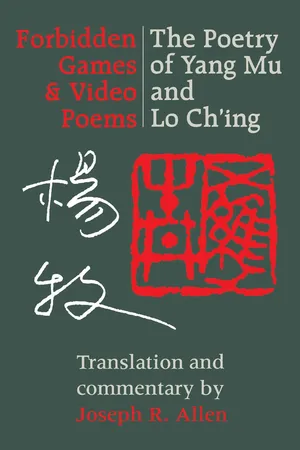
Forbidden Games and Video Poems

The Poetry of Yang Mu and Lo Ch'ing

  1. 448 pages
  2. English
  3. ePUB (mobile friendly)
  4. Available on iOS & Android
eBook - ePub
Available until 23 Dec |Learn more

Forbidden Games and Video Poems

The Poetry of Yang Mu and Lo Ch'ing

About this book

Two contemporary poets from Taiwan, Yang Mu (pen name for Wang Ching-hsien, b. 1940) and Lo Ch'ing (pen name for Lo Ch'ing-che, b. 1948), are represented in this bilingual edition of Chinese poetry ranging from the romantic to the postmodern. Both poets were involved in the selection of poems for this volume, the first edition in any language of their selected work. Their backgrounds, literary styles, and professional lifes are profiled and compared by translator Joseph R. Allen in critical essays that show how Yang and Lo represent basic directions in modern Chinese poetics and how they have contributed to the definition of modernism and postmodernism in China. The book's organization reflects each poet's method of composition. Yang's poems are chronologically arrangd, as his poetry tends to describe a narrative line that closely parallels his own biography. Lo's poems, which explore a world of concept and metaphor, are grouped by theme. Although each poet has a range of poetic voices, Yang's work can be considered the peak of high modernism in Chinese poetry, while Lo's more problematic work suggests the direction of new explorations in the art. In this way the two poets are mutually illuminating. Each group of poems is prefaced by an "illustration" that draws from another side of the poet's intellectual life. For Yang, who is a professor of comparative literature at the University of Washington, these are excerpts from his academic work (written under the name C.H. Wang) in English. The poems by Lo, a well-known painter living in Taiwan, are illustrated by five of his own ink paintings.

Frequently asked questions

Yes, you can cancel anytime from the Subscription tab in your account settings on the Perlego website. Your subscription will stay active until the end of your current billing period. Learn how to cancel your subscription.
No, books cannot be downloaded as external files, such as PDFs, for use outside of Perlego. However, you can download books within the Perlego app for offline reading on mobile or tablet. Learn more here.
Perlego offers two plans: Essential and Complete
  • Essential is ideal for learners and professionals who enjoy exploring a wide range of subjects. Access the Essential Library with 800,000+ trusted titles and best-sellers across business, personal growth, and the humanities. Includes unlimited reading time and Standard Read Aloud voice.
  • Complete: Perfect for advanced learners and researchers needing full, unrestricted access. Unlock 1.4M+ books across hundreds of subjects, including academic and specialized titles. The Complete Plan also includes advanced features like Premium Read Aloud and Research Assistant.
Both plans are available with monthly, semester, or annual billing cycles.
We are an online textbook subscription service, where you can get access to an entire online library for less than the price of a single book per month. With over 1 million books across 1000+ topics, we’ve got you covered! Learn more here.
Look out for the read-aloud symbol on your next book to see if you can listen to it. The read-aloud tool reads text aloud for you, highlighting the text as it is being read. You can pause it, speed it up and slow it down. Learn more here.
Yes! You can use the Perlego app on both iOS or Android devices to read anytime, anywhere — even offline. Perfect for commutes or when you’re on the go.
Please note we cannot support devices running on iOS 13 and Android 7 or earlier. Learn more about using the app.
Yes, you can access Forbidden Games and Video Poems by Yang Mu,Lo Ch'ing, Joseph R. Allen in PDF and/or ePUB format, as well as other popular books in Literature & Poetry. We have over one million books available in our catalogue for you to explore.

Information

FORBIDDEN GAMES

The Poetry of Yang Mu

From Taiwan to Iowa

From Ritual to Allegory

Risking the danger of endorsing excessive theorization of literature or, still worse, of tolerating the corruption of literary study currently evident in the games of critical jargon, I maintain that a proper approach in the comparative study of literature genetically unrelated is through the application of a tested theory. A tested theory is one that has been formulated first to assess an individual work in a particular tradition, used repeatedly on other works of similar nature and thereby revised and validated in that tradition. We apply it to the interpretation of works in another tradition. Often it is possible that, in so doing, we will illuminate these works with a strikingly new light and discover traits and messages never appreciated before. What we can find in literature of several traditions are not parallels or influences, but a common sense, a shared aspiration defined before individual backgrounds, an encyclopedia diversely cataloged, a poetry as a means of humanistic education. We fail if, instead of this, we fall back to piling more jargon upon jargon, confusing ourselves in the murky, infinitesimal units of the terminology popular in literary criticism but unknown in literature. For better or for worse, literary criticism is a key to literature. Literary criticism is not literature.
. . . Aware of the pitfalls scattered in various fashionable theories, I have chosen to adhere to what poetry itself has taught me, and to an organized set of literary concepts in the scholarly tradition. . . . If the poetry should appear to be inadequate as an expression of the progress of the Chinese humanities in that stage, I, not poetry, should be blamed. This book, written in English, seeks to identify the Chinese experiences of antiquity as the poets undertook to record their joys and sorrows in poetry, which, I believe, is immediate to our judgment when it is classified and subtitled according to the set of concepts. As much as I am eager to uncover the mysterious and the beautiful from a comparatist point of view, I am cautious to be obedient, as far as possible, to the great tradition of classical Chinese philology. I have tried to adjust our attitude toward affirming the position of some poems in a critical way, but I never wittingly invent anything to divest traditional philology of its authority. We are removed from these poems by twenty-three to thirty centuries and, in the present case, by a greatly changed semantics under the impact of which I consider them, and further, by an entirely different language in which I manage to write about them. I hope that, in spite of all this, my efforts may still bring early Chinese poetry to a modern context to be appreciated by an audience unbelievable to its creators. Had it not been for this purpose, I would always write in Chinese.
From the preface, xiii-xiv.
image

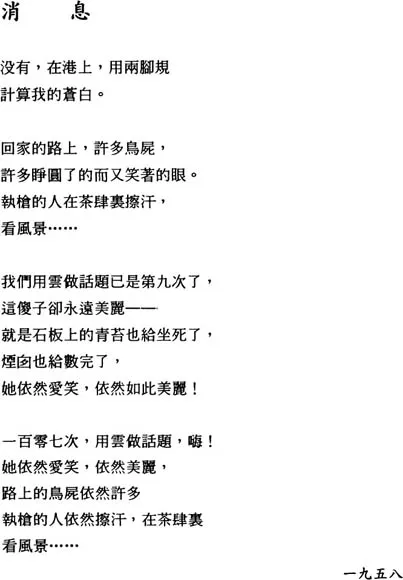
The News

Over the bay, not plotting the dimensions of my pallor
With calipers.
The road home is strewn with the bodies of dead birds,
Their smiling eyes stare blankly.
In teahouses men armed with rifles wipe their sweaty brows,
Looking out at the scenery . . .
Nine times now we have talked of clouds,
This fool who is always so pretty—
The moss on the stone bench has succumbed to our sitting,
The smokestacks have all been counted,
And still she giggles, still so pretty.
And so, we have talked of clouds one hundred seven times,
And still she giggles, still so pretty,
The road is still strewn with dead birds.
Armed with rifles, men in teahouses still wipe their sweaty brows,
Looking out at the scenery . . .
1958
image

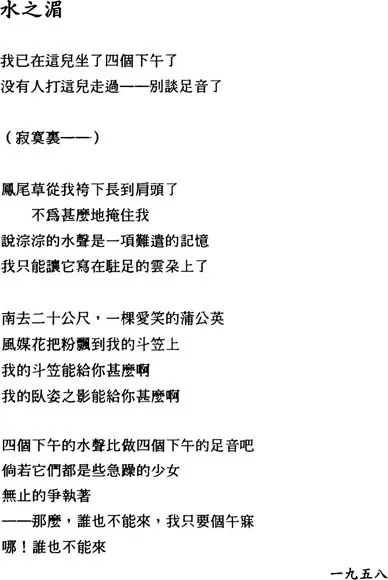
The River’s Edge

I have sat here these four endless afternoons
And no one has come—not even the tread of footsteps
(in silence)
The phoenix ferns have grown from thigh to shoulder
Concealing me for no apparent reason
Claiming that the murmur of the river is a memory I can’t shed
I can only let it be inscribe...

Table of contents

  1. Cover
  2. Half title
  3. Title
  4. Copyright
  5. Contents
  6. Acknowledgements
  7. Written with People in Mind
  8. A Poem Is a Cat in One’s Mind
  9. Yang Mu and Lo Ch’ing: A Profile
  10. Forbidden Games: The Poetry of Yang Mu
  11. Video Poems: The Poetry of Lo Ch’ing
  12. Translator’s Notes
  13. Density and Lucidity: The Poetics of Yang Mu and Lo Ch’ing
  14. Sources
  15. Bibliography of Selected Works by Yang Mu and Lo Ch’ing