![]()
Glossary/Index
Text page references follow the definitions. Numerals in parentheses indicate figures where features are displayed.
Ablation: The loss of mass from snow or ice, most commonly by melt but also by sublimation or scour. 35
Age-hardening: A characteristic property of disturbed snow to gain strength with time through bond growth among the rearranged snow particles. 15, 16, 89 (7, 9, 74)
Avalanche, loose snow: A sliding mass of snow that originates at a point on a slope as a small surface clump of snow and sweeps up larger and larger snow quantities as it falls. 31, 46, 79 (34, 35, 36, 38)
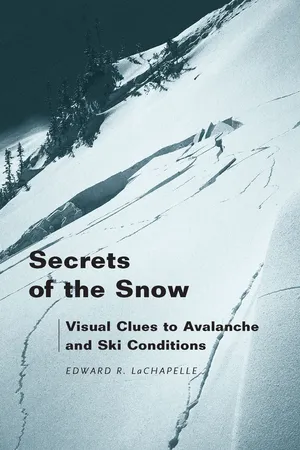
Avalanche, slab: A sliding mass of snow that breaks away as a discrete, cohesive layer from the clearly defined line of failure (the fracture line, or crown face). 13, 16, 22, 37, 51 (cover photo, 43)
Condensation: The phase change from gas (water vapor) to liquid (water) or to solid (ice). 20, 27, 35
Cornice: An overhanging mass of snow deposited on the lee of a ridge or other obstacle to drifting snow. 23, 24 (14, 15, 16)
Depth hoar: Fragile crystal formed within the snow cover when strong temperature gradients induce existing snow crystals or grains to recrystallize by passing through the vapor phase. 9, 16, 18, 20, 89 (74)
Evaporation: The phase change from liquid (water) to gas (water vapor). 40
Failure plane: The surface between two usually cohesive snow layers (slabs) and often the sliding surface of a slab avalanche. 21, 22
Firn: Snow, usually on a glacier, that has survived a complete season of ablation. 27, 35, 69 (20)
Firnspiegel: A thin, usually fragile layer of smooth, clear ice that forms over a melting snow surface with just the right heat-balance conditions. Sometimes called “glacier fire” when it reflects sunlight like a mirror. 80 (65)
Hard depth hoar: Dense, fine-grained old snow cemented by tiny vapor-deposited crystals between the grains. Like depth hoar, it is generated by strong temperature gradients, but results in a gain instead of loss of strength. 18, 20 (11)
Kinetic growth: Metamorphism of snow crystals by recrystallization under the influence of strong temperature gradients. 41
Metamorphism: Changes in size and shape of snow crystals or grains governed by the internal environment of the snow cover. 44, 59
Radiation cooling: Loss of heat from a snow surface when the radiation heat balance is negative for that surface. Loss of energy in the long-wave (infrared) part of the spectrum dominates this kind of cooling. It is especially strong with dry air, clear skies, and high altitudes. 8, 42, 80
Release zone: The part of a slope, usually the upper part, where an avalanche breaks loose. This may apply to both loose snow and slab avalanches. 63 (cover photo, 4, 16, 34, 36, 37, 38, 43, 44, 45, 46, 63, 77)
Rime: A dense, fine-grained deposit built up from the freezing of supercooled cloud droplets onto exposed objects, including falling snow crystals. 5, 8, 33, 38, 39, 40, 68, 69 (frontispiece, 1, 28, 55)
Snow climate: The characteristic combination for a given area of winter weather parameters, such as temperature, wind, snowfall amounts, and percentage of clear skies. 5, 8, 9, 16 (1, 2, 3, 4)
Snow creep: The internal deformation of the snow cover under the influence of gravity resulting in downhill displacement on a slope.
Snow crystal: An individual particle of snow, often with some form of hexagonal symmetry, whose water molecules are arranged in a common crystallographic orientation. 69
Snow density: The weight of a snow mass per unit volume. Very low density snow “fluff” may weigh 20 to 40 kilograms per cubic meter. Typical new snow densities are 70 to 120 kg/m3, while dense old snow may reach 400 to 500 and firn 600 kg/m3. The density of bubble-free ice is 917 kg/m3. 8, 11, 13, 16, 18, 26, 30, 33, 44, 94
Snowflake: An aggregation of individual snow crystals. 30
Snow glide: The slow sliding of the snow cover along the ground under influence of gravity on a slope. The amount of glide is highly dependent on ground roughness and character. It is not the same as snow creep, defined above. The total displacement of the snow surface on a slope is the sum of creep, glide, and settlement. 56, 89 (44, 45, 75)
Snow settlement: Compaction of the snow cover through metamorphism and compression. On a sloping surface, additional deformations occur from snow creep and snow glide, defined above. 44, 45, 74, 79, 82, 87 (33a and b, 70)
Sublimation: The phase change from solid (ice) directly to gas (water vapor) at subfreezing temperatures without an intermediate liquid (water) phase. Sublimation sometimes also refers to the reverse (water vapor directly to ice) but is not used here in this latter sense. 11, 16
Supercooled: Water that remains liquid when cooled below the freezing point is said to be supercooled. Tiny droplets, such as those that make up clouds, are much more easily supercooled than larger masses of water. 5, 38, 68
Surface heat balance: The algebraic sum of heat inputs (plus) and losses (minus) to a surface. For snow, these include sensible heat by conduction from below or turbulent transfer from the atmosphere, condensation or evaporation, and both long (infrare...