![]()
Appendix 1
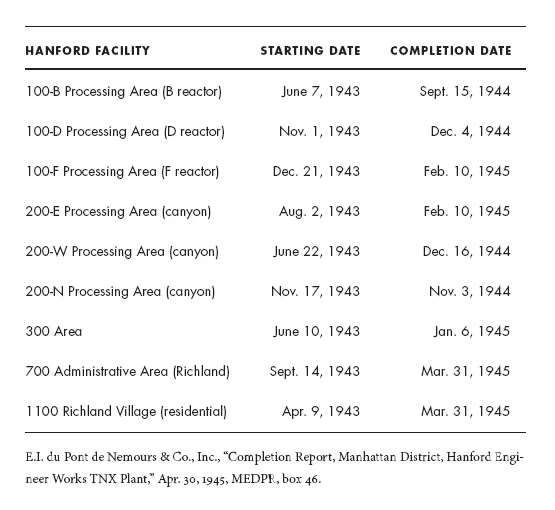
Starting and Completion Dates of Manhattan Project Facilities at Hanford, 1943-45
![]()
Appendix 2
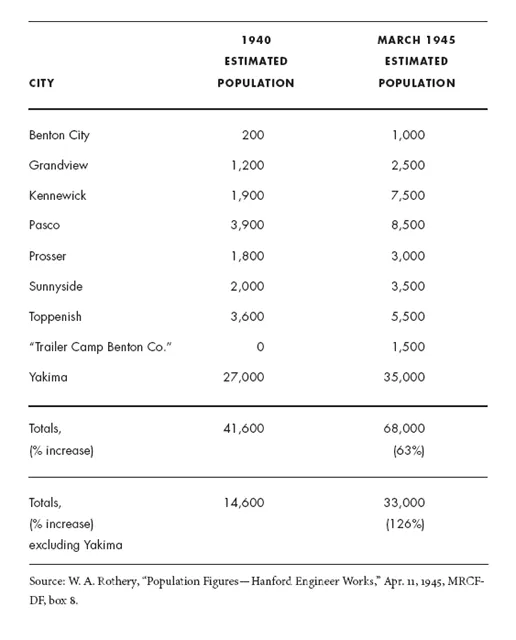
Wartime Population Increase in Hanford Area
![]()
Appendix 3
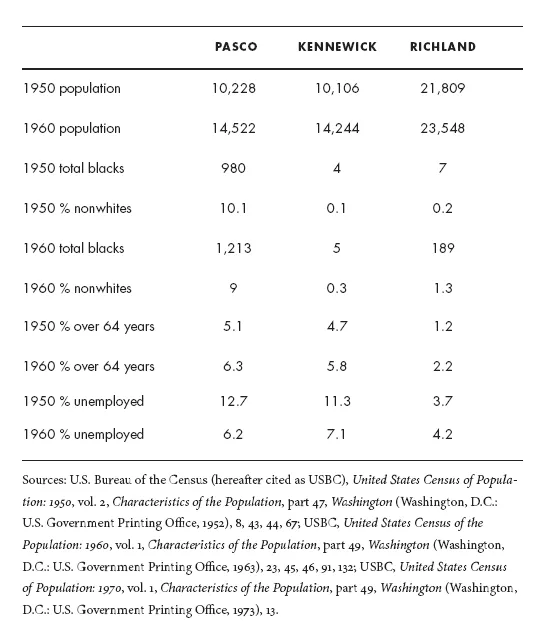
Tri-Cities Demographic Data, 1950-60
![]()
Appendix 4
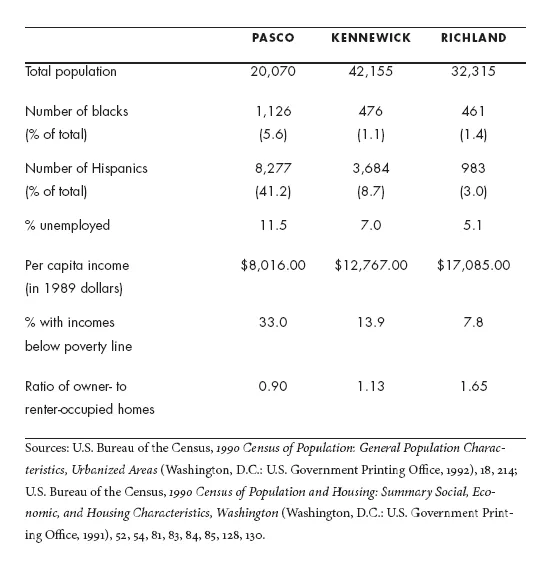
Tri-Cities Demographic Data, 1990
![]()
Note on Sources
Writing about the history of American nuclear-weapons programs requires understanding the different, intricate systems of storing and identifying documents generated since 1942 by the U.S. government and its contractors. The research for this book relies heavily upon declassified, and never classified, materials held by two different government entities: the United States Department of Energy (DOE) and the National Archives and Records Administration (NARA). A few words about each institution's holdings may be instructive to readers and researchers.
Over the years, production of nuclear weapons in the United States has been the responsibility of, successively, the Army (through 1946); the Atomic Energy Commission (1947-1974); the Energy Research and Development Administration (1975-76); and the Department of Energy (1977-present). Today, the Department of Energy is responsible for preserving and making available the declassified documents produced over the years by the different federal agencies and their assorted contractors. Those documents are available at more than one DOE location and are accessible in different ways. We have attempted to identify the place where we consulted or obtained each unpublished document that we cite; however, many of those documents are available in more than one location.
The Department of Energy maintains the DOE Historical Research Center within its Office of History and Heritage Resources in Germantown, Maryland. A number of collections are available there, including the Richland Diversification Files, the Atomic Energy Commission Division of Production materials, the General Manager files, and the Energy History Collection. Some of these collections have their own numbering system, which we have attempted to acknowledge consistently in our notes. Thus we identify a letter from Carroll L. Wilson to J. Robert Oppenheimer, April 16, 1948, as being from “GenMan 5580:17,” that is, the collection of the General Manager Files, box 5580, folder 17. In many cases specific documents were assigned their own numbers by the agency generating them. Thus the report from the AEC Advisory Committee on Reactor Safeguards is identified as “ACRS Report on Modifications to Hanford Reactors,” Feb. 4, 1958, AEC 172/22, pp. 1-2, 51-58Sec, 1284:6, “AEC 172/22” is the internal identifying number given by the commission, while 1284:6 refers to box 1284, folder 6.
At Richland, Washington, the DOE maintains the United States Department of Energy Public Reading Room (PRR) as part of its Richland Operations Office. Many documents consulted in this facility are identified with the initials PRR in the endnotes. Most (but not all) documents from this collection may also be identified with either an accession number or a document number. For example, the Hanford Works Monthly Report (HWMR) for June 1949, dated July 18, 1949, bears the PRR accession number 10373, and the document number HW 13793-Del; we have endeavored to provide one or the other. Document numbers have different provenances. The prefix HW in the above example, for instance, identifies the document as pertaining to the Hanford Works—the name for the site during the Cold War. (During World War II the site was called the Hanford Engineer Works, and many document numbers from that period commonly begin with the letters HAN.) On the other hand, some documents have identifiers that associate them with a government entity. Thus the diary of Captain F. A. Valente is associated with the Manhattan Engineer District (document numbers MED1001 through MED1004). Still other PRR documents are identified by the microfiche numbers.
The DOE has put thousands of Hanford documents and photographs on line through the Hanford Declassified Document Retrieval System (DDRS), located at http://www2.hanford.gov/declass/. Through its Advanced Search protocol, DDRS allows multiple ways of retrieving an item, e.g., through document number, accession number, author, company, title, keyword, or date. Plugging in one kind of identifier usually calls up other kinds.
Part of the mission of the DOE Office of History and Heritage Resources is to prepare DOE records for transfer to the National Archives and Records Administration. As a result, documents are constantly in motion from one agency to the other. For historians and others, this presents problems. In our research at the DOE Historical Research Center in Germantown, Maryland, we consulted the Secretariat Files of the U.S. Atomic Energy Commission, grouped then by DOE staff into the periods 1947-1951 and 1951-1958, and therefore abbreviated as 47-51Sec and 51-58Sec in our notes. Those two collections were later transferred to the NARA branch at College Park, Maryland. As part of the transfer, we have been told, the files were reboxed and renumbered; yet no inventory of the transfer, explaining how the National Archives reorganized the collection, has been found. To make matters worse, from what we can gather, a number of the files from the AEC Secretariat for 1947-1951 and 1951-1958 have been re-classified and are therefore no longer available to researchers without appropriate security clearances. After consultation and deliberation, we have decided to retain in our manuscript the information derived from research in the AEC Secretariat Files, regardless of whether the pertinent documents are now classified or declassified. Unable to develop the current provenance for these materials, we maintain the citations that we established upon doing research in the DOE Historical Research Center. In other words, in our endnotes, citations to 47-51Sec and 51-58Sec refer to erstwhile DOE holdings that may no longer be accessed using the location, box numbers, and file numbers that we provide. But the authors, titles, and dates of individual documents provide some information about our sources, and we have confirmed the accuracy of our research by checking citations carefully against the records generated in the course of our research, including photocopies of many of the pertinent documents and notes drawn from others.
The National Archives and Records Administration holds the great majority of the materials pertaining to U.S. nuclear weapons programs in Record Group 326. Many of these materials are available at National Archives II, or the National Archives at College Park, Maryland. One such collection is the David Lilienthal Papers (abbreviated in our notes as LP). However, many of the materials from Record Group 326 that we examined were located in the National Archives Center, Southeast Region, outside of Atlanta in East Point, Georgia; this branch has now relocated to Morrow, Georgia. After World War II, many papers concerning Hanford were filed together with those from the Manhattan Project site at Oak Ridge, Tennessee, and therefore ended up at NARA's facility in the southeast (rather than the northwest) region. In our notes, these materials are identified with the following abbreviations: MED-C, MEDPR, MRCF-ACC, and MRCF-DF.
Most of the illustrations in this book originated with the DOE and its predecessor agencies. We located some of them on the DDRS website. Many others were identified and obtained through Lockheed Martin, a DOE subcontractor whose offices in the Tri-Cities have assumed responsibility for many historical photographs of Hanford.
Of course, DOE and NARA have no monopoly on historical records pertaining to Hanford. Many other collections contain important materials, including the Manuscript Division of the Hagley Museum and Library, Wilmington, Delaware, which has many records pertaining to activities of the DuPont company. We have been fortunate to work next door to the University of Washington Libraries, which are particularly rich on materials concerning Hanford. Many of those materials, including the papers of U.S. Senator Henry M. Jackson (D-WA), U.S. Senator Warren G. Magnuson (D-WA), and Richland Mayor Fred Clagett, are housed in Special Collections. The Libraries’ division of Government Publications has also proved important as an official repository for the hundreds of reports and publications generated by the Hanford Environmental Dose Reconstruction Project (HEDR).
![]()
Abbreviations Used in Notes
47-51SEC AND 51-58SEC
These abbreviations refer to the Secretariat Files of the Atomic Energy Commission, Record Group 326, National Archives II, College Park, Maryland. We consulted these materials in the Historical Research Center, Office of History and Heritage Resources, Department of Energy, Germantown, Maryland, where they were organized into the periods 1947-1951 and 1951-1958. Items from these collections are generally cited with the box and folder numbers used by DOE, as in 97:20.
58-66SEC
Secretariat Files, U.S. Atomic Energy Commission, 1958-1966, on file in Historical Research Center, Office of History and Heritage Resources, Department of Energy, Germantown, Maryland.
AEC
U.S. Atomic Energy Commission
CBN
Columbia Basin News
DDRS
Hanford Declassified Document Retrieval System. Online access to numerous documents and photographs concerning Hanford after 1942 via http://www2.hanford.gov/declass/.
DOE
U.S. Department of Energy
EHC
Energy History Collection. Miscellaneous materials in the Historical Research Center, Office of History and Heritage Resources, U.S. Department of Energy, Germantown, Maryland.
ERDA
U.S. Energy Research and Development Administration
FCP
Fred Clagett Papers, Accession 3543, Special Collections, University of Washington Libraries, Seattle. Materials are generally referred to by the box number, e.g., FCP4.
FTM
“Col. F[ranklin]. T. Matthias, Notes and Diary” [1942-1946]. This microfiche document was consulted at the Department of Energy Public Reading Room, Richland, Washington.
GE
General Electric
GENMAN
General Manager Files, Office of History and Heritage Resources, U.S. Department of Energy, Germantown, Maryland.
HEWMR
Hanford Engineer Works Monthly Report. These reports were consulted in the Department of Energy Public Reading Room, Richland, Washington.
HMJP
Henry M. Jackson Papers, Accession 3560, Special Collections, University of Washington Libraries, Seattle. This collection has been subdivided by period, so that, for example, Jackson's first two senatorial terms are covered mainly in Accession 3560-3. In the notes, this subdivision of the accession is given as HMJP-3. Items from the collection are generally cited with the box and folder numbers, as in 97:20.
HMLMD
Hagley Museum and Library Manuscripts Division, Wilmington, Delaware.
HWMR
Hanford Works Monthly Report. These reports were generally consulted in the Department of Energy Public Reading Room, Richland, Washington.
JCAE
Joint Committee on Atomic Energy, U.S. Congress
JGT
J. Gordon Turnbull, Inc., and Graham, Anderson...