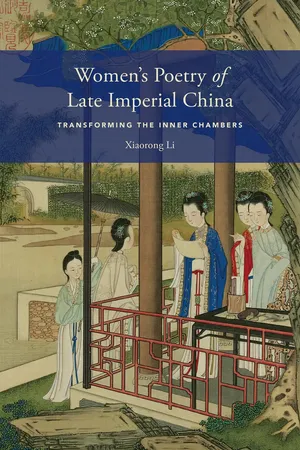
Women's Poetry of Late Imperial China
Transforming the Inner Chambers
- 264 pages
- English
- PDF
- Available on iOS & Android
About this book
This study of poetry by women in late imperial China examines the metamorphosis of the trope of the "inner chambers" (gui), to which women were confined in traditional Chinese households, and which in literature were both a real and an imaginary place. Originally popularized in sixth-century "palace style" poetry, the inner chambers were used by male writers as a setting in which to celebrate female beauty, to lament the loneliness of abandoned women, and by extension, to serve as a political allegory for the exile of loyal and upright male ministers spurned by the imperial court. Female writers of lyric poetry (ci) soon adopted the theme, beginning its transition from male fantasy to multidimensional representation of women and their place in society, and eventually its manifestation in other poetic genres as well. Emerging from the role of sexual objects within poetry, late imperial women were agents of literary change in their expansion and complication of the boudoir theme. While some take ownership and de-eroticizing its imagery for their own purposes, adding voices of children and older women, and filling the inner chambers with purposeful activity such as conversation, teaching, religious ritual, music, sewing, childcare, and chess-playing, some simply want to escape from their confinement and protest gender restrictions imposed on women. Women's Poetry of Late Imperial China traces this evolution across centuries, providing and analyzing examples of poetic themes, motifs, and imagery associated with the inner chambers, and demonstrating the complication and nuancing of the gui theme by increasingly aware and sophisticated women writers.
Frequently asked questions
- Essential is ideal for learners and professionals who enjoy exploring a wide range of subjects. Access the Essential Library with 800,000+ trusted titles and best-sellers across business, personal growth, and the humanities. Includes unlimited reading time and Standard Read Aloud voice.
- Complete: Perfect for advanced learners and researchers needing full, unrestricted access. Unlock 1.4M+ books across hundreds of subjects, including academic and specialized titles. The Complete Plan also includes advanced features like Premium Read Aloud and Research Assistant.
Please note we cannot support devices running on iOS 13 and Android 7 or earlier. Learn more about using the app.
Information
Table of contents
- Contents
- Acknowledgments
- Introduction
- 1. The Green Window: The Boudoir in Poetic Convention
- 2. A New Feminine Ideal: The Case of The Anthology of Correct Beginnings
- 3. Convention and Intervention: The Lyrical World of Gu Zhenli
- 4. Inside Out: The Gui in Times of Chaos
- 5. The Old Boudoir and the “New Woman”: The Late Qing and Early Republican Era
- Conclusion
- Notes
- Glossary of Chinese Characters
- Bibliography
- Index