eBook - ePub
Available until 23 Dec |Learn more
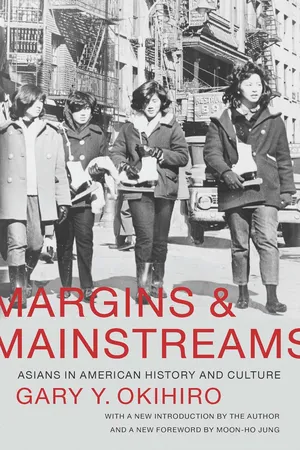
Margins and Mainstreams
Asians in American History and Culture
This book is available to read until 23rd December, 2025
- 240 pages
- English
- ePUB (mobile friendly)
- Available on iOS & Android
eBook - ePub
Available until 23 Dec |Learn more
About this book
In this classic book on the meaning of multiculturalism in larger American society, Gary Okihiro explores the significance of Asian American experiences from the perspectives of historical consciousness, race, gender, class, and culture. While exploring anew the meanings of Asian American social history, Okihiro argues that the core values and ideals of the nation emanate today not from the so-called mainstream but from the margins, from among Asian and African Americans, Latinos and American Indians, women, and the gay and lesbian community. Those groups in their struggles for equality, have helped to preserve and advance the founders' ideals and have made America a more democratic place for all.
Frequently asked questions
Yes, you can cancel anytime from the Subscription tab in your account settings on the Perlego website. Your subscription will stay active until the end of your current billing period. Learn how to cancel your subscription.
No, books cannot be downloaded as external files, such as PDFs, for use outside of Perlego. However, you can download books within the Perlego app for offline reading on mobile or tablet. Learn more here.
Perlego offers two plans: Essential and Complete
- Essential is ideal for learners and professionals who enjoy exploring a wide range of subjects. Access the Essential Library with 800,000+ trusted titles and best-sellers across business, personal growth, and the humanities. Includes unlimited reading time and Standard Read Aloud voice.
- Complete: Perfect for advanced learners and researchers needing full, unrestricted access. Unlock 1.4M+ books across hundreds of subjects, including academic and specialized titles. The Complete Plan also includes advanced features like Premium Read Aloud and Research Assistant.
We are an online textbook subscription service, where you can get access to an entire online library for less than the price of a single book per month. With over 1 million books across 1000+ topics, we’ve got you covered! Learn more here.
Look out for the read-aloud symbol on your next book to see if you can listen to it. The read-aloud tool reads text aloud for you, highlighting the text as it is being read. You can pause it, speed it up and slow it down. Learn more here.
Yes! You can use the Perlego app on both iOS or Android devices to read anytime, anywhere — even offline. Perfect for commutes or when you’re on the go.
Please note we cannot support devices running on iOS 13 and Android 7 or earlier. Learn more about using the app.
Please note we cannot support devices running on iOS 13 and Android 7 or earlier. Learn more about using the app.
Yes, you can access Margins and Mainstreams by Gary Y. Okihiro in PDF and/or ePUB format, as well as other popular books in Social Sciences & North American History. We have over one million books available in our catalogue for you to explore.
Information
1
When and Where I Enter
A SOLITARY figure defies a tank, insofar as a solitary figure can defy a tank. A “goddess of liberty” in the image of the Statue of Liberty arises from the midst of a vast throng gathered in Beijing's Tiananmen Square. The November 1, 1991, issue of Asiaweek carries the caption “Welcoming Asians” under a picture of the Statue of Liberty in New York Harbor awash in the light of fireworks.1 Contained within those images—vivid and memorable—is what Swedish social scientist Gunnar Myrdal called the American creed. Democracy, equality, and liberty form the core of that creed, and the “mighty woman with a torch” has come to symbolize those ideals to, in the words of the poet Emma Lazarus, the tired, the poor, the huddled masses “yearning to breathe free.”
On another island, on the other coast, stands not a statue but a wooden barrack. Solitary figures hunch over to carve poems on the walls.2
The sea-scape resembles lichen twisting and turning for a thousand li.
There is no shore to land and it is difficult to walk.
With a gentle breeze I arrived at the city thinking all would be so.
At ease, how was one to know he was to live in a wooden building?
In the quiet of night, I heard, faintly, the whistling of wind.
The forms and shadows saddened me; upon seeing the landscape, I composed a poem.
The floating clouds, the fog, darken the sky.
The moon shines faintly as the insects chirp.
Grief and bitterness entwined are heaven sent.
The sad person sits alone, leaning by a window.
Angel Island, not Ellis Island, was the main port of entry for Chinese migrants “yearning to breathe free” from 1910 to 1940.3 There, separated by cold currents from the golden shore, the migrants were carefully screened by U.S. Immigration officials and held for days, weeks, and months to determine their fitness for America. The 1882 Chinese Exclusion Act had prohibited entry to Chinese workers, indicative of a race- and class-based politics, because according to the act, “in the opinion of the Government of the United States, the coming of Chinese laborers to this country endangers the good order of certain localities within the territory thereof.”4
In New York City, a year after passage of the Chinese Exclusion Act, Emma Lazarus wrote the poem that now graces the base of the Statue of Liberty. But the statue had not been envisioned as a symbol of welcome to the world's “wretched refuse” by its maker, French sculptor Frederic Auguste Batholdi, and at its unveiling in 1886, President Grover Cleveland proclaimed that the statue's light would radiate outward into “the darkness of ignorance and man's oppression until Liberty enlightens the world.”5 In other words, the statue commemorated republican stability, and according to the October 29, 1886, New York World, it stood forever as a warning against lawlessness and anarchy and as a pledge of friendship with nations that “dare strike for freedom.” That meaning was changed by European immigrants, who saw the statue as welcoming them, and by Americanizers, who, during the 1920s and 1930s, after the 1924 Immigration Act restricting mass immigration, sought a symbol to instill within the children of immigrants patriotism and a love for country.6
The tale of those two islands, separated by the vast interior and lapped by different waters, comprises a metaphor of America and the Asian American experience. America was not always a nation of immigrants, nor was America unfailingly a land of democracy, equality, and liberty. The romantic sentiment of the American identity, “this new man,” expressed by French immigrant J. Hector St. John de Crèvecoeur was probably not the dominant view, nor did it apply to all of America's people. Writing in 1782, Crèvecoeur exclaimed: “What then is the American, this new man?…I could point out to you a family whose grandfather was an Englishman, whose wife was Dutch, whose son married a French woman, and whose present four sons have now four wives of different nations. He is an American, who leaving behind him all his ancient prejudices and manners, receives new ones from the new mode of life he has embraced, the new government he obeys, and the new rank he holds. He becomes an American by being received in the broad lap of our great Alma Mater. Here individuals of all nations are melted into a new race of men.”7
Instead, the prevailing view was a narrower construction that distinguished “settler,” or original colonist, from “immigrant,” and that required a single origin and common culture. Americans, John Jay wrote in the Federalist papers, were “one united people—a people descended from the same ancestors, speaking the same language, professing the same religion, attached to the same principles of government, very similar in their manners and customs.”8 That eighteenth-century discrimination between settler and immigrant proved inadequate for the building of a new republic during the nineteenth century. The quest for a unifying national identity, conceived along the lines of Crèvecoeur's notion whereby “individuals of all nations are melted into a new race of men,” an idea later called the “melting pot,” paralleled the building of networks of roads, railroads, and communications links that unified and bound the nation.9
Although Asians helped to construct those iron links that connected East to West, they, along with other peoples of color, were excluded from the industrial, masculine, destroying melting pot. Ellis Island was not their port of entry; its statue was not their goddess of liberty. Instead, the square-jawed, androgynous visage of the “Mother of Exiles” turned outward to instruct, to warn, and to repel those who would endanger the good order of America's shores, both at home and abroad. The indigenous inhabitants of Africa, Asia, and the Americas were not members of the community but were more akin to the wilderness, which required penetration and domestication. Three years after the Constitution was ratified, the first Congress met and restricted admission into the American community to “free white persons” through the Naturalization Act of 1790. Although the act was modified to include “persons of African nativity or descent” in 1870 and Chinese nationals in 1943, the racial criterion for citizenship was eliminated completely only in 1952, 162 years after the original delineation of the Republic's members, or, according to the Naturalization Act, the “worthy part of mankind.”
In 1886, African American educator Anna Julia Cooper told a group of African American ministers: “Only the BLACK WOMAN can say ‘when and where I enter…then and there the whole Negro race enters with me.’”10 Cooper's confident declaration held profound meaning. African American men bore the stigma of race, but African American women bore the stigmata of race and gender. Her liberation, her access to the full promise of America, embraced the admission of the entire race. The matter of “when and where,” accordingly, is an engendered, enabling moment. The matter of “when and where,” in addition, is a generative, transformative moment. The matter of “when and where,” finally, is an extravagant, expansive moment. That entry into the American community, however enfeebled by barriers to full membership, parallels the earlier entry into historical consciousness, and the “when and where” of both moments are engendered/enabling, generative/transformative, extravagant/expansive.
Asians entered into the European American historical consciousness long before the mid-nineteenth-century Chinese migration to “Gold Mountain” and, I believe, even before Yankee traders and American diplomats and missionaries traveled to China in the late eighteenth century. The “when and where” of the Asian American experience can be found within the European imagination and construction of Asians and Asia and within their expansion eastward and westward to Asia for conquest and trade.
Writing in the fifth or fourth century B.C.E., Hippocrates, Greek physician and “father of medicine,” offered a “scientific” view of Asia and its people.11 Asia, Hippocrates held, differed “in every respect” and “very widely” from Europe. He attributed those contrasts to the environment, which shaped the peoples’ bodily conformations and their characters. Asia's mild, uniform climate supported lush vegetation and plentiful harvests, but under those conditions “courage, endurance, industry and high spirit could not arise” and “pleasure must be supreme.” Asians reflected the seasons in their natures, exhibiting a “monotonous sameness” and “stagnation,” and their form of government, led by kings who ruled as “despots,” enfeebled Asians even more. Among Asians, Hippocrates reported, were “Longheads” and “Phasians.” The latter had yellowish complexions “as though they suffered from jaundice.” Because of the differing environments in which they lived, Hippocrates concluded that Europeans had a wider variety of physical types and were more courageous and energetic than Asians, “for uniformity engenders slackness, while variation fosters endurance in both body and soul; rest and slackness are food for cowardice, endurance and exertion for bravery.”12
Aristotle mirrored Hippocrates’ views of Asia during the fourth century B.C.E. In his Politics, Aristotle observed that northern Europeans were “full of spirit, but wanting in intelligence and skill,” whereas Asians were “intelligent and inventive,” but lacked spirit and were therefore “always in a state of subjection and slavery.” The Greeks, in contrast, lived between those two groups and thus were both “high-spirited and also intelligent.” Further, argued Aristotle, barbarians were by nature “more servile in character” than Greeks, and he reported that some Asians practiced cannibalism.13 The fourth-century B.C.E. conflict between Persia and Greece, between barbarism and civilization, between inferior and superior, tested the “great chain of being” idea propounded by Plato and Aristotle. Alexander the Great's thrust into India, to “the ends of the world,” was a one-sided affair, according to the Roman historian Arrian, a chronicler of the expedition. Using contemporary accounts but writing some four hundred years after Alexander's death in 323 B.C.E., Arrian contrasted Alexander's ingenuity and dauntless spirit—“he could not endure to think of putting an end to the war so long as he could find enemies”—with the cowardice of the barbarian hordes, who fled pell-mell at the sight of the conqueror.14 In a speech to his officers, as recorded by Arrian, Alexander reminded them that they were “ever conquerors” and their enemies were “always beaten,” that the Greeks were “a free people” and the Asians, “a nation of slaves.” He praised the strength and valor of the Greeks, who were “inured to warlike toils,” and he declared that their enemies had been “enervated by long ease and effeminacy” and called them “the wanton, the luxurious, and effeminate Asiatics.”15
Such accounts of Asia, based upon the belief in a generative relationship between the environment and race and culture, enabled an exotic, alienating construction of Asians, whether witnessed or simply imagined. Literary critics Edward W. Said and Mary B. Campbell have characterized that European conception of Asia and Asians—“the Other”—as “almost a European invention,” according to Said, a place of “romance, exotic beings, haunting memories and landscapes, remarkable experiences,” and for Campbell, that conception was “the ground for dynamic struggles between the powers of language and the facts of life.”16 Accordingly, the Greek historian Ctesias, writing probably in the fifth century B.C.E., reveled in the accounts of “dog-faced creatures” and “creatures without heads” that supposedly inhabited Africa, and he peopled his Asia with those same monstrous beasts. Likewise, the author of the early medieval account Wonders of the East described Asian women “who have boars’ tusks and hair down to their heels and oxen's tails growing out of their loins. These women are thirteen feet tall, and their bodies have the whiteness of marble, and they have camels’ feet and donkeys’ teeth.” Alexander the Great, hero of Wonders of the East, kills those giant, tusked, and tailed women “because of their obscenity” and thereby eliminates strangeness and makes the world sane and safe again. Asia in Wonders of the East, writes Campbell, “stands in opposition to the world we know and the laws that govern it,” and thus was beyond and outside the realm of order and sensibility.17
That otherworldliness, that flight from reality, pervades the earliest Christian European text to define Europe in opposition to Asia, the Peregrinatio ad terram sanctam by Egeria, probably written during the late fourth century C.E. Although her account of her journey to the Holy Land contained “moments of awe, reverence, wonder or gratitude,” it described an exotic Asia that served to highlight the positive, the real, the substantial Europe. De locis sanctis, written during the late seventh century C.E. by Adamnan, abbot at Iona's monastery, recounted a similar Asia from the travels of Bishop Arculf to the Holy Land. Asia, according to De locis sanctis, was a strange, even demonic place, where people exhibited grotesque inversions and perversions of human nature, and where a prerational, stagnant configuration existed, “a world stripped of spirit and past.”18
Asia, according to Campbell and Said, was Europe's Other.19 Asia was the location of Europe's oldest, greatest, and richest colonies, the source of its civilization and languages, its cultural contestant, and the wellspring of one of its most persistent images of the Other. At the same time, cautions Said, the assumptions of Orientalism were not merely abstractions and figments of the European imagination but composed a system of thought that supported a “Western style for dominating, restructuring, and having authority over” Asia. Within Orientalism's lexicon, Asians were inferior to and deformations of Europeans, and Orientalism's purpose was to stir an inert people, raise them to their former greatness, shape them and give them an identity, and subdue and domesticate them. That colonization, wrote Said, was an engendered subordination, by which European men aroused, penetrated, and possessed a passive, dark, and vacuous “Eastern bride,” imposing movemen...
Table of contents
- Cover Page
- Title Page
- Copyright Page
- Dedication
- Contents
- Preface to the Original Edition
- Foreword
- Introduction to the 2014 Edition
- 1 - When and Where I Enter
- 2 - Is Yellow Black or White?
- 3 - Recentering Women
- 4 - Family Album History
- 5 - Perils of the Body and Mind
- 6 - Margin as Mainstream
- Bibliography
- Index