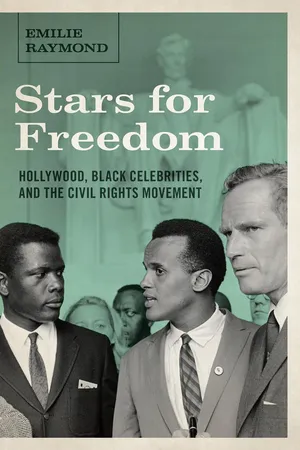
Stars for Freedom
eBook - ePub
Available until 23 Dec |Learn more

Stars for Freedom

Hollywood, Black Celebrities, and the Civil Rights Movement

  1. 352 pages
  2. English
  3. ePUB (mobile friendly)
  4. Available on iOS & Android
eBook - ePub
Available until 23 Dec |Learn more

Stars for Freedom

Hollywood, Black Celebrities, and the Civil Rights Movement

About this book

From Oprah Winfrey to Angelina Jolie, George Clooney to Leonardo DiCaprio, Americans have come to expect that Hollywood celebrities will be outspoken advocates for social and political causes. However, that wasn't always the case. As Emilie Raymond shows, during the civil rights movement the Stars for Freedom - a handful of celebrities both black and white - risked their careers by crusading for racial equality, and forged the role of celebrity in American political culture. Focusing on the "Leading Six" trailblazers - Harry Belafonte, Ossie Davis, Ruby Dee, Sammy Davis, Jr., Dick Gregory, and Sidney Poitier - Raymond reveals how they not only advanced the civil rights movement in front of the cameras, but also worked tirelessly behind the scenes, raising money for Martin Luther King, Jr.'s legal defense, leading membership drives for the NAACP, and personally engaging with workaday activists to boost morale. Through meticulous research, engaging writing, and new interviews with key players, Raymond traces the careers of the Leading Six against the backdrop of the movement. Perhaps most revealing is the new light she sheds on Sammy Davis, Jr., exploring how his controversial public image allowed him to raise more money for the movement than any other celebrity. The result is an entertaining and informative book that will appeal to film buffs and civil rights historians alike, as well as to anyone interested in the rise of celebrity power in American society. A Capell Family Book A V Ethel Willis White Book

Frequently asked questions

Yes, you can cancel anytime from the Subscription tab in your account settings on the Perlego website. Your subscription will stay active until the end of your current billing period. Learn how to cancel your subscription.
No, books cannot be downloaded as external files, such as PDFs, for use outside of Perlego. However, you can download books within the Perlego app for offline reading on mobile or tablet. Learn more here.
Perlego offers two plans: Essential and Complete
  • Essential is ideal for learners and professionals who enjoy exploring a wide range of subjects. Access the Essential Library with 800,000+ trusted titles and best-sellers across business, personal growth, and the humanities. Includes unlimited reading time and Standard Read Aloud voice.
  • Complete: Perfect for advanced learners and researchers needing full, unrestricted access. Unlock 1.4M+ books across hundreds of subjects, including academic and specialized titles. The Complete Plan also includes advanced features like Premium Read Aloud and Research Assistant.
Both plans are available with monthly, semester, or annual billing cycles.
We are an online textbook subscription service, where you can get access to an entire online library for less than the price of a single book per month. With over 1 million books across 1000+ topics, we’ve got you covered! Learn more here.
Look out for the read-aloud symbol on your next book to see if you can listen to it. The read-aloud tool reads text aloud for you, highlighting the text as it is being read. You can pause it, speed it up and slow it down. Learn more here.
Yes! You can use the Perlego app on both iOS or Android devices to read anytime, anywhere — even offline. Perfect for commutes or when you’re on the go.
Please note we cannot support devices running on iOS 13 and Android 7 or earlier. Learn more about using the app.
Yes, you can access Stars for Freedom by Emilie Raymond in PDF and/or ePUB format, as well as other popular books in Social Sciences & African American Studies. We have over one million books available in our catalogue for you to explore.

NOTES

NOTES TO PREFACE
1 Jamie Foxx in Stephanie Chan, “Jamie Foxx: Will Smith, Jay Z Should Be Next Civil Rights Leaders,” video, Hollywood Reporter, August 28, 2013, accessed October 14, 2014, http://www.hollywoodreporter.com/news/jamie-foxx-will-smith-jay-616846.
2 “The SCLC Story in Words and Pictures,” booklet (Atlanta, Georgia: SCLC, 1964), 40–42, F. “M. L. King #3736,” George Stevens Papers, Special Collection, Margaret Herrick Library-Academy of Motion Pictures Arts and Sciences, Beverly Hills, California.
3 Brian Ward, Just My Soul Responding: Rhythm and Blues, Black Consciousness, and Race Relations (Berkeley: University of California Press, 1998), 293–303; and Ingrid Monson, Freedom Sounds: Civil Rights Call Out to Jazz and Africa (Oxford: Oxford University Press, 2007), 201–22.
4 Thomas Sugrue, Sweet Land of Liberty: The Forgotten Struggle for Civil Rights in the North (New York: Random House, 2008), xiv–xvi; and Martha Biondi, To Stand and Fight: The Struggle for Civil Rights in Postwar New York City (Cambridge, MA. And London: Harvard University Press, 2003), 279.
5 See also Douglas Flamming, Bound for Freedom: Black Los Angeles in Jim Crow America (Berkeley: University of California Press, 2005); Matthew J. Countryman, Up South: Civil Rights and Black Power in Philadelphia (Philadelphia: University of Pennsylvania Press, 2006); Colleen Doody, Detroit’s Cold War: The Origins of Postwar Conservatism (Urbana, Chicago, and Springfield: University of Illinois Press, 2013); James R. Ralph, Jr. Northern Protest: Martin Luther King, Jr., Chicago, and the Civil Rights Movement (Cambridge, MA: Harvard University Press, 1993); and Daniel Martinez Hosang, Racial Propositions: Ballot Initiatives and the Making of Postwar California (University of California Press, 2010).
6 Sidney Poitier, The Measure of a Man: A Spiritual Autobiography (San Francisco: Harper, 2007), 108–9.
7 Gloria Richardson in Ward, Just My Soul, 314.
8 Stokley Carmichael, with Ekwrieme Michael Thelwell, Ready for Revolution: The Life and Struggles of Stokley Carmichael (Kwame Ture) (New York: Scribner, 2003), 256.
9 Richard deCordova, Picture Personalities: The Emergence of the Star System in America (Urbana: University of Illinois Press, 1990), 51–81; Charles L. Ponce de Leon, Self Exposure: Human Interest Journalism and the Emergence of Celebrity in America, 1890–1940 (Chapel Hill: University of North Carolina Press, 2002), 42–43; and Chris Rojek, Celebrity (London: Reaktion Books, 2001), 189.
10 Donald Bogle, Toms, Coons, Mulattoes, Mammies, and Bucks: An Interpretive History of Blacks in American Films (New York: Continuum, 2001), 3–18; and Joshua Gamson, Claims to Fame: Celebrity in Contemporary America (Berkeley: University of California Press, 1994), 18.
11 Thomas Cripps, Slow Fade to Black: The Negro in American Film, 1900–1942 (New York: Oxford University Press, 1977), 8; and Aram Goudsouzian, Sidney Poitier: Man, Actor, Icon (Chapel Hill: University of North Carolina Press, 2004), 67.
12 Jill Watts, Hattie McDaniel: Black Ambition, White Hollywood (New York: Amistad, 2005), 223–25.
13 Arthur Knight, “Star Dancers: African-American Constructions of Stardom, 1925–60,” in Classic Hollywood, Classic Whiteness, ed. Daniel Bernardi (Minneapolis and London: University of Minnesota Press, 2001), 402–5.
14 Walter White in Watts, Hattie, 227.
15 James Gavin, Stormy Weather: The Life of Lena Horne (New York: Atria Books, 2009), 93–105.
16 “White Answers Stars’ Blast at ‘Interference,’” Pittsburgh Courier, March 2, 1946, 17; and Watts, Hattie, 223.
17 Norman Corwin, Trivializing America: The Triumph of Mediocrity (Secaucus, NJ: Carol Publishing Company, 1986); Neil Postman, Amusing Ourselves to Death (New York: Penguin, 2005); and Darrel M. West and John Orman, Celebrity Politics (Upper Saddle River, New Jersey: Prentice Hall, 2003), 119.
18 Robert D. Benford and Scott A. Hunt, “Dramaturgy and Social Movements: The Social Construction and Communication of Power,” Sociological Inquiry 62, no. 1 (Feb. 1992): 36–55; Steven J. Ross, Hollywood Left and Right: How Movie Stars Shaped American Politics (Oxford University Press, 2011); Donald T. Critchlow, When Hollywood Was Right (Cambridge University Press, 2013); Kathryn Cramer Brownell, Showbiz Politics: Hollywood in American Political Life (Chapel Hill: University of North Carolina Press, 2014); and Rojek, Celebrity, 198.
NOTES TO CHAPTER 1
Epigraph: Diahann Carroll, The Legs Are the Last to Go (New York: Amistad, 2008), 117.
1 Izzy Rowe, “Izzy Rowe’s Notebook,” Daily Defender, October 31, 1959, 22, F. “Porgy Publicity #1636,” Samuel Goldwyn Papers, Special Collections, Margaret Herrick Library–Academy of Motion Pictures Arts and Sciences, Beverly Hills, California (hereafter referred to as MHL-AMPAS); James Baldwin, “On Catfish Row: Porgy and Bess in the Movies,” Commentary 28 (Sept. 1959): 247–48; and Sidney Poitier in Frederic Morton, “The Audacity of Sidney Poitier,” Holiday, June 1961, 105, Core Collection–Sidney Poitier, MHL-AMPAS.
2 George H. Roeder, Jr., The Censored War: American Visual Experience during World War II (New Haven: Yale University Press, 1993), 47.
3 John Nickel, “Disabling African-American Men: Liberalism and Race Message Films,” Cinema Journal 44, no. 1 (Fall 2004): 25.
4 Thomas Cripps and David Culbert, “The Negro Soldier (1944): Film Propaganda in Black and White,” Hollywood as Historian: American Film in a Cultural Context, ed. Peter C. Rollins (Lexington: University Press of Kentucky, 1983), 132.
5 Labor Code Section 2855, known as “the seven-year rule,” is also referred to as the de Havilland rule for the actress Olivia de Havilland, who successfully sued Warner Brothers after the ...

Table of contents

  1. Cover Page
  2. Title Page
  3. Copyright Page
  4. Dedication
  5. Contents
  6. Preface
  7. Acknowledgments
  8. One - Cleaning Up Catfish Row: Black Celebrity and the Making of Porgy and Bess
  9. Two - Sammy Davis, Jr.: Daring, Deferential, and “Money”
  10. Three - Harry Belafonte and the Northern Liberal Network
  11. Four - The Arts Group and the March on Washington
  12. Five - Dick Gregory and Celebrity Grassroots Activism
  13. Six - Stars for Selma
  14. Seven - Celebrities and Black Power
  15. Epilogue
  16. Notes
  17. Bibliography
  18. Index