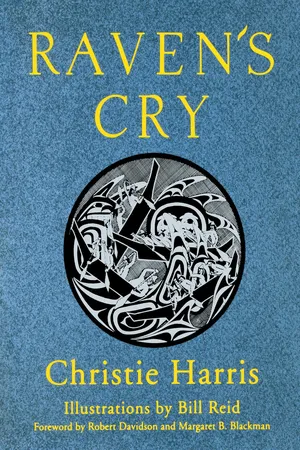
Raven's Cry is a Northwest Coast classic -- a moving and powerful work that is a fictionalized retelling of the near destruction of the Haida nation. The Haida are a proud and cultured people, whose home is Haida Gwaii (the Queen Charlotte Islands) off the coast of northern British Columbia. Until the first Europeans arrived in 1775, the Haida were the lords of the coast. The meeting of cultures was a fateful one: the Europeans had the advantages of firearms and immunity to their own deadly diseases. In just 150 years, the Haida and their culture were pushed to the edge of extinction. Christie Harris recreates this tale of tragedy and the ultimate survival of native spirit with dignity, beauty and ethnographic accuracy.
- 196 pages
- English
- ePUB (mobile friendly)
- Available on iOS & Android
eBook - ePub
Raven's Cry
About this book
Information
Topic
Ciencias socialesSubtopic
Estudios de nativos americanosEIGHT
LATER, CHIEF 7IDANSUU MENTIONED THE GOLD RUSH CITY of Victoria to his heir. “If I had obeyed the governor,” he said ruefully, “perhaps . . .” His voice died away in anguish.
“Native chiefs can’t obey a foreign intruder,” Da•axiigang protested. “We can’t acknowledge his right to command us.”
“Unless we give him that right. I’ve been thinking,” said Chief 7idansuu. “The governor has a feeling heart. And there’s native blood in his family. Even his name is one honored in our lineage. I think, if he had more power, he’d stand up to the whisky traders.” He gazed long and silently at the sea. “So I’ve decided to give him more power among the chiefs.”
To do this, Chief 7idansuu went south to Victoria. He talked earnestly about smallpox, whisky traders, native lands, and other matters of vital, mutual interest. Then he presented many gifts to make the governor wealthier and more important in native eyes.
“And now I’ll raise a pole to him,” he announced on his return to the village. “He’s the best Iron Man I ever met.”
Unfortunately, Governor Douglas retired that year, though not before making a strong case for generous treatment of native people, or before setting aside many reserves. The queen had honored him with a knighthood.
The Haida honored him with a more unique tribute, a totem pole. Since Sir James Douglas appeared to own no personal crests, however, the Haida had to do what they could. They decided that his identifying symbol was his top hat; and 7idansuu contented himself with carving a lifelike figure of the ex-governor in frock coat and top hat at the top of a bare cedar pole.
He raised it with ceremony. And his people, caught up in this ancient ceremony of pole-raising, cheered as the Haida had always cheered. Their numbness was passing at last. The old cycle of springtime and geese, summer and wild roses, autumn and the salmon runs, winter and winter gales, was healing shattered spirits.

Da•axiigang did more for his people than he knew. When they saw his eager face glowing above some exquisite new slate pole, they found their fears lifting like sea mists in the morning sun. They knew in their hearts that their totem poles were not evil. They wanted only to dismiss the catastrophe from their minds, and to live as they had always lived. Old customs were as reassuring as the old, reliable rhythm of the seasons.
Only men like Chief 7idansuu recognized the shallowness of the reassurance. The pride of the Haida had been broken. A baffling sense of shame was rotting the foundations of their very life.
As soon as the raven cried each morning, they were up and busy, repairing their lives. They harvested the sea and the seashore and the berry swamps and the forest. They chipped, chipped, chipped at fragrant cedars to shape canoes for the trade.
But there was an emptiness.
Some men filled the emptiness with ambition. Many chieftainships were now vacant; great names waited for new wearers.
“We’re all descended from Copper Woman,” ambitious Eagles pointed out.
“And we’re all descended from Foam Woman,” ambitious Ravens noted.
Any man in the proper family could claim one of its chieftainships or its famous names. He could make his claim valid only by public acceptance of it at a potlatch. If he could become wealthy enough to give a potlatch; if people would accept his gifts, and so his claim, at that potlatch; if he could pay for the carving and the raising of a pole bearing the crests he now laid claim to, he could become a noble.
Ambition proved as infectious as smallpox had been. Men in some families other than the tightly controlled Sdast’a•aas families even sold wives and daughters into a life of shame in the gold camps to get wealth for their potlatches; ambitious women offered to go. Contenders served whisky at their feasts to lure the witnesses they needed.
All along the northwest coast of North America, competing totem poles rose higher and higher in the villages. After the horror of the epidemic, and perhaps in violent reaction to it, came the tragedy of the golden age of totem poles. Crest poles towered against the sky, no longer a reverent tribute to the past. Sea captains reported that native villages looked from a distance like harbors crowded with ships’ masts.
True chief were dismayed at this ruinous greed for prestige. They hastened to strengthen their own ancient, honored bloodlines.
Sdast’a•aas Eagles and Kaigani Ravens consulted. The survival of the highest lineages outweighed all other considerations, certainly those of age. So arrangements were made for the marriage of Sun-Lak-Kwee-Kun. It was agreed that as soon as she emerged from the ceremonial seclusion of girlhood into the dignity of young womanhood, she would become the young, second wife of Chief 7idansuu. The younger orphaned Raven princess would be publicly proclaimed their daughter at the marriage potlatch. Then she would marry Da•axiigang when she came of age.
The pageant of a Haida state wedding took place at Kaigani in the autumn of 1870. A fleet of Sdast’a•aas canoes went to Alaska to bring their new young chieftainess home to Haida Gwaii. And 7idansuu’s first wife (whose concern for their mutual Raven lineage also outweighed other considerations) folded two richly cloaked orphans to her heart. She accepted them both, like daughters. And Gu•uu, now a handsome Raven chieftain, welcomed them affectionately into the close family circle.
To 7idansuu’s twelve personal slaves were now added Sun-Lak-Kwee-Kun’s ten slaves. To his store of household goods were added the wedding gifts of the delighted Kaigani. The house at Kung was warmed with blazing fires and stories and laughter. Flickering light glinted on the lovely young chieftainess’s gold earrings and bracelets and anklets, all engraved with her favorite Killer Whale crest.
Though she was merry on occasion, and though she clung wistfully to her “daughter” in private, her public decorum began to match the name that meant Most Serene Highness. And in her presence, the brash nouveaux riches of other clans fumbled with awkwardness. She began to be the force that strong women tend to become in a matrilineal social order.
All of this added to Chief 7idansuu’s power to control his people for their own salvation. While other villages began to be dubbed “towns of sick women and totem poles,” his was called “the hope of the Haida race” by the few outsiders who cared at all.
The native population was decreasing steadily now, year after year.
The government appointed a commissioner to administer the affairs of a dying race. All the land belonged to the queen, this commissioner informed the native people; but the government would give them sufficient lands for their use.
The native chiefs protested with dignity, vigor, and logic.
“What we don’t like about the government is their saying this, ‘We will give you this much land,’ ” they protested. “How can they give it when it is our own? We cannot understand it. They have never bought it from us or our forefathers. They have never fought and conquered our people and taken the land that way, and yet they say now they will give us so much land—our own land!”
The logic was unanswerable, so the government did not bother to answer.
Isolated by the wild sea, though, the Haida could assert more independence than other nations along the coast. Chief 7idansuu could devote himself mainly to domestic problems.
Town Chief 7wii•aa too had survived the epidemic, as had his relative Siigee, a spirited and highborn Raven chief, who was old Town Chief Siigee’s nephew.
“Young Siigee is my hope at Massett,” 7idansuu confided to Sun-Lak-Kwee-Kun. “We must have peace in Haida Gwaii. We can’t afford to hurt one another.”
Young Chief Siigee surged with the old spirit of the sea rover, with the old Haida joy in the ocean. He followed the now sparse and wary sea otter and seal far off to the west. He slept happily on the wide Pacific, and then roved even farther west. He had the steadiness to shoot a seal when he and his target were both heaving in a rough sea.
“He heartens all the young men,” 7idansuu observed. “He gives them back their Haida pride. And he laughs away the fears of the women.”
Massett was increasingly important. With its famous stand of red cedars at the head of Massett Inlet, the village was becoming “the shipyard of the north.” And with its central position on the north coast of Haida Gwaii, it was drawing in the huddled remnants of neighboring villages.
Similarly, Skidegate was central on the east coast. And with its monopoly of slate—Skidegate owned the only known deposit of argillite on the coast—it was becoming the headquarters of the curio trade. It, too, was drawing in lonely remnants.
Only Massett and Skidegate would survive. People remembered this on dark, lonely nights. More and more they saw Kwanduhadgaa’s vision coming true.
“Maybe we should move to Massett,” people whispered even at Kung.
Early in the year of 1876, a ceremonial Massett messenger arrived at Kung. Town Chief 7wii•aa, he said, wished to scatter the eagle-down at a feast he would give in honor of the illustrious head chief of the Sdast’a•aas Eagles.
This is Siigee’s doing! Chief 7idansuu thought gratefully.
The feast was set for the first blooming of the wild roses, the messenger said. Then the canoe-traders would have returned from Fort Simpson, and the clam-diggers would be back from the beaches.
Gu•uu narrowed his eyes with suspicion at this invitation. “Once before, an old Haida enemy was invited to a dance of peace in 7wii•aa’s house,” he pointed out.
It had been a long, long time before, with another 7wii•aa. And each visitor had arrived only to have his head lopped off as he entered through the hole in the portal pole. A supposed shout of welcome had drowned out the sound of each successive murder.
“We have nothing to fear from this 7wii•aa,” Gu•uu’s father assured him. “This peace dance is Siigee’s doing. And I’m happy to go.”
His happiness was short lived. Massett canoe-makers had not even left yet for Fort Simpson when Siigee was caught in a squall off Rose Spit. He and his shipwrecked crew managed to struggle ashore through the terrible surf. They managed to drag themselves up the beach ahead of the oncoming tide. But they had been too long in the numbing water.
Sickness struck at Siigee’s lungs. And though the medicine man worked over him with charms and incantations, he became desperately ill. His sunken eyes burned; his cheeks flamed with fever; he coughed incessantly.
“This is the Iron Man’s sickness,” his anxious young wife said, recognizing the consumptive symptoms now so prevalent in native villages. “Maybe we should send for the Iron Man’s sorcerer.” Being a Tsimshian from the mainland, she knew of the medical work of the missionaries.
Chief 7wii•aa was reluctant to offend his own medicine man by bringing in a foreign sorcerer.
“Then I’ll send for him myself,” Siigee’s wife told several people. And she se...
Table of contents
- Cover
- Half title
- Title
- Copyright
- Dedication
- Foreword
- Preface
- Before You Start The Story
- One
- Two
- Three
- Four
- Five
- Six
- Seven
- Eight
- Nine
- Ten
- Glossary
Trusted by 375,005 students
Access to over 1.5 million titles for a fair monthly price.
Study more efficiently using our study tools.
Frequently asked questions
Yes, you can cancel anytime from the Subscription tab in your account settings on the Perlego website. Your subscription will stay active until the end of your current billing period. Learn how to cancel your subscription
No, books cannot be downloaded as external files, such as PDFs, for use outside of Perlego. However, you can download books within the Perlego app for offline reading on mobile or tablet. Learn how to download books offline
Perlego offers two plans: Essential and Complete
- Essential is ideal for learners and professionals who enjoy exploring a wide range of subjects. Access the Essential Library with 800,000+ trusted titles and best-sellers across business, personal growth, and the humanities. Includes unlimited reading time and Standard Read Aloud voice.
- Complete: Perfect for advanced learners and researchers needing full, unrestricted access. Unlock 1.5M+ books across hundreds of subjects, including academic and specialized titles. The Complete Plan also includes advanced features like Premium Read Aloud and Research Assistant.
We are an online textbook subscription service, where you can get access to an entire online library for less than the price of a single book per month. With over 1.5 million books across 990+ topics, we’ve got you covered! Learn about our mission
Look out for the read-aloud symbol on your next book to see if you can listen to it. The read-aloud tool reads text aloud for you, highlighting the text as it is being read. You can pause it, speed it up and slow it down. Learn more about Read Aloud
Yes! You can use the Perlego app on both iOS and Android devices to read anytime, anywhere — even offline. Perfect for commutes or when you’re on the go.
Please note we cannot support devices running on iOS 13 and Android 7 or earlier. Learn more about using the app
Please note we cannot support devices running on iOS 13 and Android 7 or earlier. Learn more about using the app
Yes, you can access Raven's Cry by Christie Harris,Bill Reid in PDF and/or ePUB format, as well as other popular books in Ciencias sociales & Estudios de nativos americanos. We have over 1.5 million books available in our catalogue for you to explore.