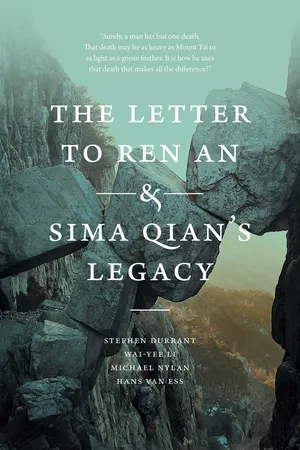
Sima Qian (first century BCE), the author of Record of the Historian (Shiji), is China's earliest and best-known historian, and his "Letter to Ren An" is the most famous letter in Chinese history. In the letter, Sima Qian explains his decision to finish his life's work, the first comprehensive history of China, instead of honorably committing suicide following his castration for "deceiving the emperor." In the twentieth and twenty-first centuries, some scholars have queried the authenticity of the letter. Is it a genuine piece of writing by Sima Qian or an early work of literary impersonation? The Letter to Ren An and Sima Qian's Legacy provides a full translation of the letter and uses different methods to explore issues in textual history. It also shows how ideas about friendship, loyalty, factionalism, and authorship encoded in the letter have far-reaching implications for the study of China.
eBook - ePub
The Letter to Ren An and Sima Qian's Legacy
- 190 pages
- English
- ePUB (mobile friendly)
- Available on iOS & Android
eBook - ePub
The Letter to Ren An and Sima Qian's Legacy
About this book
Information
CHAPTER 1
The Letter to Ren An
English Translation
THE DIRECTOR OF ARCHIVES SIMA QIAN, A MENIAL trudging ahead of the horse, repeatedly bows low in respect and speaks.1 Honorable Shaoqing, sometime ago you condescended to send a letter instructing me about my responsibilities to exercise due care when dealing with others and my duty to recommend worthy men and promote gentlemen for court service. While your intention was utterly sincere, it is as if you thought that I might not regard you as my teacher but would instead treat your words as the advice of the common run of men. I would not dare behave in such a way. Although but a broken-down nag, I have stood by and heeded my elders’ examples. Now, however, I consider my body ruined and debased. Whenever I act, I meet reproach. Those I would benefit, I only harm. “So it is I stifle my grief and have no one to speak to.”2 A proverb asks, “On whose behalf would you act? And who can be made to heed you?” After Zhongzi Qi died, Boya never again played the lute.3 Why is that? A gentleman will do his utmost for someone who appreciates him, just as a woman will adorn herself for someone who delights in her.4 But in cases like mine, when the body has been mutilated beyond repair, things are different: even if the person possesses the fine qualities of Sui’s pearl or He’s jade, and conducts himself as well as Xu You or Boyi, he can never achieve honor and glory. He would only provoke ridicule and besmirch himself.5
I should have answered your letter, but I was just at that time traveling toward the east with the emperor.6 And then I was pressed with inconsequential business so that there were but a few days when we could have seen each another. I was so busy that I did not have a single moment to express my feelings fully to you. But now, Shaoqing, you have been declared guilty of an unfathomably serious crime. The weeks and months are passing by, and soon it will be the final month of winter.7 I am once again compelled to accompany the emperor up to Yong and fear that suddenly the unspeakable might befall you. And were I ultimately unable to vent my frustration and resentment and make them known, then a spirit departing for the long journey would harbor boundless regret.8 So allow me to sketch out my crude thoughts, and please do not blame me for my prolonged failure to respond.
I have heard that self-cultivation is the storehouse of wisdom; magnanimity, the beginning of humaneness; discernment, the mark of dutifulness; shame, after disgrace the decisive factor in courage; and the desire to leave a good name, the ultimate wellspring of good behavior.9 Only after a gentleman possesses these five virtues can he be commended to his generation and listed in the ranks of the truly noble. Thus, no disaster is more hateful than that springing from coveting advantage;10 no sorrow more painful than a shattered spirit; no action more repugnant than dishonoring one’s forebears; and no infamy greater than suffering castration. A man left a remnant from a mutilating punishment counts for nothing in others’ estimation. Not only in one era has this been so. This has always been the case.
In times past, when Lord Ling of Wei shared a chariot with Yong Qu, Confucius left for Chen.11 When Shang Yang relied on the Eunuch Jing to win an audience with the Qin ruler, Zhao Liang’s heart froze.12 And when the Han emperor had Zhao Tong ride with him in his carriage, Yuan Si turned red with anger and dismay.13 From antiquity, then, to consort with eunuchs has been a source of shame. Even a man of mediocre talent will always risk real damage to his qi when he comes into contact with a eunuch in the course of his business.14 How much more so a gentleman with soaring aspirations! The court may currently lack the right sort of men, but why do you think it would allow a remnant of knife and saw to recommend men of distinction in the empire?
Thanks to my father’s position, I have managed to serve for more than twenty years at the foot of the emperor’s chariot, always awaiting punishment for my crimes.15 From this I have learned some things about myself: First, I have been unable to demonstrate my loyal service or prove my trustworthiness, nor have I gained a reputation as a fine talent and hard worker such as would bind our illustrious ruler to me. Second, I have been unable to remedy deficiencies in the administration, making sure that the summonses duly go out to worthy men to take up office and that those living in reclusion become famous. As for external threats, I have failed to serve in the military ranks. I have captured no forts and fought on no field. I have gained no merit for beheading enemy generals and seizing enemy flags. Finally, I have not been able to exert every effort and accumulate achievements, to obtain high office and an exalted position, so as to bring glory and imperial favor to my family and those I am in contact with.16 I have not succeeded in any one of these four endeavors. It should be obvious that in simply conforming to the expectations of others and seeking their approval, I have not been of the slightest utility to the court.17
In the past, I was regularly placed among the lower officers who participate in minor deliberations in the outer court. I did not make use of that time to elicit a master plan for governing or to offer my best thinking. Today, with my ruined body, I am fit only to be a servant who sweeps and cleans, dwelling among the most despised. Were I now to lecture others about rights and wrongs in an arrogant fashion, would that not insult the court and shame the gentlemen of our age? Alas! Alas! For one like me, what is there still to say? What is there still to say?
Moreover, the course of events is not easy to explain. As a youth my behavior was unrestrained; as I grew up, I won no fine name in my hometown. Fortunately for me, our ruler, on account of my deceased father, ordered me to offer my meager skills to the court and gave me leave to come and go in the royal presence.18 But how can someone with a basin on his head ever look up to Heaven?19 So I cut myself off from the recognition of associates and ignored my duties to my family. Day and night I wore myself out thinking how best to use every meager talent that I have in service; I strove to devote myself wholeheartedly to my official duties, the better to draw close to our ruler20 and gain his favor. But in the course of acting so, I made a big mistake, and it was not to be.
Now, Li Ling and I had served together in the palace, but we were never on particularly close terms.21 As our inclinations ran along different paths, we had neither shared a single cup of wine nor formed a lively friendship. Observing his behavior, however, I considered him to be a gentleman of unusual ability. He was filial in serving his parents, trustworthy in dealings with peers, incorruptible in handling money, fair in giving and taking, deferential in maintaining the proper hierarchies, and attentive and modest in yielding to others. He always considered how best to meet any emergency that besets the ruling house, with no concern for his personal safety. In view of all his previous accomplishments, I deemed him a gentleman of quality fully able to serve the realm. For it is truly remarkable when a subject resolves to go out to face ten thousand deaths without the slightest regard for his own life or rushes forward to help out in any disaster that befalls the realm! But now, in the course of discharging his duties, he made one mistake, and court officials, who thought only of saving their skins and preserving their wives and children, stepped forward to exaggerate his shortcomings! This truly made me sick at heart!
Moreover, Li Ling led fewer than five thousand foot soldiers and marched deep into the lands defended by nomads on horseback. He and his men reached all the way to the Khan’s court, dangling bait in the tiger’s mouth and boldly challenging those invincible Xiongnu. Facing tens of thousands of enemy troops,22 they engaged the Khan’s men in battle for over ten days, killing more than the number of troops in their own army. The enemy had no time to rescue the dying and succor the wounded; their leaders, dressed in their felts and furs, all quaked with fear. As a result, the Khan summoned his Worthy Kings of Right and Left.23 He enlisted anyone who could draw a bow and had his entire nation join in the attack and surround Li Ling’s troops. Li Ling’s army pushed for more than three hundred miles, fighting skirmishes every step of the way, until their arrows were gone and the road blocked. No rescue forces arrived, and the dead and wounded piled up.24 Even so, when Li Ling gave a call to rally his troops, each and every soldier rose up. With their faces covered in tears and awash with blood, their ranks advanced, thrusting forward their empty wooden bows to meet the enemies’ shining metal blades, even as they choked back their sobs. They then turned north to continue the struggle to the death against the enemy. Before Li Ling had fallen into captivity, his messenger came to the Han court to report this, and all the court officers and princes raised their goblets to toast His Majesty’s health.
A few days later there came word of Li Ling’s defeat. Because of this news, our ruler could no longer savor his food or enjoy granting audiences. The high-ranking ministers, in their grief and fear, did not know what to do. When I observed the emperor so distraught and downcast, I really wanted to help him by giving him sincere advice, however stupid. In doing so, I failed to take into account my low status. Considering that Li Ling had always denied himself the best foods so that he might share them with his fellow officers, it was no mere coincidence that he had been able to get his men to fight to the death.25 Even the most famous generals of ancient times could not surpass him in this regard. No matter that he had suffered defeat, one should ponder his intentions26 and, moreover, credit him with the desire to find the right way to repay the Han.27 His situation had left him with no options, yet his merit, considering the enemy troops he smote, should have sufficed to win him fame throughout the empire. I harbored a wish to explain all of this, but I found no way to do so. Just at that point, I was summoned into the imperial presence on a question, and I took the opportunity to speak of Li Ling’s achievements in these very terms, hoping thereby to broaden the ruler’s understanding of the situation and block the resentful criticisms. I somehow could not fully explain what I meant, and our illustrious ruler did not entirely understand. He thought that I was slandering the Ershi General, Li Guangli, while making clever excuses for Li Ling, so I was sent down, a condemned man, to the judges. For all my sincere and steadfast loyalty, I ultimately could not give a good account of my actions. In consequence, I was found guilty of deceiving the emperor, and finally the judges’ decision was upheld.28
My family, being poor, had insufficient funds to purchase remission of my crime.29 None of my acquaintances offered to save me, and none of my close associates put in a single word on my behalf.30 A body is not made of wood or stone! With only the officers of the law for company, I was kept in confinement deep within the prison walls. To whom could I voice my grievances? This is something that you, Shaoqing, have seen for yourself. Were my actions not as I have written? Once Li Ling had surrendered, and thus ruined his family’s good name, I, too, was thrust into the Silkworm Chamber,31 becoming irrevocably the laughingstock of the empire.32 So tragic! So very tragic! It is not easy to explain this sequence of events to vulgar men.
My late father’s merit was not on a par with those dignitaries with broken tallies or vermillion prescripts.33 Men of letters, archivists, astronomers, and calendrical experts34 are classed with the diviners and invocators. In fact, these men the ruler toys with and patronizes in ...
Table of contents
- Cover
- Title Page
- Copyright
- Dedication
- Contents
- Acknowledgments
- Han Dynasty Emperors
- Introduction
- Chapter 1 The Letter to Ren An: English Translation
- Chapter 2 Seeking Answers, Finding More Questions
- Chapter 3 Dissent against Emperor Wu of the Han
- Chapter 4 Friendship and Other Tropes in the Letter to Ren An
- Chapter 5 The Letter to Ren An and Authorship in the Chinese Tradition
- Appendix: The Letter to Ren An: Chinese Text
- Notes
- Glossary of Chinese Characters
- Suggested Readings
- Bibliography
- Index
Trusted by 375,005 students
Access to over 1.5 million titles for a fair monthly price.
Study more efficiently using our study tools.
Frequently asked questions
Yes, you can cancel anytime from the Subscription tab in your account settings on the Perlego website. Your subscription will stay active until the end of your current billing period. Learn how to cancel your subscription
No, books cannot be downloaded as external files, such as PDFs, for use outside of Perlego. However, you can download books within the Perlego app for offline reading on mobile or tablet. Learn how to download books offline
Perlego offers two plans: Essential and Complete
- Essential is ideal for learners and professionals who enjoy exploring a wide range of subjects. Access the Essential Library with 800,000+ trusted titles and best-sellers across business, personal growth, and the humanities. Includes unlimited reading time and Standard Read Aloud voice.
- Complete: Perfect for advanced learners and researchers needing full, unrestricted access. Unlock 1.5M+ books across hundreds of subjects, including academic and specialized titles. The Complete Plan also includes advanced features like Premium Read Aloud and Research Assistant.
We are an online textbook subscription service, where you can get access to an entire online library for less than the price of a single book per month. With over 1.5 million books across 990+ topics, we’ve got you covered! Learn about our mission
Look out for the read-aloud symbol on your next book to see if you can listen to it. The read-aloud tool reads text aloud for you, highlighting the text as it is being read. You can pause it, speed it up and slow it down. Learn more about Read Aloud
Yes! You can use the Perlego app on both iOS and Android devices to read anytime, anywhere — even offline. Perfect for commutes or when you’re on the go.
Please note we cannot support devices running on iOS 13 and Android 7 or earlier. Learn more about using the app
Please note we cannot support devices running on iOS 13 and Android 7 or earlier. Learn more about using the app
Yes, you can access The Letter to Ren An and Sima Qian's Legacy by Stephen Durrant,Wai-yee Li,Michael Nylan,Hans van Ess in PDF and/or ePUB format, as well as other popular books in History & Chinese History. We have over 1.5 million books available in our catalogue for you to explore.