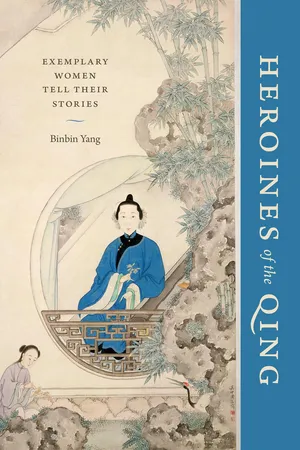
Heroines of the Qing introduces an array of Chinese women from the eighteenth and nineteenth centuries who were powerful, active subjects of their own lives and who wrote themselves as the heroines of their exemplary stories. Traditionally, "exemplary women" ( lienu )—heroic martyrs, chaste widows, and faithful maidens, for example—were written into official dynastic histories for their unrelenting adherence to female virtue by Confucian family standards. However, despite the rich writing traditions about these women, their lives were often distorted by moral and cultural agendas. Binbin Yang, drawing on interdisciplinary sources, shows how they were able to cross boundaries that were typically closed to women—boundaries not only of gender, but also of knowledge, economic power, political engagement, and ritual and cultural authority. Yang closely examines the rhetorical strategies these "exemplary women" exploited for self-representation in various writing genres and highlights their skillful negotiation with, and appropriation of, the values of female exemplarity for self-empowerment.
- 248 pages
- English
- ePUB (mobile friendly)
- Available on iOS & Android
eBook - ePub
About this book
Information
CHAPTER 1
Breaking the Silence
Cases of Outspoken Exemplary Women
Implicit in the concept of “poetry as the expression of one’s intent” was the Chinese poetics that privileged spontaneity and unmediated self-expression of the poet, which in turn generated the basic assumption in premodern Chinese literary criticism of an integral relationship between the poet’s inner life and his or her poetic works. Recent scholarship, however, has pointed out that Tao Qian (365–427; also known as Tao Yuanming), for example, consciously manipulated his reader’s reaction and constructed a self he desired his reader to see. The very fact that the poet took care to emphasize spontaneity at every stage of his composition reveals his awareness of and self-conscious defense against readers’ suspicion of his double self.1 Tao Qian’s obsessive attention to spontaneity may be seen as an example of the tension between reality and fiction in autobiographical writing.2
The result of growing tendencies from the ninth century on for a poet’s works to be organized in chronological order and edited by the poet himself was a form of “interior history” constructed by editorial choices and arrangements.3 This concern with individual interior history spawned the genre of chronological biography (nianpu)—the chronological ordering of notes for an individual’s life that could help his or her contemporaries write biographies beyond the usual eulogizing narratives in official historical writing.4 For the purpose of this study, it is the nature of a poet’s personal collection as interior history—carefully organized and edited for the reader to see—that also makes a woman’s collection of poetry a useful source of her autobiographical writings. The woman poet and critic Shen Shanbao (1808–62), for example, used her poetry collection to construct a life story and took control of the reading process through the strategy of “self-censorship,” which helped to create a consistent textual subject as a filial daughter and a dedicated young poet.5 Gan Lirou (1743–1819) organized her poetry collection by explicitly tracing her progression through the life phases of womanhood and, by this means, wrote herself into family and social histories.6 Women poets like Shen and Gan could assume literary identities in their writing that transcended their kinship roles, such as travelers, critics, and artists.7
The purpose of this chapter is to explore how women established themselves as exemplars of female virtue defined precisely by their kinship roles while articulating in the most poignant terms their uneasy relationship with these normative roles. The cases I discuss reveal stunning outspokenness, manifest either in the authors’ efforts to foreground their dilemmas and sacrifices or, oftentimes, in their expression of such “negative” emotions as anger, frustration, anxiety, bitterness, and despair. Of note are rhetorical strategies with which they mediated their expression of emotions and told their extraordinary life stories as the exemplary mother, wife, and daughter-in-law.
LIU YIN (1806–1832): THE FIRST WIFE ADOPTING THE VOICE OF THE SECOND WIFE
Liu Yin was known as Filial Woman Liu (or, more precisely, Filial Daughter-in-Law Liu) from the county of Wujin, Jiangsu. She was lauded primarily for her devoted care of her severely ill mother-in-law, which led to her own exhaustion, illness, and finally death at the age of twenty-seven.8 Around fourteen years after her death, her husband Miao Zhengjia (?–1846), also a poet, gathered the poetry drafts she left and obtained funds to have them printed in 1846 as her personal collection, Remaining Drafts from the Dreaming-of-the-Moon Tower (Mengchanlou yigao).9
Like many personal collections of works by exemplary women, the main body of Liu Yin’s collection is accompanied by a large number of eulogizing texts: three prefaces, two biographies, inscriptions (thirty-seven poems by twenty-six persons, including nineteen local literati, six gentry women, and a nun), two epilogues, and an introduction, all bent on creating a hagiographic profile.10 These texts show that Liu Yin demonstrated a wide range of exemplary behaviors in addition to that of filial piety. When she was young she was said to have admired the character of her grandfather Liu Shuchu (fl. eighteenth century), who was recorded in the local gazetteer for his filial behavior.11 When dissidence arose in her family regarding her engagement to Miao Zhengjia (whom her grandfather chose to be her fiancé, though another relative tried to persuade her to marry into an affluent household), she composed a verse to express her disdain of wealth and her insistence on fulfilling her engagement despite the destitution of the Miao family, modeling herself upon the celebrated Han dynasty exemplary wife Meng Guang.12 After her marriage to Miao, she took on all the household duties and served her mother-in-law and grand-mother-in-law respectfully, calmly, and happily despite hardships. In order to help the Miao family through financial straits, she wove late into the night and pawned her dowry to pay for the debts of her father-in-law, who stayed in Guangxi for a long time to avoid creditors, in the hope that he could come home.13 When her parents tried to persuade her to stay in her natal home after the funeral of her grand-father (so she could have more comforts), she firmly declined. She capably took care of the household while Miao traveled to attend civil service exams and to take teaching jobs in gentry families, and never troubled him with difficulties at home.14 She urged him to glorify his family name, comforted him when he was in distress, and admonished him when he could not restrain his temper. Miao was unable to establish a career; his friend Gu Huaisan (fl. nineteenth century), a historian, glossed over his frustration by comparing him to Qu Yuan (ca. 339–278 BCE).15 Liu also dedicated herself to the care of her children. When her first son died, she herself nearly died of grief and disease. After her second son survived malaria, she was emaciated. Throughout this quite standard language extolling Liu’s exemplarity, the enormous load of work put on her—and her alone—by this destitute family is evident. Her service to her ill mother-in-law was only the last on this long list of household duties that were sapping all her energy. In the words of Miao, she was “like a tree that was long withering from inside and therefore collapsed at the first gust of wind.”16
What these texts share is their emphasis on Liu’s unfailing efforts to control her emotions—namely, her perseverance through ordeals without complaining. Liu was not “emotionless,” yet when she expressed emotions, this only enhanced her exemplary profile. As an affectionate wife, she was said to “find harmonious delight” in the time she spent with Miao even when they had little to live on; as a loving mother, she was heartbroken at the death of her first son, shedding tears and blood in turn; as a filial daughter-in-law, she worried that her second son’s malaria would grieve her mother-in-law, so she held him in her arms day and night to care for him.17 On the other hand, Liu was also represented as knowing exactly when to check her emotions. She held back tears when Miao once again failed the civil service exam, and comforted him with just the proper words.18 When she herself was dangerously ill, she was able to “make all efforts to act as if she had been completely well” so she could care for her ill mother-in-law. Even days before her death, she urged Miao to return to his job, smiling and speaking normally as she saw him off.19 In short, Liu’s exemplarity lies in her perfect management of the balance between the expression and the suppression of her emotions according to appropriate rites.20 Thus did Zhang Wenhu (1808–85), the author of one of the prefaces to Liu’s collection, characterize Liu’s poetry: “It carries a forlorn tune, yet its character can be compared to that of the pine that stands prominently on the height of ten thousand feet and that undergoes frost and snow without withering.”21
One is tempted nonetheless to wonder whether Liu herself might tell the story differently. Would the writings of this woman crushed by her household duties tell of moments when she lost the perfect balance, either between the expression and the suppression of her emotions or between the sorrow and the “character” of her poetry? Would she never reveal anxieties, frustrations, or pain that did not have the positive effect of highlighting her exemplary profile?
Liu was not a prolific poet. Yet, given her overwhelming workload, the fact that she found time to write poetry at all surprised some of the authors of the eulogies,22 and may suggest the importance of poetry for her as a vehicle of self-expression. In fact, even a cursory look at the thin volume that Liu left (sixty-eight poems in total, only around half of which were composed after she was married) reminds us how useful it is to approach the lives of exemplary women the other way around, that is, by examining how they represented themselves rather than how they were represented.23 Liu’s poems about extreme cold, illnesses in her family, and the hardships of life in general are in shocking contrast to what Miao refers to as the total absence of hunger, cold, illness, and pain in her letters to him.24 What she was said to endure calm...
Table of contents
- Cover
- Title Page
- Copyright
- Dedication
- Contents
- Acknowledgments
- Note to Readers
- Introduction
- 1. Breaking the Silence: Cases of Outspoken Exemplary Women
- 2. Visualizing Exemplarity: Women’s Portraits and Paintings for Self-Representation
- 3. Staging Family Drama: Genealogical Writing as Ritual Authority
- 4. Enacting Guardians of Family Health: From Exemplary Wife to Reformer
- Conclusion
- Chinese Character Glossary
- Notes
- Bibliography
- Index
Trusted by 375,005 students
Access to over 1.5 million titles for a fair monthly price.
Study more efficiently using our study tools.
Frequently asked questions
Yes, you can cancel anytime from the Subscription tab in your account settings on the Perlego website. Your subscription will stay active until the end of your current billing period. Learn how to cancel your subscription
No, books cannot be downloaded as external files, such as PDFs, for use outside of Perlego. However, you can download books within the Perlego app for offline reading on mobile or tablet. Learn how to download books offline
Perlego offers two plans: Essential and Complete
- Essential is ideal for learners and professionals who enjoy exploring a wide range of subjects. Access the Essential Library with 800,000+ trusted titles and best-sellers across business, personal growth, and the humanities. Includes unlimited reading time and Standard Read Aloud voice.
- Complete: Perfect for advanced learners and researchers needing full, unrestricted access. Unlock 1.5M+ books across hundreds of subjects, including academic and specialized titles. The Complete Plan also includes advanced features like Premium Read Aloud and Research Assistant.
We are an online textbook subscription service, where you can get access to an entire online library for less than the price of a single book per month. With over 1.5 million books across 990+ topics, we’ve got you covered! Learn about our mission
Look out for the read-aloud symbol on your next book to see if you can listen to it. The read-aloud tool reads text aloud for you, highlighting the text as it is being read. You can pause it, speed it up and slow it down. Learn more about Read Aloud
Yes! You can use the Perlego app on both iOS and Android devices to read anytime, anywhere — even offline. Perfect for commutes or when you’re on the go.
Please note we cannot support devices running on iOS 13 and Android 7 or earlier. Learn more about using the app
Please note we cannot support devices running on iOS 13 and Android 7 or earlier. Learn more about using the app
Yes, you can access Heroines of the Qing by Binbin Yang in PDF and/or ePUB format, as well as other popular books in History & Chinese History. We have over 1.5 million books available in our catalogue for you to explore.