This collection provides new ways to understand how state power was exercised during the overlapping Liao, Song, Jin, and Yuan dynasties. Through a set of case studies, State Power in China, 900-1325 examines large questions concerning dynastic legitimacy, factional strife, the relationship between the literati and the state, and the value of centralization. How was state power exercised? Why did factional strife periodically become ferocious? Which problems did reformers seek to address? Could subordinate groups resist the state? How did politics shape the sources that survive? The nine essays in this volume explore key elements of state power, ranging from armies, taxes, and imperial patronage to factional struggles, officials' personal networks, and ways to secure control of conquered territory. Drawing on new sources, research methods, and historical perspectives, the contributors illuminate the institutional side of state power while confronting evidence of instability and change—of ways to gain, lose, or exercise power.
eBook - ePub
State Power in China, 900-1325
- 372 pages
- English
- ePUB (mobile friendly)
- Available on iOS & Android
eBook - ePub
State Power in China, 900-1325
About this book
Information
Topic
HistoriaSubtopic
Historia de ChinaPART 1
The Ruling House
1 Invoking Higher Authorities
Song Taizong’s Quest for Imperial Legitimacy and Its Architectural Legacy
TRACY MILLER
IN 989, TAIZONG SAW THE COMPLETION OF THE KAIBAO MONAStery Śarīra Pagoda (Kaibaosi Shelita) in the imperial capital at Kaifeng.1 Rather than employing the same craftsmen as Taizu (r. 960–976), the first emperor of the Song who made over the palaces in the manner of those at the Western Capital of Luoyang, Taizong (r. 976–997) selected Yu Hao, a famous builder from the newly acquired Wuyue kingdom, to construct his towering Buddhist edifice. This act was not a simple expression of conquest. Instead, it was one element of Taizong’s larger program to create a new identity distinct from that of his brother Taizu, who was known for his martial skills and fondness for Yellow River Valley aesthetics. By visibly demonstrating the ability to marshal substantial material and human resources toward a single endeavor, monumental constructions had long been known to bolster a new ruler’s claim to imperial authority. However, not all emperors used the same types of constructions for this purpose.
The goal of this chapter is to investigate the implications of certain building projects for the legitimacy and personal power of the first two Song emperors. Their pattern of building patronage and ritual performance suggests that much of what characterizes Song visual culture more broadly emerged from competition between these sibling emperors. By employing Yu Hao to build the monumental Kaibao Monastery Pagoda in Kaifeng, Taizong sought to establish himself as the leader of a new realm, one that celebrated the future as much as it embraced the past. Arguably the most public aspect of Taizong’s cultural patronage, the structure served not only to distinguish Taizong from his brother, but also to appropriate the new cosmopolitanism of the Yangzi Delta and its potential as a source of economic, technological, and spiritual power to enhance his own political capital. The pagoda marked a turning point away from the aesthetics of cultural legitimacy employed by rulers of earlier Chinese empires, those centered in the traditional capitals of Chang’an and Luoyang. It was more than a reliquary; it was a “modern” tower employed to herald the coming of a new age.
THE TOWERING PAGODA AT KAIBAO MONASTERY
The Kaibao Monastery Pagoda is perhaps the most often discussed non-extant Buddhist pagoda in Chinese art history.2 In its prime, the building would have been something to behold. Located outside the northeast gate of the Inner City wall, or Old Fengqiu Gate (Jiu Fengqiu Men), the tower was enclosed in a separate Blessed Success Pagoda Cloister (Fusheng Tayuan), as one part of an expansive imperial Buddhist monastery named after the Kaibao reign period of Song Taizu (fig. 1.1).3 Prior to its destruction by fire in 1044, the Kaibao Monastery Pagoda was, according to Ouyang Xiu (1007–1072), the tallest in the capital and considered to be an incredible feat of architectural engineering.4 Although criticized by contemporaries as an example of excess, the same sources tell us the structure was unprecedented, “resplendent in gold and jade green” (jinbi yinghuang), and took more than eight years and hundreds of millions in cash (yiwan) to complete. According to Yang Yi (974–1020), Li Tao (1115–1184), and Zhi Pan (thirteenth century), the final structure was eleven stories tall, and all sources agree that the octagonal timber pagoda soared to 360 chi which, based on excavated Song-period carpenter’s squares, would be approximately 111.28 meters high.5 To give a sense of its height, the structure was roughly 43.97 meters taller than the extant Liao dynasty Fogong Monastery Sakyamuni Pagoda (Fogongsi Shijiata, commonly known as the Yingxian Muta, ca. 1056–95) which stands at 67.31 meters (fig. 1.2).
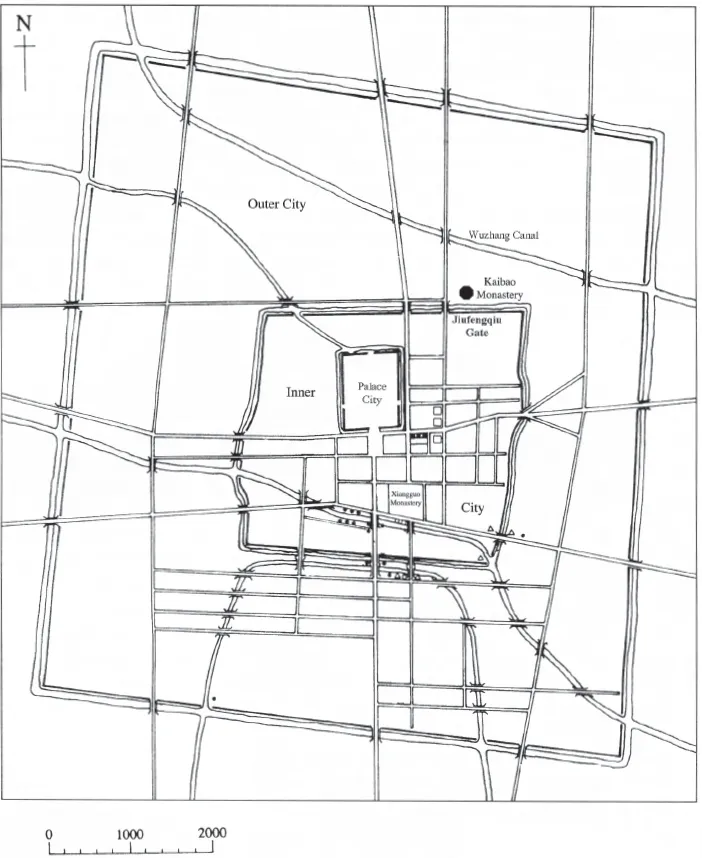
FIGURE 1.1. Kaifeng during the Song dynasty. Scale is in meters. Illustration based on Heng, Cities of Aristocrats and Bureaucrats, 153.
Perhaps because it was such an architectural wonder, we also know much about Yu Hao, the designer of the tower and the most renowned timber craftsman (duliaojiang) of Song China. One of the more detailed accounts of Yu Hao and his famous tower comes from the collected tales of Yang Yi, a favorite of Taizong’s who participated in the compilation of the Veritable Records of Taizong (Taizong shilu) and later coedited the Outstanding Models from the Storehouse of Literature (Cefu yuangui). Yang Yi started his court career as a precocious child who, in 984 at the age of eleven sui, was brought to the palace for a personal examination by Taizong and then retained in the Department of the Palace Library as a proofreader.6 Yang arrived at the capital shortly after the tower’s construction had begun. He would likely have had an opportunity to watch the process as both boy and tower grew to maturity. Yang wrote that Yu Hao was extremely skillful (jueqiao) and began his project by presenting a model to the court.7 Once on the job site, Yu Hao constructed each story secretly behind a curtain, carefully ensuring the stability of each before moving on to the next, so the structure could last 700 years without falling out of alignment (ci ke qibainian wu qingdong). Perhaps most famously, when questioned about the slightly higher northern side of the structure, he replied that he had taken environmental conditions into consideration: he claimed the northerly winds and damp ground (because of closeness to the Wuzhang canal) would have an effect on the building and it would, after a hundred years, become level.8
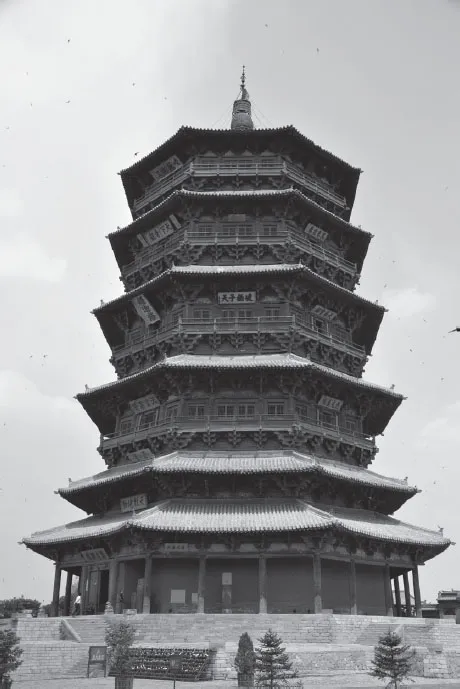
FIGURE 1.2. Śakyamuni Pagoda, Fogong Monastery, ca. 1056–1095, Yingxian, Shanxi. (Photo courtesy Scott Gilchrist.)
Yu Hao was known for more than his skillfulness, however. He was also known because he was from Hangzhou, or Qiantang, the capital of Wuyue. Taizong’s choice of Yu Hao may have helped to clarify the Wuyue origin of the relic so important to prove the authentic connection to King Aśoka (ca. 304–232 BCE), the most famous royal patron of Buddhism. The pagoda was constructed to house a smaller reliquary containing one of the nineteen “true” relics of the Buddha originally distributed to China by Aśoka. Taizong ordered this relic moved from the sacred interior (jinzhong) of its pagoda in the Wuyue capital after its ruler Qian Chu (or Qian Hongchu, r. 948–978) capitulated to the Song in 978, an event discussed below.9 It is important to note here, however, that knowledge of Wuyue architecture may have been deemed critical both to constructing a structurally sound tower of this size and to creating a spiritually effective container for the new relic.
Efficacy, both structural and spiritual, was proven in the ceremony to inter the relic after its completion. Yang Yi tells us that the emperor was carried to the temple in a palanquin to personally place the relic in the tiangong within the pagoda. A white light emitted from one corner, causing the emperor to shed tears. The pagoda, now fully charged, caused dozens of palace attendants who witnessed the miracle to decide to become monks.10 Was the structure worth the great expense of its construction purely as a symbol of political legitimacy? Or could Taizong and members of his court have believed it able to generate true spiritual power? To understand the potential of architecture to project political, cultural, and spiritual affinities it is helpful to review some examples from China’s early imperial period before turning to how this Buddhist tower’s construction contributed to the Song period shift in focus from center to coast, north to south.
ARCHITECTURE AS A TOOL FOR SPIRITUAL POWER
Large-scale building projects have long played an important role in projecting political power and legitimating claims to authority. At a minimum, monumental structures embody the ability to marshal the financial, material, and human resources necessary for their creation. Often their significance also has a substantial symbolic component, using style or magnitude to suggest alliances with, distinction from, or dominance over neighboring states and/or cultures.11 And if properly designed, at least some were believed to help actualize that power. Along with military unification and establishment of the imperial bureaucracy in premodern China, the building of highly visible structures was critical to solidifying the authority of a new regime. In the early imperial period, palaces, imperial capitals, and royal temples were the best-known building types used to display state power and acquisition of the Mandate of Heaven—the divine right to demand obedience of a newly conquered population.12 The “Zhongyong” section of the Book of Rites (Liji) describes one understanding of the purpose of rites to spirits only accessible to the emperor: “By the ceremonies of the border sacrifices (to Heaven and Earth), they served God, and by the ceremonies of the ancestral temple they sacrificed to their forefathers. If one understood the ceremonies of the border sacrifices, and the meaning of the sacrifices of the ancestral temple, it would be as easy for him to rule a state as to look into his palms.”13
Through knowledge and precise performance of the rituals at both open altars and temples, the emperor could manage the needs of the state. These rites show how emperors enlisted spirits commanding natural forces and those of the imperial ancestors to facilitate rulership through the enhanced perspective—one as easy as looking into the palm—afforded by their support.14
A very similar motivation lay behind the practice of Buddhism by both common and imperial devotees. Although the celibacy and (at least nominal) rejection of the patriline that accompanied Buddhist monastic life conflicted with indigenous cultural traditions, men and women in early medieval China left their families to join monastic communities in part because Buddhism promised the aspirant the potential to “harness the powers of the spirit world.”15 Using the imperial purse, emperors were able to display their own access to that power by building ever-taller Buddhist towers.16 For example, according to the History of the Southern Dynasties (Nan shi), in 472 Emperor Ming of the Liu-Song dynasty (r. 465–472), another “Song Taizong,” set out to build a taller pagoda than the seven-story one constructed by his older half-brother, the former Emperor Xiaowu (r. 454–464).17 Perhaps because of structural difficulties the planned ten-story pagoda in the new Xianggong Monastery would not stand, so instead he constructed two of five stories.18 Emperor Ming may also have been competing with the rival Northern Wei. In 467 Northern Wei Xianwendi (r. 465–471) constructed a seven-story pagoda at the Yongning Monastery in his capital...
Table of contents
- Cover
- Title Page
- Copyright
- Contents
- Acknowledgments
- Abbreviations Used in the Notes
- Introduction
- Part 1: The Ruling House
- Part 2: The Literati and the Political System
- Part 3: Statecraft Theory
- Part 4: State Power in Practice
- Glossary of Chinese Characters
- Contributors
- Index
Trusted by 375,005 students
Access to over 1.5 million titles for a fair monthly price.
Study more efficiently using our study tools.
Frequently asked questions
Yes, you can cancel anytime from the Subscription tab in your account settings on the Perlego website. Your subscription will stay active until the end of your current billing period. Learn how to cancel your subscription
No, books cannot be downloaded as external files, such as PDFs, for use outside of Perlego. However, you can download books within the Perlego app for offline reading on mobile or tablet. Learn how to download books offline
Perlego offers two plans: Essential and Complete
- Essential is ideal for learners and professionals who enjoy exploring a wide range of subjects. Access the Essential Library with 800,000+ trusted titles and best-sellers across business, personal growth, and the humanities. Includes unlimited reading time and Standard Read Aloud voice.
- Complete: Perfect for advanced learners and researchers needing full, unrestricted access. Unlock 1.5M+ books across hundreds of subjects, including academic and specialized titles. The Complete Plan also includes advanced features like Premium Read Aloud and Research Assistant.
We are an online textbook subscription service, where you can get access to an entire online library for less than the price of a single book per month. With over 1.5 million books across 990+ topics, we’ve got you covered! Learn about our mission
Look out for the read-aloud symbol on your next book to see if you can listen to it. The read-aloud tool reads text aloud for you, highlighting the text as it is being read. You can pause it, speed it up and slow it down. Learn more about Read Aloud
Yes! You can use the Perlego app on both iOS and Android devices to read anytime, anywhere — even offline. Perfect for commutes or when you’re on the go.
Please note we cannot support devices running on iOS 13 and Android 7 or earlier. Learn more about using the app
Please note we cannot support devices running on iOS 13 and Android 7 or earlier. Learn more about using the app
Yes, you can access State Power in China, 900-1325 by Patricia Buckley Ebrey, Paul Jakov Smith, Patricia Buckley Ebrey,Paul Jakov Smith in PDF and/or ePUB format, as well as other popular books in Historia & Historia de China. We have over 1.5 million books available in our catalogue for you to explore.