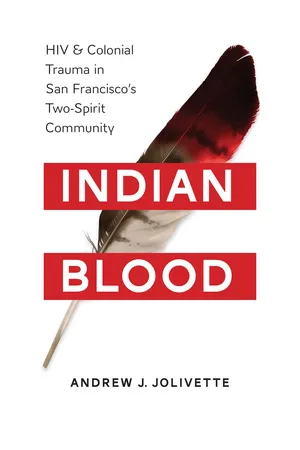
Finalist for the 2017 Lambda Literary "Lammy" Award in LGBTQ Studies The first book to examine the correlation between mixed-race identity and HIV/AIDS among Native American gay men and transgendered people, Indian Blood provides an analysis of the emerging and often contested LGBTQ "two-spirit" identification as it relates to public health and mixed-race identity. Prior to contact with European settlers, most Native American tribes held their two-spirit members in high esteem, even considering them spiritually advanced. However, after contact - and religious conversion - attitudes changed and social and cultural support networks were ruptured. This discrimination led to a breakdown in traditional values, beliefs, and practices, which in turn pushed many two-spirit members to participate in high-risk behaviors. The result is a disproportionate number of two-spirit members who currently test positive for HIV. Using surveys, focus groups, and community discussions to examine the experiences of HIV-positive members of San Francisco's two-spirit community, Indian Blood provides an innovative approach to understanding how colonization continues to affect American Indian communities and opens a series of crucial dialogues in the fields of Native American studies, public health, queer studies, and critical mixed-race studies.
eBook - ePub
Indian Blood
HIV and Colonial Trauma in San Francisco's Two-Spirit Community
- 176 pages
- English
- ePUB (mobile friendly)
- Available on iOS & Android
eBook - ePub
About this book
Information
CHAPTER 1
Indian Blood
Two-Spirit Return in the Face of Colonial Haunting
My elders told me life was once different before colonists came.
You see in that time we were once accepted and honored.
Then we were vanishing, but now we are coming
back to the ways of our ancestors.
You see in that time we were once accepted and honored.
Then we were vanishing, but now we are coming
back to the ways of our ancestors.
—Indian Blood focus group respondent
AS I RECALL MY INTRODUCTION INTO THE FIELD OF HIV/AIDS AND epidemiology, I remember the important words and research of my mentor Rafael Diaz, author of Latino Gay Men and HIV (1997), who wrote, “So many people when they disclose or talk about their HIV status say, ‘I’m HIV positive.’” Diaz points out that people with cancer don’t say, “I am cancer.” They say, “I have cancer.” Reframing how we think about HIV/AIDS can shift our well-being as marginalized communities within the capitalist bureaucracy of the public health care system in the United States.
In 2005, in a keynote address for World AIDS Day delivered at San Francisco State University, a mixed-race gay American Indian man stated:
HIV and AIDS is something that I have learned to live with. It’s also something that a part of me feels happened for a reason. I wasn’t sure if I should disclose my status in this way here today. I spoke with a colleague about it and he said, “How will disclosing impact you? Will it benefit you? Are you giving anything up?” I thought to myself: as a Native gay man of color, I have a responsibility to disclose. This is a very personal decision, but in Indigenous communities and in communities of color we lack faces to make this pandemic real. If you’ve never known someone living with AIDS, now you do. You know my story and in sharing it I hope that others will know that they can live with this. They can have a career, a family. They too can find love again. Over the past three years I have learned AIDS is not me. I am me. AIDS is only one other part of my life.
This man’s story is not uncommon. For American Indian people today, HIV/AIDS, gender, sexuality, and mixed-race identity intersect in complex and traumatic ways in the absence of the community support, cultural buffers, and stress-coping mechanisms needed to combat colonial oppression.
This is my story, too. I was the one who delivered that keynote talk. As I reflect back on the eleven years since I first delivered the speech and disclosed my HIV/AIDS positive status to my colleagues and students, a lot has happened. I think about the scars that living with HIV/AIDS may have left on my life. I think about the traumas that have existed in my communities for more than five centuries in the Americas. In 2002, when at the age of twenty-seven I received my AIDS diagnosis, I had thirty-five T-cells and a viral load of over five hundred thousand. I truly believed I was at the end of my life, but finding strength in my own vulnerabilities has allowed me to survive.
A few months after my release from the hospital, twenty-five pounds lighter and quite fragile, I went to a pipe ceremony and prayer meeting organized by friends with a medicine man, Daniel Freeland from the Navajo Nation. My endeavor to write this book, to share these stories, and to seek out a useful intervention for social and cultural reform stems from the words Dan spoke to me on that night so many years ago. He said, “You can’t think of yourself as sick. There are a lot of people out there in our communities who are going through the same thing that you are, and you can tell your story and you can help them to tell theirs, and in that way you can be a part of the process of mending the hoop that ties us all together. We don’t all get to tell our story, many have passed on.” He continued, “You have to begin to think about what healing means, what wellness means, and how there is all kinds of medicine out there. But the greatest medicine is your brother and your sister. You are your own healing.”
Dan’s words sum up my own articulation of the concept of radical love, a primary theme of this book. Socialization and stigmatization in the West create fractures and forces us to compartmentalize our lives, separating our health, our education, and our spirituality. Radical love seeks to bring all of these fragmented pieces back together. As a critical intervention, it asserts that without a process of mutual love, respect, and responsibility, we can never truly heal or achieve self-determination.
Although Cheng (2011) introduced the term radical love in theology and queer studies, it is a new theoretical concept in the context of American Indian studies. An Indigenous framing of radical love, as I define it, stems from a spiritual, cultural, and communal concern for the well-being of all other living things. Radical love in an Indigenous framework embraces all living things as relatives deserving of respect, nurturing, and care, which require in turn an emphasis on physical, spiritual, and emotional health. Radical love by necessity involves a sense of openness and vulnerability, both from community members and from researchers who practice in institutions of higher education.
I open with my own story because I believe in the practice of research justice as an extension of radical love. Research justice is about seeking solidarity with research participants. It is about working with—not on—research participants to weave a narrative, a set of life histories captured in one moment in time. Research justice is a strategic framework and methodological intervention intended to transform structural inequities in research. It insists on the centrality of community voices and leadership, in an effort to facilitate genuine, lasting social change and to foster critical engagement with communities of color, Indigenous peoples, and other marginalized groups. Research justice uses research as an empowering intervention and active disruption of the colonial policies and institutional practices that contribute to the (re)production of social inequalities in research and public policy. It is a ceremonial act that seeks to shift our focus from simple data gathering to relationship building, as a single community formed of scholars, cultural experts, and knowledge keepers. The DataCenter, the organization credited with coining the term, believes that research justice is achieved when marginalized communities are recognized as experts and reclaim, own, and wield all forms of knowledge and information (Jolivette 2015). It is within this context, of knowledge construction as a component of research justice, that this book endeavors to engage with multiple forms of Indigenous knowledge and intellectualism.
When I set out to conduct the research for the original pilot study that became Indian Blood, I was an IHART (Indigenous HIV/AIDS Research Training) Fellow at the Indigenous Wellness Research Institute at the University of Washington, under the mentorship of Karina Walters and Bonnie Duran. My foray into public health and HIV disparities research—and the methodological framework of this book as a critical intervention into the HIV/AIDS epidemic—is deeply influenced by my experiences both with research justice and with the IHART program. Each offers a vehicle for intervening in the most pressing questions in Native American studies today. First and foremost, the field must ask: How do we understand the contemporary impact of colonial haunting on the well-being of Indigenous peoples?
The concept of colonial haunting, like that of settler colonialism, recognizes the ongoing contemporary impact of colonization on Indigenous peoples (Vernaci 2010, Hixson 2013). Colonial haunting builds on notions of the aftermath and afterlife of violence (Gomez-Barris 2008) and on Avery Gordon’s theory of haunting (2008). Many public health scholars discuss the problem of intergenerational trauma in Indigenous communities, but they rarely acknowledge that this trauma stems from a form of spiritual, psychological, cultural, and often metaphysical haunting. I contend that colonial haunting is a contemporary and interconnected web of acts of terror against the minds, bodies, and memories of Indigenous peoples. It produces ruptures in individual and collective methods for coping with stress as well as the social supports, behaviors, and norms that protect individuals and communities from the worst effects of trauma.
Understanding the nature of the colonial haunting that has displaced, removed, relocated, and perpetrated mass acts of genocide (e.g., kidnapping, boarding school abuse, sexual assaults, murder, forced sterilization, etc.) against Indigenous peoples, contributes to our understanding of the significance of what Linda Tuhiwai Smith (1999) has termed “Indigenous methodologies.” Smith argues that for most Indigenous peoples in the Americas and the Pacific, because of these historical and ongoing abuses and the lack of access to writing about our own communities, research is considered a “dirty word.” Thus, to build a research relationship based on solidarity and research justice, one must consider research as a ceremony.1 According to Cree scholar Shawn Wilson: “If Indigenous ways of knowing have to be narrowed through one particular lens (which it certainly does not), then surely that lens would be relationality. All things are related and therefore relevant. This concept permeates recent scholarly writings by Indigenous scholars. They question whether, in fact, it is even possible for dominant system researchers to understand this concept with the depth that is required for respectful research with indigenous peoples” (Wilson 2009: 58).
This book contributes to the discourse on research justice as a ceremonial act by examining crucial sites of survival, resistance, and perseverance in the face of trauma, colonial haunting, and HIV disparities within mixed-blood American Indian communities. As a collection of Indigenous voices, this book weaves together the contemporary realities of queer, LGBTQ, and Two-Spirit people, offering new transdisciplinary theories in the hope of interrupting the tragedies of imperialism and colonialism within Indigenous communities in the United States. It is my intention that this work will serve as one of many tools in the arsenal of Indigenous scholars, activists, tribal leaders, and community-based organizations seeking methods for social change, as well as holistic cultural and political change, in the quality of life of Native peoples in North America and beyond. The history of the HIV/AIDS epidemic among Native peoples has been severely understudied (particularly by non-Natives), making this work even more crucial as an intervention tool for the ways we understand the correlations between colonialism, mixed-race identity, and health disparities such as HIV.
Today, HIV/AIDS is no longer considered an automatic death sentence, as it was in the 1980s and early 1990s. But while new advances in HIV/AIDS research continue to reduce mortality rates in the United States, HIV/AIDS continues to disproportionately impact Indigenous communities and little to no research has identified those most at risk for infection, particularly in the most marginalized segments of Native communities. American Indians and Alaska Natives have the third-highest rates of infection after African Americans and Latinos. According to the Centers for Disease Control (CDC 2010) at least 75 percent of HIV infection cases in the Native community involve men who have sex with men.
The CDC identifies several factors specific to American Indian communities that increase the chances for seroconversion (the threshold at which an antibody becomes detectable in the blood, confirming a change in viral infection status from negative to positive). American Indians have the second-highest rate of sexually transmitted infections (STIs) among all ethnic groups; having an STI increases susceptibility to HIV infection. American Indians have higher poverty rates, complete fewer years of education, are younger, are less likely to be employed, and have lower rates of health insurance (CDC 2010)—all factors that limit their access to high-quality health care, housing, and HIV prevention education. High rates of alcohol and drug use, which lead to sexual behaviors associated with increased risk for infection, are other factors leading to increased rates of infection (CDC 2010). Despite the passage of the Affordable Care Act under President Barack Obama, many Native Americans are unlikely to take full advantage of the new provisions, as a result of a long history of mistrust of federal policies. According to a 2013 USA Today article, “Although tribal members are entitled to free health care, most Indian health facilities do not offer a full array of services. When patients need major surgery or cancer treatments, for example, they are referred to specialists outside of Indian lands.” The article goes on to address how uninsured status increases poor health outcomes and lack of access among American Indian people: “As a group, the nation’s 5.2 million Native Americans have poorer health and less access to health care than the rest of the U.S. population. Their uninsured rate is nearly 30 percent, compared to 15 percent for the country as a whole” (Vestal 2013).
Mistrust of the U.S. government and its facilities is a significant barrier to HIV prevention. Indian Health Service (IHS) provides approximately two million American Indians with direct services, including tribally operated and urban Indian health centers. But there continues to be concern about the ability of government-run agencies like IHS to successfully address health disparities in Native communities. Concerns about confidentiality and quality of care, along with a general mistrust toward the U.S. government, cause many American Indians to avoid IHS altogether unless they are already quite ill (United States Civil Rights Commission 2004). These low rates of care likely contribute to lower rates of awareness of HIV status in American Indian communities. For example in 2009, 18 percent of those infected with HIV in the general U.S. adult population were unaware of their status, compared with 25 percent among American Indians.
Data limitations in HIV/AIDS research are perhaps the most significant factor responsible for the dearth of scholarship on this subject. American Indians more than any other demographic suffer from extreme underreporting due to racial misclassification (CDC 2012). Racial misidentification of Native people, particularly those of mixed ethnicity (nearly 70 percent of the current population is estimated to be racially mixed) leads to undercounting of this population in HIV surveillance systems and to the underfunding of American Indian-specific prevention programs (U.S. Census 2010).
One of the fastest-growing segments of the U.S. population is people who identify as multiracial. This population has grown by 32 percent since 2000, when the option to check two or more races became available on the U.S. census. Early data on mixed-race youth and HIV/AIDS suggest that this population may have the highest rates of HIV infection of all groups, though additional research to verify initial trends is necessary (Valleroy, MacKellar, Karon, Rosen, McFarland, Shehan, and Douglas 2000). It is within this context that my research began in 2010, as a collaboration with the Native American AIDS Project in San Francisco, with the goal of better understanding how ethnic-specific health prevention and population-targeted funding can minimize HIV/AIDS risk among the most at-risk in American Indian communities.
Indian Blood therefore, as a ceremonial act, offers a critical interrogation of the intersections of queer theory, anti-Indianism, critical mixed-race studies, public health, and queer Indigenous community formation. This is the first book to examine the relationship between mixed-race identity and HIV/AIDS. It is also the first empirical, book-length work to provide an analysis of the emerging and often contested Two-Spirit identity category within the American Indian community as it relates to public health and mixed-race identity. Indian Blood is more than an intellectual project—it is a haunting that conjures ghosts from a colonial period spanning more than 520 years in the Americas. It is a collection of the intergenerational memories and traumas relived today among mixed-race, queer-identified, transgender, and Two-Spirit (MLGBTQ2S) American Indians.
Based on surveys, focus groups, and community discussions, this book challenges readers to rethink the connections between identity categories and public health. As subjects-in-process, Two-Spirits, gay and bisexual men, and transgender people in the American Indian community contest rigid colonial and patriarchal narrations regarding blood—both metaphorically, in the case of race and ethnicity, as well as more literally, in the exchange of “blood” during intimate sexual contact.2 Here “blood” is symbolic of both the politics of racial mixing and the stigmatization of having an “infected” or “diseased” body.
Indian Blood examines colonial and settler colonial repression of Native agency and subjectivity through the development of a psychosocial nexus of HIV risk. The Indian Blood psychosocial nexus of HIV risk model (IBPN HIV risk model) includes six interconnected psychological and social factors that produce high-risk sexual behavior. These six factors are Two-Spirit cultural dissolution, historical and intergenerational trauma, gender and racial discrimination, mixed-race cognitive dissonance, sexual violence, and impaired stress-coping in urban Indian kinship networks.
I argue that as the precontact spiritual, socio-economic, and cultural significance of Two-Spirit individuals have dissolved through colonial contact with Europeans, mixed-blood American Indian queer people have experienced ruptures in the social and cultural support networks that would, under normal circumstances, have served as protective factors. As discrimination against Two-Spirits has increased from contact to the present, it has combined with a breakdown in traditional/tribally specific values, beliefs, and practices that lead to intergenerational trauma. Within the context of the MLGBTQ2S experience, trauma is manifested through racial and gender discrimination, mixed-race cognitive dissonance, and sexual violence. If these traumas are left unaddressed from a diverse range of Two-Spirit cultural ethics, they weaken stress-coping mechanisms within urban Indian kinship networks. The only way to heal from these traumas is through a return to a Two-Spirit cultural ethic of support, intergenerational mentoring, and ceremonial healing.
TWO-SPIRIT BODIES, COLONIAL TRAUMA,
AND HAUNTING IMAGINARIES
Decolonization is a central goal of this book. In order to decolonize gender, sexuality, and mixed-race identity within the American Indian community, we must understand the diversity of terms, practices, beliefs, and traditions that exist today and that were practiced in the past. Literature on the identity development processes of American Indians in terms of gender and sexuality has flourished in recent years (Walters, Evans-Campbell, Simoni, Ronquillo, and Bhuyan 2006; Giley 2006; Driskill 2008; Driskill, Finley, Giley, and Morgensen 2011; Adams and Phillips 2009; and Morgensen 2011). Indian Blood seeks to expand upon this emerging body of literature by specifically examining how mixed-race identity impacts gender and sexuality development among Native and Indigenous peoples, especially within urban Indian environments.
In many precolonial tribal societies, American Indian gender identities were much more diverse and complex than those in Western societies (Roscoe 1998). Historically, most anthropological research lacked a full understanding of what today many in academia and within American Indian communities across the United States call “Two-Spirit” people (Jacobs, Thomas, and Lang 1997; Giley 2006). While there are many debates and tensions about who and what counts as “Two-Spirit,” there is little doubt that the term emerged in the latter years of the twentieth century in response to colonial repression of Native ontologies of gender and sexuality (Driskill 2008). Qwo-Li Driskill begins that essay on Two-Spiritedness and transformation with this discussion about terms:
As w...
Table of contents
- Cover
- Title
- Copyright
- Dedication
- Contents
- Preface
- Acknowledgments
- Chapter 1 Indian Blood: Two-Spirit Return in the Face of Colonial Haunting
- Chapter 2 Two-Spirit Cultural Dissolution: HIV and Healing among Mixed-Race American Indians
- Chapter 3 Historical and Intergenerational Trauma and Radical Love
- Chapter 4 Gender and Racial Discrimination against Mixed-Race American Indian Two-Spirits
- Chapter 5 Mixed-Race Identity, Cognitive Dissonance, and Public Health
- Chapter 6 Sexual Violence and Transformative Ancestor Spirits
- Chapter 7 Stress Coping in Urban Indian Kinship Networks
- Chapter 8 Two-Spirit Return: Intergenerational Healing and Cultural Leadership among Mixed-Race American Indians
- Notes
- Bibliography
- Index
Trusted by 375,005 students
Access to over 1.5 million titles for a fair monthly price.
Study more efficiently using our study tools.
Frequently asked questions
Yes, you can cancel anytime from the Subscription tab in your account settings on the Perlego website. Your subscription will stay active until the end of your current billing period. Learn how to cancel your subscription
No, books cannot be downloaded as external files, such as PDFs, for use outside of Perlego. However, you can download books within the Perlego app for offline reading on mobile or tablet. Learn how to download books offline
Perlego offers two plans: Essential and Complete
- Essential is ideal for learners and professionals who enjoy exploring a wide range of subjects. Access the Essential Library with 800,000+ trusted titles and best-sellers across business, personal growth, and the humanities. Includes unlimited reading time and Standard Read Aloud voice.
- Complete: Perfect for advanced learners and researchers needing full, unrestricted access. Unlock 1.5M+ books across hundreds of subjects, including academic and specialized titles. The Complete Plan also includes advanced features like Premium Read Aloud and Research Assistant.
We are an online textbook subscription service, where you can get access to an entire online library for less than the price of a single book per month. With over 1.5 million books across 990+ topics, we’ve got you covered! Learn about our mission
Look out for the read-aloud symbol on your next book to see if you can listen to it. The read-aloud tool reads text aloud for you, highlighting the text as it is being read. You can pause it, speed it up and slow it down. Learn more about Read Aloud
Yes! You can use the Perlego app on both iOS and Android devices to read anytime, anywhere — even offline. Perfect for commutes or when you’re on the go.
Please note we cannot support devices running on iOS 13 and Android 7 or earlier. Learn more about using the app
Please note we cannot support devices running on iOS 13 and Android 7 or earlier. Learn more about using the app
Yes, you can access Indian Blood by Andrew J. Jolivétte in PDF and/or ePUB format, as well as other popular books in Social Sciences & North American History. We have over 1.5 million books available in our catalogue for you to explore.