The Black Flags raided their way from southern China into northern Vietnam, competing during the second half of the nineteenth century against other armed migrants and uplands communities for the control of commerce, specifically opium, and natural resources, such as copper. At the edges of three empires (the Qing empire in China, the Vietnamese empire governed by the Nguyen dynasty, and, eventually, French Colonial Vietnam), the Black Flags and their rivals sustained networks of power and dominance through the framework of political regimes. This lively history demonstrates the plasticity of borderlines, the limits of imposed boundaries, and the flexible division between apolitical banditry and political rebellion in the borderlands of China and Vietnam. Imperial Bandits contributes to the ongoing reassessment of borderland areas as frontiers for state expansion, showing that, as a setting for many forms of human activity, borderlands continue to exist well after the establishment of formal boundaries.
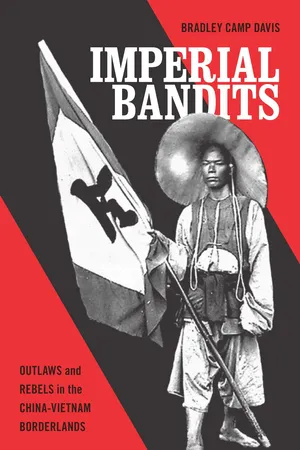
eBook - ePub
Imperial Bandits
Outlaws and Rebels in the China-Vietnam Borderlands
- 288 pages
- English
- ePUB (mobile friendly)
- Available on iOS & Android
eBook - ePub
Imperial Bandits
Outlaws and Rebels in the China-Vietnam Borderlands
About this book
Information
1
OPIUM AND REBELLION AT HIGH ALTITUDES
IN 1875, torrential rains devastated Tuyên Quang Province. Already poverty stricken, this region on the northern Vietnamese border faced the worst flooding in memory after dikes failed to contain the rain-swelled rivers. According to provincial official Vũ Trọng Bình, who witnessed the aftermath, “Everyone was poor, officials, ordinary people, even the bandits. Everyone was desperately poor.”1 Having watched the flood waters recede, Vũ Trọng Bình, a twenty-year veteran of the imperial bureaucracy, took a moment to record his thoughts. As he began to write, he found his hands covered in weeping sores, a physical manifestation of the related stress.2
Historically, flood control was a principal responsibility of imperial officials in Vietnam and China. In Nguyễn Vietnam, during the Tự Đức reign (1848–83), several officials in northern provinces proposed an aggressive expansion of dikeworks and irrigation canals as a way to prevent or ameliorate flooding.3 Vũ Trọng Bình himself managed the strengthening of flood defenses in several provinces, including Tuyên Quang. However, another sort of flood also troubled him. “Our province,” he lamented, “has been in dire straits for twenty years … all local officials agree that the bandits have the strength of an army.”4 A deluge of banditry overwhelmed the province as imperial officials anxiously looked on.
For Vũ Trọng Bình, banditry was a ubiquitous feature of the mountainous borderlands landscape. As unusually heavy rains threatened imperial dikeworks, so did uncontrolled bandit groups jeopardize imperial authority. Writing about the Mediterranean, historian Paul Saint Cassia has noted that banditry, as a label, evokes state power; “certain types of violent behavior” become banditry through an official, statist lens while this same behavior is “not necessarily seen in the same way at the grassroots.”5 In the borderlands, distinctions between bandit and official became subsumed by the culture of violence, the common currency of both imperial authority and the bandit power that flooded the borderlands. In northern Vietnam, where dikes channeled excess water, imperial authority faced a deluge of banditry.
Tracing the source of this flood takes us to the 1850s, when a series of uprisings erupted in the mountains. Groups carrying white flags led raids and attacks against imperial authority; these appeared in the official consciousness against the backdrop of the Yunnan opium trade, which intensified divisions between various communities in the borderlands. Following the outbreak of this rebellion, two groups of former rebels from southern China entered Vietnamese territory. One of these was the Yellow Flag Army, the subject of Vũ Trọng Bình’s lamentations over Tuyên Quang. The other was the Black Flags, led by Liu Yongfu. The story of how these two groups came to dominate the borderlands is the subject of this chapter.
In the following pages, I discuss the common origins of the Black and Yellow Flags, their shared networks of mobility, their divergent paths to power, and their very different relationships to both imperial authorities and local communities in the uplands and valleys. The intertwined history of the Black and Yellow Flags illustrates the violence at the heart of imperial authority. One of the most significant events in this story, the Vietnamese authorities’ employment of the Black Flags—an event that often inspires condemnation in oral traditions—represents neither a political abberation nor a fundamental weakness of the Vietnamese imperial system. Rather, the employment of the Black Flags, bandits working for the empire, was an imperial claim to monopolize violence. Especially in the uplands, we will see this claim challenged throughout the late nineteenth century, both by other bandits and by communities at the grassroots.
THE WHITE FLAG REBELLION
Although imperial bandits such as the Black Flags brought new violence to the mountains, it was a rebellion that began in the uplands that drew the Black Flags to Vietnam. As the trade in Yunnanese opium brought Chinese merchants into northern Vietnam, the White Flag Rebellion challenged Vietnamese imperial authority in areas where the empire had only a thin presence.
In the official record, the White Flag Rebellion first appeared in the mountains, in the borderlands between Nguyễn territory and the Qing Empire where Yao and Hmong speakers, identified as Man in Vietnam, maintained a loose historical relationship with communities at lower elevations.
The events known to Vietnamese administrators as the White Flag Rebellion present a special problem for historians. On the one hand, we can see violent, retributive acts by uplands populations against lowlands settlements occurring against the background of economic and demographic change, a culture of violence fed by dislocation. The Vietnamese Empire’s encouragement of new settlements in the mountainous borderlands and the commercialization of Yunnanese opium provide the material context for these events. On the other hand, the term rebellion assumes a unity of action, a coherent organization, and a deeply held common purpose. In the administrative record, White Flag raids appear as an index of social dislocation and imperial anxiety in an environment of economic change.
Although I refer to the White Flags as a rebellion in the following pages, any ethnonationalist aims associated with the White Flags exclusively belong to the twentieth century. Anthropologists, ethnographers, and ethnohistorians in Vietnam folded the story of the White Flags into the historical background of Yao and Hmong communities in the northern uplands. Under the White Flag, these scholars claimed, Yao and Hmong speakers united against the oppressive feudal regime of precolonial Vietnam, laying the foundation for over a century of struggle.6 During the nineteenth century, however, the White Flags emerged from the economic and demographic changes in the China-Vietnam borderlands.
OPIUM FROM YUNNAN
At the center of the White Flag Rebellion was opium. Although strongly associated with European imperialism, the cultivation and trade of opium, mostly for medicinal purposes, began in southern China perhaps as early as the eleventh century.7 Opium from Yunnan became increasingly popular in the wake of the opium wars (mid-nineteenth century), a conflict that stemmed from the British trade in Indian opium to China.8 Traditionally, users in China smoked sundried crude opium that produced a mild inebriation. The product from British India, sold under the brand name “Patna,” had a higher potency and a higher cost.9 By the mid-nineteenth century, domestically produced, more inexpensive opium from Yunnan began to push British Patna out of the consumer market.10
Even prior to the opium wars, the Qing Empire treated domestic and foreign opium very differently. In Yunnan, officials had to weigh the need to curtail opium consumption and its attendant problems against the livelihoods of local farmers.11 A distinction between “foreign opium” (yangyao) and medicinal, “indigenous opium” (tuyao) reflected both agricultural and medicinal realities. The protection of a domestic good enabled Chinese farmers to compete against foreign opium from British India, which tended to have a higher price as well as a higher potency. During the eighteenth century, Ortai, the Manchu official who led a violent campaign to transform China’s southwest, remarked on opium’s reputed prophylactic qualities against disease, an endorsement that made opium an officially recognized regional necessity.12 Opium enabled agents of the Qing imperial project to negotiate an otherwise hostile environment.
In Vietnam, however, opium drew condemnation from the imperial court. Since the 1820s, officials at Huế had taken a dim view of the product, deeming it a “poisonous substance.” Although these criticisms applied to opium in general, the Minh Mạng emperor reserved particular ire for the trade in British Indian opium, noting that “foreign countries” supplied generous amounts of this “poison” to China.13 For the Minh Mạng emperor, the defeat of China in the First Opium War (1839–42) manifested the deleterious effects of the British opium trade. China’s defeat by Britain was also, he noted, a warning to other countries.14
Despite criticism from Huế, the Yunnanese opium trade was a powerful commercial force in the borderlands. By the 1850s, perhaps as early as the 1840s, opium flowed through a town called Lào Cai, in Thuỷ Vĩ County, Hưng Hóa Province, far from the court. Although Vietnamese officials referred to the town as Bảo Thắng, Lào Cai received its name from Chinese merchants; in Yunnanese (guanhua), Lào Cai means “old market” or “old road.” In the mid-nineteenth century, Chinese merchants joined Tai-speaking populations in this borderlands town. Intercommunal tensions and a relatively thin administrative framework meant that imperial Vietnam could not depend on salaried officials in Lào Cai. Consequently, Tai powerbrokers and Chinese merchants dominated the area, with Vietnamese imperial authorities hiring official agents from the Tai elite.15
However, this improvised arrangement produced intercommunal tensions. It excluded populations indexed as Man who lived at altitudes above Tai elites and Chinese merchants.16 The consequences of this exclusion became apparent in October 1860, when armed raiding parties struck Tai and Chinese settlements in the hills around Lào Cai. Although Tai miltia drove these raiding parties to the mountains in retreat, these eruptions of violence signaled a new disruption to Vietnamese imperial authority.17 These raids in Hưng Hóa were a threat to trade and empire in a space where imperial authority relied on merchants and the Tai elite.
TENSIONS AT HIGH ALTITUDES
In the Vietnamese imperial imagination, the bustling river port of Lào Cai belonged to Hưng Hóa Province. During the nineteenth century, Hưng Hóa was one of the largest and most diversely populated provinces in Vietnam, containing all or part of the present day provinces of Điện Biên, Lai Châu, Lào Cai, Hà Giang, Yên Baí, and Sơn La.18 When reforms in the 1830s called for the construction of a provincial system throughout Vietnam, an imperial territorial form—the province—became another layer in the complex political topography of the borderlands.
The of...
Table of contents
- Cover
- Title Page
- Copyright
- Dedication
- Contents
- Acknowledgments
- Note on Language
- Introduction: Imperial Bandits, Cultures of Violence, and Oral Traditions
- 1 Opium and Rebellion at High Altitudes
- 2 Commerce, Rebellion, and Consular Optics
- 3 Imperial Bandits and the Sino-French War
- 4 Borderline, Resistance, and Technology
- Conclusion: Flags in the Dust
- Notes
- Glossary
- Bibliography
- Index
Trusted by 375,005 students
Access to over 1.5 million titles for a fair monthly price.
Study more efficiently using our study tools.
Frequently asked questions
Yes, you can cancel anytime from the Subscription tab in your account settings on the Perlego website. Your subscription will stay active until the end of your current billing period. Learn how to cancel your subscription
No, books cannot be downloaded as external files, such as PDFs, for use outside of Perlego. However, you can download books within the Perlego app for offline reading on mobile or tablet. Learn how to download books offline
Perlego offers two plans: Essential and Complete
- Essential is ideal for learners and professionals who enjoy exploring a wide range of subjects. Access the Essential Library with 800,000+ trusted titles and best-sellers across business, personal growth, and the humanities. Includes unlimited reading time and Standard Read Aloud voice.
- Complete: Perfect for advanced learners and researchers needing full, unrestricted access. Unlock 1.5M+ books across hundreds of subjects, including academic and specialized titles. The Complete Plan also includes advanced features like Premium Read Aloud and Research Assistant.
We are an online textbook subscription service, where you can get access to an entire online library for less than the price of a single book per month. With over 1.5 million books across 990+ topics, we’ve got you covered! Learn about our mission
Look out for the read-aloud symbol on your next book to see if you can listen to it. The read-aloud tool reads text aloud for you, highlighting the text as it is being read. You can pause it, speed it up and slow it down. Learn more about Read Aloud
Yes! You can use the Perlego app on both iOS and Android devices to read anytime, anywhere — even offline. Perfect for commutes or when you’re on the go.
Please note we cannot support devices running on iOS 13 and Android 7 or earlier. Learn more about using the app
Please note we cannot support devices running on iOS 13 and Android 7 or earlier. Learn more about using the app
Yes, you can access Imperial Bandits by Bradley Camp Davis, Charles F. Keyes, Laurie J. Sears, Vicente Rafael, Charles F. Keyes,Laurie J. Sears,Vicente Rafael in PDF and/or ePUB format, as well as other popular books in History & Asian History. We have over 1.5 million books available in our catalogue for you to explore.