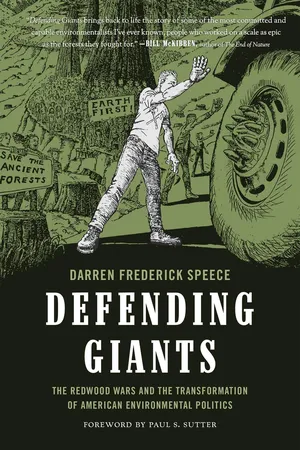
Giant redwoods are American icons, paragons of grandeur, exceptionalism, and endurance. They are also symbols of conflict and negotiation, remnants of environmental battles over the limits of industrialization, profiteering, and globalization. Since the middle of the nineteenth century, logging operations have eaten away at the redwood forest, particularly areas covered by ancient giant redwoods. Today, such trees occupy a mere 120, 000 acres. Their existence is testimony to the efforts of activists to rescue some of these giants from destruction. Very few conservation battles have endured longer or with more violence than on the North Coast of California, behind what locals call the Redwood Curtain. Defending Giants explores the long history of the Redwood Wars, focusing on the ways rural Americans fought for control over both North Coast society and its forests. Activists defended these trees not only because the redwood forest had dwindled in size, but also because, by the late twentieth century, the local economy was increasingly dominated by multinational corporations. The resulting conflict—the Redwood Wars—pitted workers and environmental activists against the rising tide of globalization and industrial logging in a complex war over endangered species, sustainable forestry, and, of course, the fate of the last ancient redwoods. Activists perched in trees and filed lawsuits, while the timber industry, led by Pacific Lumber, fought the lawsuits and used their power to halt reform efforts. Ultimately, the Clinton administration sidestepped Congress and the courts to negotiate an innovative compromise. In the process, the Redwood Wars transformed American environmental politics by shifting the balance of power away from Congress and into the hands of the executive branch.
eBook - ePub
Defending Giants
The Redwood Wars and the Transformation of American Environmental Politics
- 384 pages
- English
- ePUB (mobile friendly)
- Available on iOS & Android
eBook - ePub
Defending Giants
The Redwood Wars and the Transformation of American Environmental Politics
About this book
Information
NOTES
INTRODUCTION
1 Judi Bari, “The Earth First! Car Bombing,” Earth First! Journal, February 2, 1994.
2 Mike Geniella, “Bari Trial Pressed over FBI Problems,” Eureka Times Standard, April 7, 1997, EPIC archives, Redway, CA; Evelyn Nieves, “Environmentalists Win Bombing Lawsuit,” New York Times, June 12, 2002 (www.nytimes.com/2002/06/12/us/environmentalists-win-bombing-lawsuit.html); Judi Bari and Darryl Cherney v. FBI Agents Stockton Buck, Frank Doyle, John Reidkes, and Phillip Sena, and Oakland Police Officers Clyde M. Sims, Robert Chenault, and Michael Sitterud, No. C 91–01057 CW, US District Court, Northern District of California (June 11, 2002); Bari and Cherney v. FBI, 14 F.3d 457 (January 12, 1994; http://law.justia.com/cases/federal/appellate-courts/f3/14/457/613523).
3 David Harris, The Last Stand: The War between Wall Street and Main Street over California’s Ancient Redwoods (New York: Times Books, 1995). See also Alston Chase, In a Dark Wood: The Fights over Forests and the Myths of Nature (New Brunswick, NJ: Transaction, 2001).
4 The dominant narrative has largely been crafted through journalistic and polemic accounts. David Harris wrote the only journalistic book that deals solely with the Headwaters conflict (The Last Stand). The journalistic and polemical treatments that attend briefly to the Headwaters conflict include Chase, In a Dark Wood; David Helvarg, The War against the Greens: The “Wise-Use” Movement, the New Right, and the Browning of America (Boulder, CO: Johnson Books, 2004); Christopher Manes, Green Rage: Radical Environmentalism and the Unmaking of Civilization (Boston: Little, Brown, 1990); Jacqueline Vaughn, Green Backlash: The History and Politics of the Environmental Opposition in the U.S. (Boulder, CO: Lynne Rienner, 1997); and Susan Zakin, Coyotes and Town Dogs: Earth First! and the Environmental Movement (Tuson: University of Arizona Press, 1993). A few scholarly books that are focused on environmentalism briefly mention the Headwaters conflict: Douglass Bevington, Rebirth of Environmentalism: Grassroots Activism from the Spotted Owl to the Polar Bear (Washington, DC: Island Press, 2009); Alessandro Bonanno and Douglas H. Constance, Stories of Globalization: Transnational Corporations, Resistance, and the State (University Park: Pennsylvania State University Press, 2008); Samuel Hays, Wars in the Woods: The Rise of Ecological Forestry (Pittsburgh, PA: University of Pittsburgh Press, 2007); Carolyn Merchant, Radical Ecology: The Search for a Livable World (New York: Routledge, 2005); Rik Scarce, Eco-Warriors: Understanding the Radical Environmental Movement (Walnut Creek, CA: Left Coast Press, 2006); and Richard Widdick, Trouble in the Forest: California’s Redwood Timber Wars (Minneapolis: University of Minnesota Press, 2009). Both Hays and Merchant erred in reference to the timber company name and the name of the forest, respectively. Bonanno and Constance repeat the morality play narrative, while Bevington and Widdick briefly offer more nuanced interpretations of Pacific Lumber Company’s history. Some firsthand accounts include Judi Bari, Timber Wars (Monroe, ME: Common Courage Press, 1994); Joan Dunning, From the Redwood Forest: Ancient Trees and the Bottom Line: A Headwaters Journey (White River Junction, VT: Chelsea Green Publishing, 1998); Dave Foreman, Confessions of an Eco-Warrior (New York: Harmony Books, 1991); and Julia Butterfly Hill, The Legacy of Luna: The Story of a Tree, a Woman, and the Struggle to Save the Redwoods (New York: HarperCollins, 2000).
5 David Harris, interview by the author, Mill Valley, CA, May 1, 2007 (recording and notes in possession of author).
6 See William Cronon, “The Trouble with Wilderness,” in Uncommon Ground: Rethinking the Human Place in Nature, ed. William Cronon (New York: W. W. Norton, 1996), 69–90; William Dietrich, The Final Forest: The Battle for the Last Great Trees of the Pacific Northwest (New York: Penguin Books, 1993); Kathie Durbin, Tree Huggers: Victory, Defeat, and Renewal in the Northwest Ancient Forest Campaign (Seattle: Mountaineers, 1996); Ramachandra Guha, “Radical American Environmentalism and Wilderness Preservation: A Third World Critique,” in The Great New Wilderness Debate: An Expansive Collection of Writings Defining Wilderness from John Muir to Gary Snyder, ed. J. Baird Callicott and Michael P. Nelson (Athens: University of Georgia Press, 1998), 231–45; Kevin R. Marsh, Drawing Lines in the Forest: Creating Wilderness Areas in the Pacific Northwest (Seattle: University of Washington Press, 2007); Reed F. Noss, ed., The Redwood Forest: History, Ecology, and Conservation of the Coast Redwoods (Washington, DC: Island Press, 2000), 87 (regarding old-growth definition); James Morton Turner, The Promise of Wilderness: American Environmental Politics since 1964 (Seattle: University of Washington Press, 2012); and Stephen Lewis Yaffee, The Wisdom of the Spotted Owl: Policy Lessons for a New Century (Washington, DC: Island Press, 1994).
7 Corporatism, as used here, refers to the definition Ellis Hawley used in his classic article, “The Discovery and Study of a ‘Corporate Liberalism,’” Business History Review 52, no. 3 (Autumn 1978): 309–20. Hawley defines corporatism as a system whereby industries are guided by “officially recognized, non-competitive, role-ordered occupational or functional groupings … where the state properly functions as a coordinator, assistant, and midwife rather than director or regulator.”
8 Turner, Promise of Wilderness, 248–52, 273–89, 315–40.
9 For a fuller discussion of the history of globalization, workers, and environmentalism, see Erik Loomis, Out of Sight: The Long and Disturbing Story of Corporations Outsourcing Catastrophe (New York: New Press, 2015).
10 The narrative of nationalization and professionalization is largely the product of Samuel Hays’s and Roderick Nash’s classic books and the reactions to them: Samuel P. Hays, Beauty, Health, and Permanence: Environmental Politics in the United States, 1955–1985 (Pittsburgh, PA: University of Pittsburgh Press, 1987); Roderick Nash, Wilderness and the American Mind (New Haven, CT: Yale University Press, 1973). For more on the development of modern environmentalism and its professionalization, see especially Gary C. Bryner, Blue Skies, Green Politics: The Clean Air Act of 1990 and Its Implementation (Washington, DC: Congressional Quarterly Press, 1995); Michael P. Cohen, The History of the Sierra Club, 1892–1970 (San Francisco: Sierra Club Books, 1988); Stephen Fox, The American Conservation Movement: John Muir and His Legacy (Madison: University of Wisconsin Press, 1985); Paul Hirt, A Conspiracy of Optimism: Management of the National Forests since World War Two (Lincoln: University of Nebraska Press, 1994); Robert Gottlieb, Forcing the Spring: The Transformation of the American Environmental Movement (Washington, DC: Island Press, 1993); Mark W. T. Harvey, A Symbol of Wilderness: Echo Park and the American Conservation Movement (Seattle: University of Washington Press, 1989); Samuel P. Hays, A History of Environmental Politics since 1945 (Pittsburgh, PA: University of Pittsburgh Press, 2000); Michael E. Kraft, Environmental Policy and Politics (New York: Pearson Longman, 2007); Richard J. Lazarus, The Making of Environmental Policy (Chicago: University of Chicago Press, 2004); Dennis C. Lemaster, Decade of Change: The Remaking of Forest Service Statutory Authority during the 1970s (Westport, CT: Greenwood Press, 1984); J. Michael McCloskey, In the Thick of It: My Life in the Sierra Club (Washington, DC: Island Press, 2005); Adam Rome, The Bulldozer in the Countryside: Suburban Sprawl and the Rise of American Environmentalism (Cambridge: Cambridge University Press, 2001); Christopher C. Sellers, Crabgrass Crucible: Suburban Nature and the Rise of Environmentalism in Twentieth-Century America (Chapel Hill: University of North Carolina Press, 2012); Paul Sutter, Driven Wild: How the Fight against Automobiles Launched the Modern Wilderness Movement (Seattle: University of Washington Press, 2002); Turner, Promise of Wilderness; Edgar Wayburn, Your Land and Mine: Evolution of a Conservationist (San Francisco: Sierra Club Books, 2004); and Thomas R. Wellock, Preserving the Nation: The Conservation and Environmental Movements, 1870–2000 (Wheeling, WV: Harlan Davidson, 2007). Rome, Sutter, Turner, and Wellock each argue there was greater continuity between the pre- and postwar environmental movements than what Hays and Nash found. Sellers revitalized the argument that there was a marked difference between the pre- and postwar environmental movements, as well as noting the important role suburban activism played in postwar environmentalism.
11 Regarding the origins of scientific forestry, see Henry E. Lowood, “The Calculating Forester: Quantification, Cameral Science, and the Emergence of Scientific Forestry Management in Germany,” in The Quantifying Spirit in the 18th Century, ed. Tore Frangsmyr, J. L. Heilbron, and Robin E. Rider (Berkeley: University of California Press, 1990), 315–42. Regarding the fusion of preservation and conservation ideology, see Samuel P. Hays, Conservation and the Gospel of Efficiency: The Progressive Conservation Movement, 1890–1920 (Cambridge, MA: Harvard University Press, 1959); Hays, Beauty, Health and Permanence; and Cohen, History of the Sierra Club, 2, 4–16, 114–19. In particular, Cohen highlights the ways Muir’s views of landscapes were often anthropocentric, desiring a “partly wild and partly tame Sierra,” 12. See Emily Wakild, Revolutionary Parks: Conservation, Social Justice, and Mexico’s National Parks, 1910–1940 (Tucson: University of Arizona Press, 2011); and “Border Chasm: International Boundary Parks and Mexican Conservation, 1935–1945,” Environmental History 14 (July 2009): 453–75, for a wonderful discussion of how ideas and practices involving wilderness, work, local interests, tradition, and conservation intermingled during Mexico’s interwar national park boom. In many ways, the situations in Mexico and California were similar due to the need to contend with private property rights and the traditional practices of rural populations.
12 See Richard White, “Are You an Environmentalist or Do You Work for a Living? Work and Nature,” in Cronon, Uncommon Ground, 171–85.
13 For a discussion of radical environmentalism, wilderness, and the critiques of both, see Cronon, “The Trouble with Wilderness”; and all of the essays in J. Baird Callicott and Michael P. Nelson, eds., The Great New Wilderness Debate: An Expansive Collection of Writings Defining Wilderness from John Muir to Gary Snyder (Athens: University of Georgia Press, 1998), especially Guha, “Radical American Environmentalism.” The classic texts covering the wilderness debate are Callicott and Nelson, eds., The Great New Wilderness Debate; Cronon, Uncommon Ground; Gottlieb, Forcing the Spring; Nash, Wilderness and the American Mind; Nancy Langston, Forest Dreams...
Table of contents
- Cover
- Title Page
- Copyright
- Contents
- Foreword
- Acknowledgments
- Abbreviations
- Maps
- Introduction
- One Deep Roots
- Two The War Begins
- Three Radicalization
- Four Bursting Out
- Five The Transformation
- Epilogue
- Notes
- Selected Bibliography
- Index
- Illustrations
Trusted by 375,005 students
Access to over 1.5 million titles for a fair monthly price.
Study more efficiently using our study tools.
Frequently asked questions
Yes, you can cancel anytime from the Subscription tab in your account settings on the Perlego website. Your subscription will stay active until the end of your current billing period. Learn how to cancel your subscription
No, books cannot be downloaded as external files, such as PDFs, for use outside of Perlego. However, you can download books within the Perlego app for offline reading on mobile or tablet. Learn how to download books offline
Perlego offers two plans: Essential and Complete
- Essential is ideal for learners and professionals who enjoy exploring a wide range of subjects. Access the Essential Library with 800,000+ trusted titles and best-sellers across business, personal growth, and the humanities. Includes unlimited reading time and Standard Read Aloud voice.
- Complete: Perfect for advanced learners and researchers needing full, unrestricted access. Unlock 1.5M+ books across hundreds of subjects, including academic and specialized titles. The Complete Plan also includes advanced features like Premium Read Aloud and Research Assistant.
We are an online textbook subscription service, where you can get access to an entire online library for less than the price of a single book per month. With over 1.5 million books across 990+ topics, we’ve got you covered! Learn about our mission
Look out for the read-aloud symbol on your next book to see if you can listen to it. The read-aloud tool reads text aloud for you, highlighting the text as it is being read. You can pause it, speed it up and slow it down. Learn more about Read Aloud
Yes! You can use the Perlego app on both iOS and Android devices to read anytime, anywhere — even offline. Perfect for commutes or when you’re on the go.
Please note we cannot support devices running on iOS 13 and Android 7 or earlier. Learn more about using the app
Please note we cannot support devices running on iOS 13 and Android 7 or earlier. Learn more about using the app
Yes, you can access Defending Giants by Darren Frederick Speece in PDF and/or ePUB format, as well as other popular books in History & North American History. We have over 1.5 million books available in our catalogue for you to explore.