Between the late sixteenth and early twentieth centuries, Banaras, the iconic Hindu center in northern India that is often described as the oldest living city in the world, was reconstructed materially as well as imaginatively, and embellished with temples, monasteries, mansions, and ghats (riverfront fortress-palaces). Banaras's refurbished sacred landscape became the subject of pilgrimage maps and its spectacular riverfront was depicted in panoramas and described in travelogues. In Banaras Reconstructed, Madhuri Desai examines the confluences, as well as the tensions, that have shaped this complex and remarkable city. In so doing, she raises issues central to historical as well as contemporary Indian identity and delves into larger questions about religious urban environments in South Asia.
- 304 pages
- English
- ePUB (mobile friendly)
- Available on iOS & Android
eBook - ePub
About this book
Information
CHAPTER ONE
AUTHENTICITY AND PILGRIMAGE
NOTIONS regarding static religious practices and associations in an unchanging city were certainly reiterated by scholars, residents, and visitors seduced by Orientalist perspectives. Yet the city’s status as a preeminent tirtha (pilgrimage site) and center of Sanskrit scholarship lies beyond the confines and interpretations of this relatively recent intersection of colonial politics and knowledge. While the city’s sacred role is closely connected to a deep textual history, the sheer volume and diversity of this literature speaks to a corresponding complexity of beliefs. To understand the city, sites and myths were consolidated through texts whose authors maintained a sharp focus on the religious landscape of the sacred zone of Kashikshetra. The fact that texts had to be continuously assessed, recompiled, and summarized suggests that their authors were concerned with altering notions of religion and sanctity as textual visions and sacred zones became intertwined, consistent with the ever-changing nature of all human societies.
Since at least the late eighteenth century, colonial archaeologists have consolidated a Buddhist identity for early Banaras. Vestiges of this past include the Dhamek stupa at Sarnath, the adjoining monastery, and various sculptural remains that date from as early as the second century of the Common Era. Stone sculpture and sculptural fragments from as early as the fifth century have also been discovered in the northern sections of the city. Some of these images, such as a fifth-century stone image of Krishna Govardhanadhara, are currently housed in the Bharat Kala Bhavan museum.1 Other fragments of sculptures and miniature shrines have been incorporated within eighteenth-century temples and temple precincts. Taken together, these various findings certainly establish the city’s antiquity. Yet substantial evidence for its role as a Shaiva Hindu sacred landscape, centered moreover on a significant temple, remains elusive.
In 1904 and 1905 the Royal Asiatic Society published (in two volumes) an English-language translation of the travel narratives of the Chinese Buddhist monk Yuan Chwang (Xuanzang/Hiouen Thsang) by one of its member-scholars, Thomas Watters. He concluded that Yuan Chwang left seventh-century China (during the Tang period) to travel to the “Western” lands and visited the “Varanasi district” that had a capital city of the same name.2 The visiting Chinese monk described a city populated by some Buddhist scholars and several more who believed in “other systems.” The four manuscripts (block-printed texts) consulted by Watters provide varying descriptions of the temples within the city. They range from descriptions of a single large temple to twenty or more temples, to more than a hundred temples, variously located either within the city or the entire district. Their principal deity is represented as an enormous image in only one manuscript but more generally as a linga. Watters suspected that the passage describing an enormous image may actually have been a later interpolation within this text.3
While Yuan Chwang’s account provides evidence for Varanasi being a center for Buddhists well as for Shaiva scholarship and religious practices, the precise nature of its sacred landscape at this time (and particularly its temples) remains uncertain. Scholars tend to use these mostly Buddhist material fragments to suggest that these vestiges can directly reflect and conform to the contours and significant nodes of contemporary ritual zones, pilgrimage routes, and sacred sites in Banaras. To project the notion of a consolidated and unified Hinduism onto the religious landscape of seventh-century or even twelfth-century Kashi would certainly constitute an anachronism since the religious beliefs, ritual practices, and their related spaces and locales would have to remain unchanged for centuries.4
The puranas (collection of myths) on Banaras or Kashi are often representations of negotiated pasts. Since the Kashikhand (first composed in the fourteenth century) was incorporated into the textual tradition of the puranas, it has been cast as a source of religious authority and ritual continuity within medieval and, to some extent, modern Hinduism. More significant, the Kashikhand is viewed as a summary of religious traditions within the purana tradition, rather than as an expression of the contemporary concerns of its authors.5 The authors of the Kashikhand defined multiple pilgrimage routes and sacred zones, most of them centered on the preeminent Vishweshwur temple. If any discrepancies between the Kashikhand and older texts are ever noted, they are usually seen as a result of the repeated destruction of temples and shrines and consequently of the disruption of pilgrimage and ritual practices by successive Islamic regimes.6 Certainly on the face of it, the physical proximity of temple and mosque at several sites in the contemporary city tends to substantiate such theories.
A contemporary visitor to the Vishweshwur temple cannot fail to notice the Mughal period Gyan Vapi mosque next door. Visitors also learn about the Adi-Vishweshwur temple, a little distance away, that stands next door to another mosque from the sultanate period, more commonly known as “Razia’s mosque” (Fig. 1.1). Adi-Vishweshwur (the Ur-Vishweshwur), as its name suggests, is supposedly the original site of the Vishweshwur temple. They are informed that the Vishweshwur linga was uprooted and eventually relocated at least twice—the first time to the Gyan Vapi precinct and subsequently to its present location. Visitors cannot miss the Dharhara mosque on the riverfront that was built to replace the Bindu Madhav temple, and they learn of the Alamgiri mosque built on the foundations of the Krittivaseshwur temple. The presence of such visible signifiers of ritual disruption lends credence to the widespread conclusion that if it were not for these interruptions, the ritual landscape of the sacred zone of Kashikshetra would have remained constant and unchanged. Such assumptions, however, are not borne out by evidence either through texts or by the history of activism engaged in by their Brahmin authors. Texts and sacred zones were formed through a gradual and mutually contingent evolution. Furthermore, spatial formations were sustained through an urban environment that evolved through complex relationships between politics and patronage. If a first wave of Ghurid intervention in the twelfth century did indeed disrupt the city’s ritual rhythms, a settled period of Indo-Islamic regimes also saw the emergence of elaborate sacred geographies and, more significant, robust new ritual traditions.
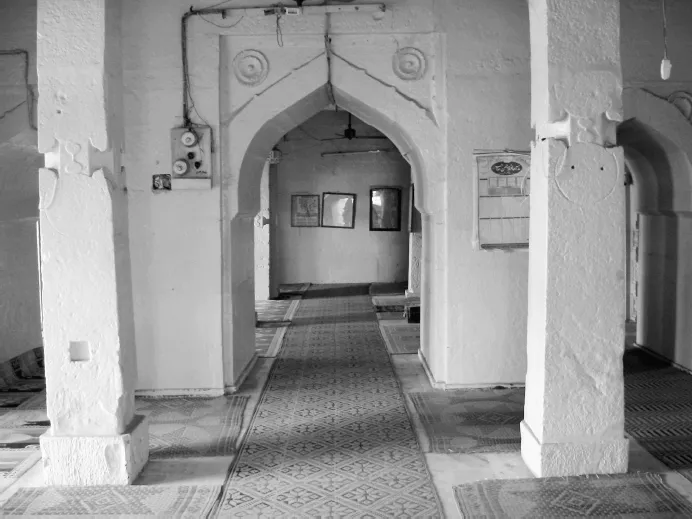
FIG. 1.1 “Razia’s mosque.”
TEXTS AND THE SACRED LANDSCAPE
Sacred regions, sacred sites, pilgrimage routes, and their multiple interpretations intersected with the processes and experiences of urbanization in Banaras. Theories regarding perfectly shaped sacred zones and the religious significance of particular sites were articulated through texts that were composed by successive generations of Brahmins. The lived experience of pilgrimage, however, was molded by the physical reality of the city of Banaras, where urban interventions could often alter sacred configurations as the city was continually and often quite prosaically transformed. An overview of the purana textual corpus that is dated between the sixth and twelfth centuries suggests that eventually a number of sacred sites connected to diverse streams within an evolving Hinduism converged to form the basis of a sacred region.7
Some shared ideas that came to anchor notions of sanctity for the city include the tirtha (pilgrimage destination) and the tirtha yatra (pilgrimage). The tirtha is a sacred site that affords the pilgrim an opportunity to glimpse, indeed to “cross over” and make tangible contact with, the divine. The tirtha yatra can be a pilgrimage to one or several tirthas. These concepts are intimately linked to definitions of sacred regions and routes. An idea that was repeatedly addressed and defined was that of the entire city and its immediate environs as the sacred region of Kashikshetra.8 This idea was closely aligned with another concept: that of the Muktikshetra. Textual and popular traditions (these latter constitute a range of everyday practices related to but also distinguishable from prescriptions in texts) maintain that living and ultimately dying within the Muktikshetra would result in salvation from the endless cycle of reincarnation and rebirth. This Muktikshetra was variously imagined either as a perfect circle or square with a Shivalinga at its center and with well-defined edges. While the concept of such a zone has remained consistent, definitions of its overall shape, boundaries, and center have altered over the centuries. Among these, the Vishweshwur temple evolved as a central anchor for multiple sacred zones since at least the fourteenth century.
Shiva’s connection with the city was and is a theme in several purana texts. Shiva is a supreme deity, one of the Hindu “trinity” (along with Brahma and Vishnu), and his connection to the Ganges River is crystallized through a myth in which he tames the ferocious, heavenly, and life-sustaining river by binding her in his hair locks before letting her flow gently on earth.9 At Banaras, Shiva is celebrated both as an ascetic and in his grihastha (householder) aspect, and the city is a home for the deity and his consort Parvati. Shiva’s simultaneous ascetic identity is also celebrated by the various Shaiva muths (monasteries) and mendicant sects connected to the city. The most extensive myths related to Shiva as Vishweshwur (Lord of the Universe) and his connection with the city were certainly elaborated in the Kashikhand that became part of the purana tradition when it was added to the sixth century Skandapurana.10 This text came to play a hegemonic role in the city’s ritual life by the late eighteenth century. In addition, the authors of the Kashirahasya, which was added to another text, the Brahmavaivartapurana, prescribed the Panchkroshi pilgrimage—a route that was also focused on the Vishweshwur linga.11 Patronage in the city between the late sixteenth and late eighteenth centuries has been directed towards constructing two successive temples to house this linga. In popular perception the contours of the Panchkroshi route merged with the idea of the sacred zone of Kashikshetra.
Kashikshetra and the city of Kashi or Banaras are, at least conceptually, imagined as distinct but intimately entangled entities. Given the belief that residence within the sacred zone is a means to accruing religious merit, the urban zone of Banaras has remained confined within the limits of Kashikshetra for much of its history. In both perception and practice the zone is bound by the Panchkroshi pilgrimage, and pilgrims followed this irregular route in an act of circumambulation around the sacred zone. The banks of the Ganges between its two feeder streams—the Varuna to the north and the Assi to the south—provide the other sacred edges. The confluence of each stream with the river was deemed significant, as were numerous sites along this stretch.
The extensive literature on Kashikshetra that defined the sanctity of sites through myths and divine associations was incorporated into the puranas through contingent, historical circumstances. Distinct versions of a purana text can vary in length and content, as material was often added or removed in response to changing political and cultural conditions. Given their following across South Asia, as well as their interactions with various local and vernacular practices and traditions, different recensions of the same purana could differ in terms of length and content.12 To remain meaningful, purana texts had to be contextualized by Brahmin scholars who were intent on finding contemporary relevance for established practices. Considering the diversity, voluminous nature, and sheer numbers of purana texts, Brahmin scholars concentrated on specific sites and sacred zones that they considered immediately relevant to their circumstances. Individual Brahmin scholars could differ in terms of the weight and relevance that they granted to a particular deity or sacred site. They debated the relative merits of sites as well as religious traditions and practices. Several scholars summarized personal opinions in a type of text called a nibandha that although concise was composed with due regard to textual citation.
From a historian’s perspective, nibandha texts provide glimpses into historical debates regarding religious practices and sites. By extension, they provide valuable clues about the trajectories of developing sacred zones and their urbanization. More recently, particularly since the late nineteenth century, Brahmin scholars began to write guidebooks in vernacular languages, providing visiting pilgrims with selective information about sites drawn from purana texts along with their locations within the contemporary city accompanied by precise and current directions and addresses. It is noteworthy that scholars continued to refer to the puranas as repositories of religious authority and tradition and cited them within the bodies of their nibandha with the intention of authenticating current concerns.
Such variation in opinion extended to definitions of the Muktikshetra or Kashikshetra sacred zones. These had already been on shifting ground, at least since the twelfth century, as Bhatta Lakshmidhara, the Gahadavala minister and scholar, revealed in his twelfth-century text, the Krtyakalpataru.13 Lakshmidhara consolidated diverse traditions that were associated with twelfth-century Kashi and tried to define its sacred limits. Hans Bakker has evaluated some of Lakshmidhara’s interpretations and summaries.14 According to Bakker’s general analysis, the region of Kashikshetra in the Skandapurana was defined as extending one krosa (unit of measurement roughly equivalent to a mile and a half) in each direction with its center in the shri...
Table of contents
- Cover
- Title Page
- Copyright
- Dedication
- Contents
- Acknowledgments
- Introduction: The Paradox of Banaras
- Chapter One: Authenticity and Pilgrimage
- Chapter Two: Palimpsests and Authority
- Chapter Three: Expansion and Invention
- Chapter Four: Spectacle and Ritual
- Chapter Five: Order and Antiquity
- Chapter Six: Visions and Embellishments
- Conclusion: Banaras Revisited
- Notes
- Glossary
- Bibliography
- Index
- Color plates
Trusted by 375,005 students
Access to over 1.5 million titles for a fair monthly price.
Study more efficiently using our study tools.
Frequently asked questions
Yes, you can cancel anytime from the Subscription tab in your account settings on the Perlego website. Your subscription will stay active until the end of your current billing period. Learn how to cancel your subscription
No, books cannot be downloaded as external files, such as PDFs, for use outside of Perlego. However, you can download books within the Perlego app for offline reading on mobile or tablet. Learn how to download books offline
Perlego offers two plans: Essential and Complete
- Essential is ideal for learners and professionals who enjoy exploring a wide range of subjects. Access the Essential Library with 800,000+ trusted titles and best-sellers across business, personal growth, and the humanities. Includes unlimited reading time and Standard Read Aloud voice.
- Complete: Perfect for advanced learners and researchers needing full, unrestricted access. Unlock 1.5M+ books across hundreds of subjects, including academic and specialized titles. The Complete Plan also includes advanced features like Premium Read Aloud and Research Assistant.
We are an online textbook subscription service, where you can get access to an entire online library for less than the price of a single book per month. With over 1.5 million books across 990+ topics, we’ve got you covered! Learn about our mission
Look out for the read-aloud symbol on your next book to see if you can listen to it. The read-aloud tool reads text aloud for you, highlighting the text as it is being read. You can pause it, speed it up and slow it down. Learn more about Read Aloud
Yes! You can use the Perlego app on both iOS and Android devices to read anytime, anywhere — even offline. Perfect for commutes or when you’re on the go.
Please note we cannot support devices running on iOS 13 and Android 7 or earlier. Learn more about using the app
Please note we cannot support devices running on iOS 13 and Android 7 or earlier. Learn more about using the app
Yes, you can access Banaras Reconstructed by Madhuri Desai in PDF and/or ePUB format, as well as other popular books in History & History of Architecture. We have over 1.5 million books available in our catalogue for you to explore.