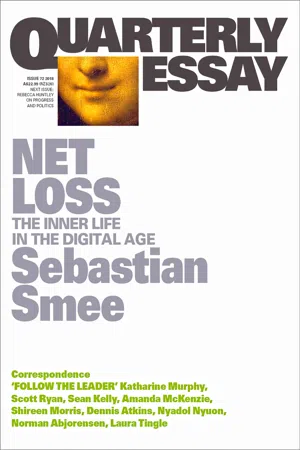
What is the inner life? And is it vanishing in the digital age?Throughout history, artists and philosophers have cultivated the deep self, and seen value in solitudeand reflection. But today, through social media, wall-to-wall marketing, reality television and theagitation of modern life, everything feels illuminated, made transparent. We feel bereft without ourphones and their cameras and the feeling of instant connectivity. It gets hard to pick up a book, harderstill to stay with it.In this eloquent and profound essay, renowned critic Sebastian Smee brings to the surface the idea ofinner life – the awareness one may feel in front of a great painting or while listening to extraordinarymusic by a window at dusk or in a forest at night. No nostalgic lament, this essay evokes what isvaluable and worth cultivating – a connection to our true selves, and a feeling of agency in the mysteryof our own lives. At the same time, such contemplation puts us in an intensely charged relationshipwith things, people or works of art that are outside us.If we lose this power, Smee asks, what do we lose of ourselves?
- 128 pages
- English
- ePUB (mobile friendly)
- Available on iOS & Android
eBook - ePub
Quarterly Essay 72 on the Inner Life in the Digital Age
About this book
Information
NET LOSS | The Inner Life in the Digital Age |
Sebastian Smee |
Every day I spend hours and hours on my phone. I have Instagram, Facebook and Twitter accounts. I have three email addresses. I watch soccer highlights, comedy clips, how-to advice and random music videos on YouTube. I download podcasts, which I listen to while driving, and I’m addicted to Waze and Google Maps. I do all this, and much more besides, without much thought, just a little lingering anxiety.
We are all doing it, aren’t we? It has come to feel completely normal. Even when I put my device aside and attach it to a charger, it pulses away in my mind, like the throat of a toad, full of blind, amphibian appetite. Habitually, several times a day, I check certain apps that bring me news from the worlds of sport, politics and art. A goal by Zlatan Ibrahimović. A shark attack off La Perouse. The latest tweet by Donald Trump. A painting by Banksy that self-destructs after it is purchased at auction. All of it more or less extraordinary and tending towards the unthinkable, which is precisely the reason I click on it.
I am aware that using apps, signing up for their services and paying for things online means I am handing out information about myself to people whose motives I can’t know. I feel I should be bothered by this, but I’m not, particularly. Any potentially harmful ramifications feel too distant, obscured by weedy thickets of cause-and-effect I can’t possibly unravel. I try not to think about what the makers of these apps, the advertisers to whom they sell my data, or the people to whom they sell it on, think they know about me by now. But it comes to my mind, I admit, whenever I get an incoming call, usually sometime in the early afternoon, which briefly makes me feel as though I may be in the opening scenes of a David Lynch movie. I answer it, knowing better, but … well, just in case. A prerecorded female voice starts speaking in Mandarin or Russian or robotic American English. I hang up, mumbling an unnecessary explanation to whomever I might be with.
Ah, I tell myself: they know superficial stuff about me, whoever these people are. They know my phone number and my age. They probably know what sports teams I support, what music I listen to, and where I do the weekly food shop. From all this, they can probably guess (though I try to keep my opinions to myself) how I will vote. But they cannot know my inner life.
*
Wait. “Inner life”? What would that even be? I search through old notebooks and come across a passage I wrote down years ago. It’s Anton Chekhov, describing Gurov, the character at the centre of his most famous story, “The Lady with the Dog.” “He had two lives,” writes Chekhov,
one open, seen, and known by all who cared to know, full of relative truth and of relative falsehood, exactly like the lives of his friends and acquaintances; and another life running its course in secret. And through some strange, perhaps accidental conjunction of circumstances, everything that was essential, of interest and of value to him, everything that made the kernel of his life, was hidden from other people; and all that was false in him, the sheath in which he hid himself to conceal the truth – such, for instance, as his work in the bank, his discussions at the club … his presence with his wife at anniversary festivities – all that was open. And he judged of others by himself, not believing in what he saw, and always believing that every man had his real, most interesting life under the cover of secrecy and under the cover of night.
There is something almost biblical about Chekhov’s passage: its commanding clarity, its plain language, its explanatory force. The imagery here could not be more explicit. In Gurov, Chekhov is saying, and perhaps in all of us, there is an inside and there is an outside. The inside, the “kernel,” hidden from other people, is essential, of interest, real. It may be harder to get to know – it runs its course in secret – but in the quest for self-knowledge, it has tremendous prestige. (It is not by accident that we are reading about it in a prestigious work of fiction: our “inner lives” are precisely what we expect to learn about in literature.) The outside, the “sheath,” is all relative and, at its worst, false, a sham.
This conception implies a whole philosophy of selfhood, and a whole literature to go with it. There would be no Virginia Woolf, Marcel Proust, James Joyce or Robert Musil; there would be no Catcher in the Rye, no Albert Camus, no Christina Stead or Alice Munro without this troubling distinction between a true core and a sham exterior.
I say “troubling” only because there is a sense in the passage that something is not right. What is sham and what is true? That’s one problem – one I’m not about to try to solve. The other is more immediate. It’s that the distinction between inside and outside, so sharply etched, feels fundamentally worrisome. It is the source, Chekhov seems to be suggesting, of an unknown malaise in Gurov. He is a man divided. There is a pressure building within him, which may be intolerable. There may not be a gun on the wall, but there’s no doubt about it: Gurov is headed for trouble.
*
In this essay, I want to dig into this idea that we all have an inner life with its own history of metamorphosis – rich, complex and often obscure, even to ourselves, but essential to who we are. It is a part of us we neglect at our peril. I am interested in it because of my sense that, as we live more and more of our lives online and attached to our phones, and as we are battered and buffeted by all the informational, corporate and political surges of contemporary life, this notion of an elusive but somehow sustaining inner self is eroding. I think this may be a bigger change, with more serious ramifications, than we realise. Once nurtured in secret, protected by norms of discretion or a presumption of mystery, this “inner” self today feels harshly illuminated and remorselessly externalised, and at the same time flattened, constricted and quantified.
The companies shaping our new reality have powerful tools. They promise to connect us on social media; to entertain us on reality TV, YouTube and Facebook; to identify, target and even diagnose us through surveys, questionnaires and tests; to win our votes, enlist our support and market their wares and services. All this is being done. New efficiencies are being found. Meanwhile, the idea of a dark, inner being, silent, inaccessible – the part of us that comes into view while standing by a window at dusk, while walking in the suburbs at midnight or while listening to a melancholy song – has come to seem exotic and unfamiliar, like a rumoured lake in a forgotten forest, a living body of water which no-one has seen for years. Is this idea of the self, from which whole histories of literature and art have been woven, a mere fiction? Or is it just a stagnant entity, a despised leftover of an exhausted and tattered humanism?
We can no longer assume that it has its own reality. To the extent that it exists at all, it seems to have no place in public discourse. Even in discussions of art, it is ignored, thwarted, factored out. The senses with which we could have grasped, recognised and nurtured it are atrophying. Our children, from a young age, are encouraged to present performative versions of themselves online, and these versions, concocted from who knows what combination of software design, peer pressure and fantasy, appear to take on greater and greater substance in the formation of their characters. They are lonely, it sometimes seems. But the devices pulsing in their pockets or propped near their pillows as they sleep reassure them that they are never far from virtual connections – even if those connections may be fraught in ways beyond their ken. In their constant recourse to these devices, they are only following the example set by the adults around them, who stare at our screens all day, who feel visibly bereft without our phones and the illusion they create of wisdom and connectivity and infinite memory, so that no adorable moment need ever go unphotographed, and no photograph is ever lost. It gets harder, in any case, to be alone with ourselves or to pick up a book; harder still to stay with it.
*
What do I mean by inner life?
Your inner life may be obscure even to yourself. Like freedom, it is hard to define except negatively. It has to do, I assume, with your age and personal history, with the ebb and flow of chemicals inside your brain, and with your body’s itches and aches. But also, I would say, with your apprehensions of beauty, your intimations of death, what is going on inside you when you are in love, or when your whole being is in turmoil.
Inner life carries on at a knight’s leap remove from opinions and politics, from news headlines and from the tailored ads that appear algorithmically in your inbox. It is obscurely affected by the weather, yes, by the angle of the sun’s rays overhead and by shifts in atmospheric pressure. Perhaps also by an early, traumatic experience, the last great book you read, your most recent humiliation, or the last intensely beautiful person you saw in the street. But all this in ways you would struggle ever to put into words.
“Inner life” is not a literal description, it is a metaphor – and in some ways a misleading one. I’m not sure, for instance, that it is, in fact, “inner” – even if we are to use that term figuratively. Just as often it comes into play when we feel ourselves to be in an intensely charged relationship with things, or people, or works of art, that are outside us; when, for instance, we are “wooing” those distant parts of ourselves Alice Munro once wrote about: “I seemed to be often looking for a place to hide,” confessed the narrator in one of her stories – “sometimes from the children but more often from the jobs to be done and the phone ringing and the sociability of the neighborhood. I wanted to hide so that I could get busy at my real work, which was a sort of wooing of distant parts of myself.” Inner life is our “real work.” Those distant parts, which Munro’s narrator wants to woo, are like the pressure she needs to bring back her self-definition, her sense of reality.
The obscurity and unknowability of our inner selves is a nuisance, perhaps even a threat, to the social media companies and their software developers who frame and direct so much of our daily attention. It impedes their software’s ability to get to know us, and thus our ability to use the software. And yet, of course, we want to use the software (the software knows how to make us want it). So we do what we must. We make available to the software a version of ourselves it can more easily work with. We reduce ourselves in order for it to fit. “We know,” as Zadie Smith wrote when The Social Network came out, “that having two thousand Facebook friends is not what it looks like. We know that we are using the software to behave in a certain, superficial way toward others … But do we know, are we alert to, what the software is doing to us? Is it possible that what is communicated between people online ‘eventually becomes their truth’?”
I don’t claim to know the answer to Smith’s questions. But I am interested in the process of adaptation, or reduction, because there is a sense in which we are being humiliated by it. And betrayed. Betrayed by corporations, data sets, statistical analyses and the algorithms that would presume to know us. But betrayed, too, by ourselves – by our willingness, what can often seem our eagerness, to make ourselves smaller.
Is it a pity? If you believe that we are larger, more mysterious, deeper, more multivalent and less easily exploited than the software designers would like us to be, then yes, it is a pity – if only because when we ramble through strange cities at night; when we walk in the shadows of mountains or along deserted beaches; when we watch our children sing in a choir or hum and mutter themselves to sleep; when we look into an animal’s eyes after putting down our phones; or when we stand before a painting of a boy made 500 years ago, it does seem, does it not, that we are, all of us, harder to account for than the current orthodoxy would have it?
*
I was talking with a friend of mine recently – he lives in London, he works in the global gas trade. He thinks we are all basically just algorithms – by which I think he means that we are like constantly developing sets of instructions carrying out the various operations and interactions required to keep us alive and in good health and getting what we want; or like problems to be solved by calculation. We are very sophisticated algorithms, to be sure (although god help us, look how dumb we can be!). But really, says my friend, that’s all we are. Or at least, he might say, that’s the most useful and least deluded way to understand ourselves.
I know where he is coming from. Pressed to offer an account of how things work, I am basically a materialist myself, and content to acknowledge (although I know little about it) that mathematical calculation seems to underlie much of material reality. For my friend, things work by cause and effect. If this and this, then this, that and the other. And so on. Yes, sure, it’s a problem when we don’t know this and this. You always have to acknowledge and try to account for what Donald Rumsfeld astutely called the “known unknowns” and the “unknown unknowns.” But that’s the way it goes, and the good news is, we know more than we ever did. We are animals with big brains on planet earth. We live in societies, we organise ourselves according to our best advantage. Things are always – but always – going wrong. Yet the algorithms adjust. Hopefully things get better. If they don’t, too bad, we all die anyway. And that’s actually part of the algorithm: death is just “not life,” another all-but-arbitrary term in the whole big equation.
Lacking conviction in any alternative explanation, this is actually, I admit, pretty close to how I see things too. We would all save ourselves a lot of trouble, I tend to think, if we could only remember that we are, in fact, animals on a planet in the middle of a universe we only dimly understand; that free will is at best a useful fiction; that we and everything else living will die; and that all things, both dead and alive, are in constant flux.
And yet I am bored already.
What’s more, I’ll be honest, I don’t particularly feel like an algorithm. I stare at my bookshelf, or at a painting in a gallery, or I wander through the streets that surround where I live, and I struggle to reconcile the sentences inside the books, or the 100-year-old tree I love, its leaves trembling in the urban gloaming, or the painting in the local museum I always return to, with the idea that we are all basically algorithms. It is difficult. Is the resistance I feel explained by the fact that I am too wedded to old, sentimental, deluded ways of seeing, as represented by these books, that old idea of “nature,” those paintings?
My friend would probably say so. He is extremely congenial. But he has no time, frankly, for airy-fairy nonsense. He has a global economy to supply with gas, rational calculations to make. Also, he needs to get to the gym before the day is out and to organise a present for his son’s birthday. That last will be hard. His wife may help. She is a banker, who helps investors back the right renewable energy companies. Things are changing so quickly now, she tells me; the whole energy economy is being dramatically overhauled. To charge my phone, for instance, I’ll soon have a little solar panel on the back of the device so that I can just put it panel-side up on a table to charge. Problem solved. Problems are being solved. A few years ago, she managed investments in the global food industry and its various supply chains. When she talked about her work back then, she reminded me of what I secretly knew but didn’t and still don’t want to admit: that when we go to the supermarket we are the worst kind of dilettantes. We rarely think about where our neatly packaged meat and gorgeously stacked, mist-sprayed vegetables come from. We don’t want to.
She knows, however. On a work trip to Kenya, on behalf of investors, she once visited a farm where French beans are grown, prepared and packaged for a supermarket chain in the United Kingdom. A third of the workers there, and many of their children, had AIDS. So the company that ran the farm did the rational thing: it built a hospital at the farm and set up strict protocols (algorithms, really) for what to do when, as happens all the time, a worker with AIDS cuts herself while topping and tailing the beans.
That was one issue. Another was that none of the workers at the farm had bank accounts. So the company had a problem to solve. Gangs who knew when payday was would wait for the buses to unload the workers back in their village after their shift. The gangs would mug them and take their money. So to lower the likelihood of those terrible scenes, the company decided to pay them not weekly or monthly but irregularly, unpredictably.
These were, said my friend, the realities – problems for the farm management and the supermarket chain to solve, and for its investors to back with funding, so that, down the line, profits would be made. If this (workers and their children have AIDS), then this (onsite hospital, sterilisation protocols). If this (no bank accounts) and this (poverty, gangs, theft), then this (unpredictable paydays). Straightforward. This is the stuff that people with real responsibilities – as opposed to art critics and dilettantes – have to deal with. Philosophise all you like. It won’t change anything.
Given the gravity and sheer scope of the things they are dealing with, my friends have no time for sentimentality. They admire art, literature, dance and classical music – they go to concerts (she trained as a classical musician) and to the ballet, and they will occasionally visit museums – but they certainly have no time for proposing elaborate solutions to things that are not, indispu...
Table of contents
- Cover Page
- Title Page
- Copyright
- Contents
- Net Loss: The Inner Life in the Digital Age, Sebastian Smee
- Correspondence
- Contributors
- Back Cover
Trusted by 375,005 students
Access to over 1.5 million titles for a fair monthly price.
Study more efficiently using our study tools.
Frequently asked questions
Yes, you can cancel anytime from the Subscription tab in your account settings on the Perlego website. Your subscription will stay active until the end of your current billing period. Learn how to cancel your subscription
No, books cannot be downloaded as external files, such as PDFs, for use outside of Perlego. However, you can download books within the Perlego app for offline reading on mobile or tablet. Learn how to download books offline
Perlego offers two plans: Essential and Complete
- Essential is ideal for learners and professionals who enjoy exploring a wide range of subjects. Access the Essential Library with 800,000+ trusted titles and best-sellers across business, personal growth, and the humanities. Includes unlimited reading time and Standard Read Aloud voice.
- Complete: Perfect for advanced learners and researchers needing full, unrestricted access. Unlock 1.5M+ books across hundreds of subjects, including academic and specialized titles. The Complete Plan also includes advanced features like Premium Read Aloud and Research Assistant.
We are an online textbook subscription service, where you can get access to an entire online library for less than the price of a single book per month. With over 1.5 million books across 990+ topics, we’ve got you covered! Learn about our mission
Look out for the read-aloud symbol on your next book to see if you can listen to it. The read-aloud tool reads text aloud for you, highlighting the text as it is being read. You can pause it, speed it up and slow it down. Learn more about Read Aloud
Yes! You can use the Perlego app on both iOS and Android devices to read anytime, anywhere — even offline. Perfect for commutes or when you’re on the go.
Please note we cannot support devices running on iOS 13 and Android 7 or earlier. Learn more about using the app
Please note we cannot support devices running on iOS 13 and Android 7 or earlier. Learn more about using the app
Yes, you can access Quarterly Essay 72 on the Inner Life in the Digital Age by Sebastian Smee in PDF and/or ePUB format, as well as other popular books in Social Sciences & Sociology. We have over 1.5 million books available in our catalogue for you to explore.