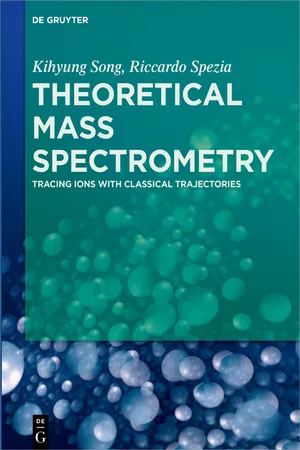
This book discusses fragmentation mechanisms of molecules under mass spectrometry conditions and the resulting peaks observed in ESI-MS/MS experiments. The underlying principles are used to understand everything from small molecules to biological poly-peptides collision induced dissociation. In a theoretical approach, gas phase reactivity of molecular ions is coupled with chemical dynamics simulations.
eBook - ePub
Theoretical Mass Spectrometry
Tracing Ions with Classical Trajectories
- 242 pages
- English
- ePUB (mobile friendly)
- Available on iOS & Android
eBook - ePub
About this book
Information
Topic
Physical SciencesSubtopic
Analytic Chemistry1Introduction
Theoretical chemistry has made enormous progress in recent years mainly thanks to advances in two areas: (i) methods and algorithms and (ii) computational power. Nowadays, many properties of molecules can be predicted by simple quantum chemistry calculations, which consist in giving initial positions to the nuclei composing a given molecule via an adapted software and obtaining requested properties as output. This apparently simple and somehow black-box procedure is composed by simple elementary steps that can be summarized as follows:
- Given a guess of atomic arrangement, which reflects some “chemical knowledge” or “intuition,” the electronic energy is calculated following a chosen quantum chemistry method, providing the wave function and energy;
- From the quantum mechanical energy, the gradient is also calculated and a “geometry optimization” procedure starts, leading to a topological point, which is (generally) a minimum on the potential energy surface, characterized by zero first derivatives and positive second derivatives. Algorithms were optimized in order to find the correct minimum and likely the absolute minimum.
- Once a correct (and desired) geometry is located, it is possible to get the desired information from the wave function.
This conceptually simple procedure, which hides many complex aspects as we will describe in detail, particularly in Chapter 4, is able to provide a microscopic description of a given molecule in terms of atomic distances, angles, etc ...and more in general on its three-dimensional arrangement. Other important information obtained is the electronic energy, which corresponds to the energy to put together the N nuclei and M electrons composing the molecular system under study.
Knowledge of the wave function, the geometry and the energy of the molecule, allows theoretical calculations of several spectroscopic properties, such that many experimental spectra can be obtained from standard quantum chemistry calculations. In particular, almost standard procedures are present in the literature and integrated in most common quantum chemistry software, like for example:
–Infrared (IR) and Raman vibrational signatures are obtained in the harmonic approximation from the diagonalization of the Hessian matrix (which is the matrix of second derivatives, see Section 3.5.1) to locate normal modes and the evaluation of the oscillator strengths from dipole or polarizability that are accessible from the electronic density (which results from the electronic wave function) [1, 2]. Quantum chemistry represents a very powerful tool since it is possible, by reproducing the experimental vibrational spectra, to clearly characterize the geometry of a molecule. While at the beginning these calculations were limited to (small) molecules in the gas phase, nowadays it is possible to study larger molecules in solution and also to include anharmonic effects [3]. Finally, molecular dynamics is emerging as an alternative tool [4] which, even if computationally expensive, is useful in case of large anharmonic effects or when the molecule under investigation is immersed in a complex environment.
–UV-visible spectra can be obtained from calculations of excited states and relative transition intensities from the transition dipole moments. Given a ground state geometry it is possible to calculate the excited states via wave function approaches and/or via time-dependent density functional theory. Without going into the details of these theoretical methods, the idea is that the energy between electronic states can be obtained and thus compared to experiments. As for vibrational spectroscopy, it is thus possible to make a correspondence between the molecular structure and the spectroscopic information. Calculations are performed in gas phase but also in solution and in complex environments. In this last case, molecular dynamics simulations are often performed to sample the relevant conformations (of the molecule and for molecule/environment interaction).
–Also nuclear magnetic resonance (NMR) chemical shifts can be evaluated from quantum chemistry, and this requires (similarly to experiments) the use of a reference molecule. The shielding tensor can be obtained formally from the second derivative of the quantum-mechanical energy with respect to the external magnetic field and the magnetic moment of the nucleus. The spin-spin coupling constants can be calculated as well as the complete anisotropic shift tensors. [5, 6] Calculations and experiments can thus be directly compared.
The list of other spectroscopies that can be modeled using quantum chemistry calculations independently from any experimental information is nowadays very long; we can add electron paramagnetic resonance (EPR) spectroscopy, Resonance Raman, and microwave spectroscopy, just to give a few further examples. The powerful use of quantum chemistry resides in its capability of reproducing experimental observables in away that is totally independent from experiments, such that they can be (i) predictive and (ii) used to decipher many molecular properties (the first being the structure) from theory-experiment convergence.
Mass spectrometry is a longstanding physical chemistry experimental approach aimed at studying molecules in the gas phase, which is very powerful in many aspects, from fundamental science to application in analytical sciences. However, a well-established theoretical approach independent from experiments aimed to provide a theoretical mass spectra was missing. The reason is that from one side, a mass spectrum is basic and simple. It gives the mass-over-charge (m/z) ratio of the species present in the mass spectrometer, so the calculations one aims to perform seem very simple (even too simple): to identify the molecule from its brute formula. The geometrical information is not given by the experiments, so one can argue that the geometry is the minimum energy structure. On the other hand simple m/z recording of molecular ions formed in the gas phase is only the first step: often these ions are activated such that they fragment, giving rise to the so called tandem mass spectrum. The result of an activation process is an ensemble of chemical reactions belonging (in general) to the class of unimolecular dissociation. Sometimes, when the ion is brought to interact with a reactive species, bimolecular reactions are also performed. This means that now we have a complex information, somehow too complex for using a theoretical approach analogue to what used to model the spectroscopic signals mentioned previously.
Theoretical calculations should then deal with the full set of reaction products, given the activation mode employed. In general, quantum chemistry is used to identify the reaction pathways once the products are known. This can be satisfactory for (very) small molecules in which the products as well as the possible mechanisms are few. For larger systems, the identification of the reaction pathway(s) is done but is often questionable if there are no other pathways and, from a more fundamental point of view, if the system takes such a simple minimum energy pathway (MEP) on a complex potential energy surface. Chemical dynamics was thus used in pioneering studies of Hase and coworkers [7–10] in particular to model collision induced dissociation (CID). Since then, progress in modeling CID has occurred and nowadays it is not impossible to obtain a mass spectrum from mere theoretical calculations, i.e., without information on products from experiments. This book is devoted to explaining the different aspects that must be considered when dealing with a theoretical mass spectrum based on chemical dynamics via an ensemble of trajectories.
As we will see through the different chapters of this book, one needs to carefully consider the different aspects involved in the formation of a tandem mass spectrum. A first important point is to clearly decipher the underlying physics of the experiments and, in particular, the way the molecular ion is activated. This is why we detail some aspects of experimental tandem mass spectrometry in Chapter 2. Then we describe the basics of the chemical dynamics approach used to obtain a theoretical mass spectrum: trajectory methods in Chapter 3 and the way the interaction potential can be obtained in Chapter 4.
As we will see, chemical dynamics simulations provide the dynamical aspects of the chemical reactivity. This can be compared and complemented by a kinetics study. The calculations of rate constants for simple chemical events (such as uni- and bimolecular reactions) were the subject of much progress in recent decades and the key points are summarized in Chapter 5. It is important to have these aspects in mind for several reasons. One important one is to understand if the dynamical description obtained in simulations follows statistical (kinetics) behavior and thus whether the time scale simulated is representative of full reactivity. It is also important to complete the reactivity obtained in the short times of explicit dynamics with long time scale reactivity, which can be obtained by a statistical (analytical) approach.
Before showing some applications of theoretical mass spectrometry, we have summarized in Chapter 6 all the different aspects used (and needed) to perform such kinds of dynamical simulations. We then show in Chapters 7 and 8 recent applications to the study of organic and biological molecules, respectively.
Finally, in Chapter 9 we provide some conclusions and, more importantly, some suggestions for future developments. Actually, the theoretical modeling of mass spectra is much more a reality than ten years ago, but improvements are still needed. We will review some of them and we hope that this can induce future studies in this relatively new field of theoretical chemistry.
Before moving to the core of the present work, we should conclude with a nominalistic detail. Here and hereafter, we refer to “chemical dynamics” when dealing with simulations relative to theoretical mass spectrometry and not to “molecular dynamics.” There is a subtle difference between the two simulations. Molecular dynamics, which is a huge field of theoretical methods with a huge variety of applications, is intended to give equilibrium properties following the ergodic hypothesis, such that an observable is obtained as the average on a long enough “equilibrated” trajectory. Chemical dynamics, on the other hand, is aimed in studying the dynamics of a reaction that can be out-of-equilibrium, as often occurs in gas phase. In gas phase reactivity, in fact, once the products are obtained it is very unlikely that they are converted back to the reactants. This means that the statistical average should be done on the number of events and not on a single trajectory. However, apart from this kind of nominalistic difference, they have many aspects in common. A reader can enjoy finding common features and differences in the present work.
2Principles of Experimental Mass Spectrometry
2.1Introduction
In this chapter, wewill review the basic characteristics and principles of experimental mass spectrometry, with a particular aim in describing the tandem mass spectrometry (MS/MS) that is generally coupled to electrospray ionization (ESI), in particular for studying organic and biological molecules leading to the so called ESI-MS/MS. Readers interested in more experimental and application details can refer to specialized books on the field (see for example [11] and [12]).
Mass spectrometry covers an ensemble of physical and analytical chemistry techniques that are based on the de...
Table of contents
- Cover
- Title Page
- Copyright
- Acknowledgments
- Contents
- List of abbreviations
- Physical constants
- 1 Introduction
- 2 Principles of Experimental Mass Spectrometry
- 3 Classical Trajectory Methods
- 4 Interaction Energy
- 5 Principles of Chemical Kinetics
- 6 How to Simulate Real Systems
- 7 Application to Organic Molecules
- 8 Application to Biological Molecules
- 9 Summary and Future Directions
- A Mathematical Compendium
- B Principles of Classical Mechanics
- List of Figures
- List of Tables
- Bibliography
- Index
Trusted by 375,005 students
Access to over 1.5 million titles for a fair monthly price.
Study more efficiently using our study tools.
Frequently asked questions
Yes, you can cancel anytime from the Subscription tab in your account settings on the Perlego website. Your subscription will stay active until the end of your current billing period. Learn how to cancel your subscription
No, books cannot be downloaded as external files, such as PDFs, for use outside of Perlego. However, you can download books within the Perlego app for offline reading on mobile or tablet. Learn how to download books offline
We are an online textbook subscription service, where you can get access to an entire online library for less than the price of a single book per month. With over 1.5 million books across 990+ topics, we’ve got you covered! Learn about our mission
Look out for the read-aloud symbol on your next book to see if you can listen to it. The read-aloud tool reads text aloud for you, highlighting the text as it is being read. You can pause it, speed it up and slow it down. Learn more about Read Aloud
Yes! You can use the Perlego app on both iOS and Android devices to read anytime, anywhere — even offline. Perfect for commutes or when you’re on the go.
Please note we cannot support devices running on iOS 13 and Android 7 or earlier. Learn more about using the app
Please note we cannot support devices running on iOS 13 and Android 7 or earlier. Learn more about using the app
Yes, you can access Theoretical Mass Spectrometry by Kihyung Song,Riccardo Spezia in PDF and/or ePUB format, as well as other popular books in Physical Sciences & Analytic Chemistry. We have over 1.5 million books available in our catalogue for you to explore.