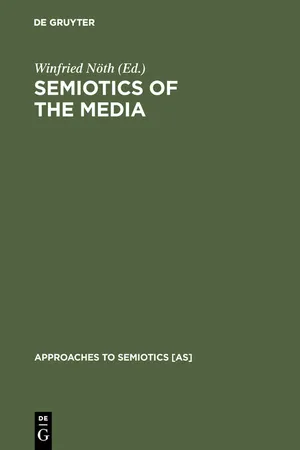
- 908 pages
- English
- PDF
- Available on iOS & Android
eBook - PDF
About this book
No detailed description available for "Semiotics of the Media".
Information
Table of contents
- Contents
- Introduction
- Part I: Semiotic foundations of the media
- Media and self-reference: The forgotten initial state
- Media between Balnibarbi and Plato's Cave
- The multimediation of the lifeworld
- The sign as medium, the medium relation as the foundation of the sign
- Semiosis of the mass media: Modeling a complex process
- The media contract
- Part II: Pictorial and graphic semiotics
- Semiotics and ethics: The image of semiotics and semiotics of the image
- The prephotographic, the photographic, and the postphotographic image
- Can pictures lie?
- On the semiotics of the image and the computer image
- Pictorial metaphor in commercial advertising
- Representation and legitimacy: A semiotic approach to the logo
- Indexical/iconic tensions: The semiotics of the postage stamp
- Combining the information of maps and other media while hiking
- Part III: Film, acting, and intermediality in the movies
- The delay of the cinema age
- The dialectic of the sign or journeys to Cape Fear
- Natural born killers: Rhythms of the filmic image and styles of violence
- “How did you find us?” — “We read the script!”: A special case of self-reference in the movies
- Words created in their own image
- Discursive stupidity: Abduction and comic in “Monty Python’s Flying Circus”; From Peirce to Freud
- The semiotics of eating and orality in the movies
- Star images: Questions for semiotic analysis
- Film acting and gender: Method acting and the male tantrum
- On some aspects of intermedial film transfer
- Media shift and intertextual reference
- Death and rebirth of the author: On a specific case of an intermedial chiasmus between literature and film
- Part IV: Television, video, and radio
- Television: The semiotic phenomenology of communication and the image
- Where is the subject in the macromedia? The question of zapping
- The surrogate audience: Ostension of spectator response in televised shows
- Liquid images: A semiotic analysis of on-air promotion and TV design of TV stations
- Foreshadowing virtual reality in narrative and film
- TV is dead, video is born: Dialogue on new intermedia communication
- Audience participation games: Consideration for parties other than the actual participant
- Part V: Computers, electronic networks, hypertext, and cyberspace
- Objects and the world metaphor: A semiotic engineering approach
- Semiotics of computer media in architecture
- “Electronic communities” as social worlds: Toward a sociosemiotic analysis of computer mediated interpersonal communication
- The cold warmth of communication in computer networks
- Semiosis at computer media
- Hypertextuality and multimedia literature
- Linguistic orientation in computational space
- Principles of spatialization in text and hypertext
- Part VI: Time, memory, media, and the semiotics of the museum
- The medium is the memory: Ars memoriae in its age of technical reproducibility
- The role of memory in the contemporary acceleration of cultural proliferation
- Listening to the virtual past
- The museum as a political media: A semiological assault
- The museum as semiotic frame: “Degenerate art” in the thirties and the nineties
- Western heritage and its autres: Cowboys and Indians, facts, and fictions
- Part VII: Aesthetic aspects of the media
- Innovation, gainful learning, and habits in the aesthetics of media
- Deep structure and design configurations in paintings
- Architecture as a mass medium?
- Poems on the bus: Some practical aspects of the reception of poetry in the mass media
- The form of the media: The intermediality of visual poetry
- Poetic aspects of a multimedia text
- Graphic notation and musical graphics: The nonnotational sign systems in new music and its multimedial, intermedial, extended-medial, and mixed-medial character
- Part VIII: Sociosemiotics and today’s myths in the media
- Divination as a mass media event
- Media, death, and democracy
- Myth of the Occident and its manifestations in the Chinese media
- Media coverage of the unreasonable in the land of hyperreason
- The media and logic of concrete action in the “housekeeping” press
- The desire of “crises”: An Occidental way of existing
- Invitation to travel: The window-shop relationship in the communication of fashion
- Nonverbal signs in an intercultural business negotiation
- Part IX: Appendix
- Index of names
- Index of subjects
Trusted by 375,005 students
Access to over 1.5 million titles for a fair monthly price.
Study more efficiently using our study tools.
Frequently asked questions
Yes, you can cancel anytime from the Subscription tab in your account settings on the Perlego website. Your subscription will stay active until the end of your current billing period. Learn how to cancel your subscription
No, books cannot be downloaded as external files, such as PDFs, for use outside of Perlego. However, you can download books within the Perlego app for offline reading on mobile or tablet. Learn how to download books offline
Perlego offers two plans: Essential and Complete
- Essential is ideal for learners and professionals who enjoy exploring a wide range of subjects. Access the Essential Library with 800,000+ trusted titles and best-sellers across business, personal growth, and the humanities. Includes unlimited reading time and Standard Read Aloud voice.
- Complete: Perfect for advanced learners and researchers needing full, unrestricted access. Unlock 1.5M+ books across hundreds of subjects, including academic and specialized titles. The Complete Plan also includes advanced features like Premium Read Aloud and Research Assistant.
We are an online textbook subscription service, where you can get access to an entire online library for less than the price of a single book per month. With over 1.5 million books across 990+ topics, we’ve got you covered! Learn about our mission
Look out for the read-aloud symbol on your next book to see if you can listen to it. The read-aloud tool reads text aloud for you, highlighting the text as it is being read. You can pause it, speed it up and slow it down. Learn more about Read Aloud
Yes! You can use the Perlego app on both iOS and Android devices to read anytime, anywhere — even offline. Perfect for commutes or when you’re on the go.
Please note we cannot support devices running on iOS 13 and Android 7 or earlier. Learn more about using the app
Please note we cannot support devices running on iOS 13 and Android 7 or earlier. Learn more about using the app
Yes, you can access Semiotics of the Media by Winfried Nöth in PDF and/or ePUB format, as well as other popular books in Languages & Linguistics & Linguistics. We have over 1.5 million books available in our catalogue for you to explore.