The book begins with an introduction of blind equalization theory and its application in neural networks, then discusses the algorithms in recurrent networks, fuzzy networks and other frequently-studied neural networks. Each algorithm is accompanied by derivation, modeling and simulation, making the book an essential reference for electrical engineers, computer intelligence researchers and neural scientists.
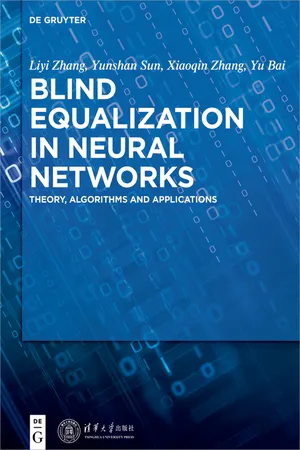
eBook - ePub
Blind Equalization in Neural Networks
Theory, Algorithms and Applications
- 268 pages
- English
- ePUB (mobile friendly)
- Available on iOS & Android
eBook - ePub
Blind Equalization in Neural Networks
Theory, Algorithms and Applications
About this book
Information
1Introduction
Abstract: In this chapter, the research significance and the application field of blind equalization (BE) are analyzed. The classification and research status of the neural network BE algorithm are summarized. The research background and the main work of this book are pointed out.
1.1The research significance of the BE technology
The concept of BE (called as the self-recovering equalization at that time) was proposed by the Japanese scholar professor Y. Sato [1] first in 1975. It has gradually become a key technology of digital communication, and also a frontier and hot research topic of communication and signals processing, because it can overcome the inter-symbol interference (ISI) effectively, reduce the bit error rate (BER), and improve reception and the quality of communication.
BE is set up on the basis of overcoming the defects of the adaptive equalization. BE only uses the prior information of received sequence itself to equalize channel characteristics, instead of sending the training sequence. As a result, the output sequence of the equalizer approximates the transmitted sequence as far as possible.
Before data transmission, a training sequence known by the receiver needs to be transmitted in the adaptive equalization. Then, the changes or errors of the sequence passing through the channel are measured by the receiver. According to the error information, parameters of equalizer are adjusted. Eventually, the channel characteristic is compensated by the equalizer. As a result, the almost undistorted signals are obtained from the sequence of equalizer output, and the reliable data transmission is guaranteed. The process is called as automatic equalization. At this time, the equalizer is in training mode. When the training process is over, the adjustment of equalizer parameter gets convergence, the reliability of decision signals is higher, and the error rate is less.
After the training process, the data begin to transmit. At that time, the transmitted signals are unknown. In order to track possible changes of channel characteristics dynamically, the receiver takes output decision signals of the equalizer as the reference signals. These reference signals are used to measure the errors produced by channel changes and to adjust the equalizer’s output signals continuously. At this time, the above-mentioned process is called as decision-directed equalization. According to the theory of adaptive filter, the condition for the equalizer to work properly under decision-directed mode is that the eye pattern opens to a certain extent in advance. The above condition can ensure equalizer-reliable convergence. If the condition is not satisfied, a training sequence known by the receiver will be sent by the sending end to train the equalizer again, and make it get convergence. Thus, the training process is also called as the learning process of the equalizer. For the general communication system, the training process is indispensable.
The development and application of the equalization technology improve the performance of communication system greatly. Just as R.D. Gitlin et al. [2] said, the revolution of the data communications can be traced back to the discovery of automatic and adaptive equalization technology in the late 1960s. However, with the development of digital communication technology to wide band, high speed, and large capacity, the shortcomings and defects of the adaptive equalization technology are increasingly exposed, mainly in the following [3]:
(1)The training sequence does not transmit useful information, so the information transmission rate of the communicati...
Table of contents
- Cover
- Title Page
- Copyright Page
- Preface
- Contents
- 1 Introduction
- 2 The Fundamental Theory of Neural Network Blind Equalization Algorithm
- 3 Research of Blind Equalization Algorithms Based on FFNN
- 4 Research of Blind Equalization Algorithms Based on the FBNN
- 5 Research of Blind Equalization Algorithms Based on FNN
- 6 Blind Equalization Algorithm Based on Evolutionary Neural Network
- 7 Blind equalization Algorithm Based on Wavelet Neural Network
- 8 Application of Neural Network Blind Equalization Algorithm in Medical Image Processing
- Appendix A: Derivation of the Hidden Layer Weight Iterative Formula in the Blind Equalization Algorithm Based on the Complex Three-Layer FFNN
- Appendix B: Iterative Formulas Derivation of Complex Blind Equalization Algorithm Based on BRNN
- Appendix C: Types of Fuzzy Membership Function
- Appendix D: Iterative Formula Derivation of Blind Equalization Algorithm Based on DRFNN
- References
- Index
Trusted by 375,005 students
Access to over 1.5 million titles for a fair monthly price.
Study more efficiently using our study tools.
Frequently asked questions
Yes, you can cancel anytime from the Subscription tab in your account settings on the Perlego website. Your subscription will stay active until the end of your current billing period. Learn how to cancel your subscription
No, books cannot be downloaded as external files, such as PDFs, for use outside of Perlego. However, you can download books within the Perlego app for offline reading on mobile or tablet. Learn how to download books offline
Perlego offers two plans: Essential and Complete
- Essential is ideal for learners and professionals who enjoy exploring a wide range of subjects. Access the Essential Library with 800,000+ trusted titles and best-sellers across business, personal growth, and the humanities. Includes unlimited reading time and Standard Read Aloud voice.
- Complete: Perfect for advanced learners and researchers needing full, unrestricted access. Unlock 1.5M+ books across hundreds of subjects, including academic and specialized titles. The Complete Plan also includes advanced features like Premium Read Aloud and Research Assistant.
We are an online textbook subscription service, where you can get access to an entire online library for less than the price of a single book per month. With over 1.5 million books across 990+ topics, we’ve got you covered! Learn about our mission
Look out for the read-aloud symbol on your next book to see if you can listen to it. The read-aloud tool reads text aloud for you, highlighting the text as it is being read. You can pause it, speed it up and slow it down. Learn more about Read Aloud
Yes! You can use the Perlego app on both iOS and Android devices to read anytime, anywhere — even offline. Perfect for commutes or when you’re on the go.
Please note we cannot support devices running on iOS 13 and Android 7 or earlier. Learn more about using the app
Please note we cannot support devices running on iOS 13 and Android 7 or earlier. Learn more about using the app
Yes, you can access Blind Equalization in Neural Networks by Liyi Zhang, Tsinghua University Press in PDF and/or ePUB format, as well as other popular books in Ciencia de la computación & Inteligencia artificial (IA) y semántica. We have over 1.5 million books available in our catalogue for you to explore.