eBook - ePub
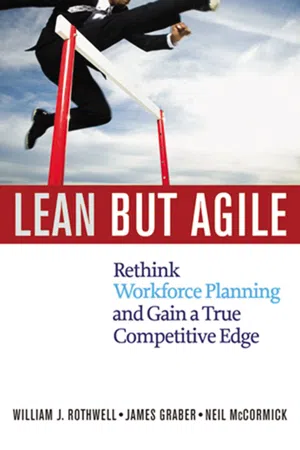
Lean but Agile
Rethink Workforce Planning and Gain a True Competitive Edge
- 240 pages
- English
- ePUB (mobile friendly)
- Available on iOS & Android
eBook - ePub
Lean but Agile
Rethink Workforce Planning and Gain a True Competitive Edge
About this book
As organizations strive to meet stringent budgets, the mandate to produce greater results with fewer resources is no longer sufficient. Rather than accepting less, managers and executives must strive for better--evaluating every process and every role and doing away with assumptions about how work gets done and who does it in order to streamline processes and maximize efficiency. William Rothwell, who was honored with the ASTD Distinguished Contribution Award in Workplace Learning and Peformance, presents a system for analyzing work and selecting the ideal combination of cost-effective resources--employees, consultants, contractors, temporary workers, and vendors--to accomplish it. Lean but Agile does this by teaching readers to focus on outcomes and work backwards--exploring the introduction, implementation, and management of lean work and agile staffing methods that will produce those outcomes. You'll also learn about advantageous changes in hiring, goal-setting, learning and development, and performance management, and the fundamental role technology can play in transforming your processes. Packed with practical advice, examples, guides, worksheets, diagrams, and metrics, Lean but Agile will help leaders, managers, and human resource professionals optimize their workforces while still achieving superior results.
Information
Subtopic
Bookkeeping & BudgetsIndex
BusinessCHAPTER 1
AN INTRODUCTION TO LEAN BUT AGILE WORK AND WORKFORCE PLANNING
WHAT IS YOUR ORGANIZATION DOING to hold down employment expenses while simultaneously ensuring that work results meet or exceed customer requirements? How is your organization experimenting with new ways of staffing the work to be done while also achieving the best results? How well is your organization planning systematically for the quantity and quality of people needed to achieve work results in line with customer needs? Read the following vignettes and describe how your organization would meet the challenges you find in each. If your organization has ways to solve all of these problems, then perhaps it already has a way to plan comprehensively and systematically for work results and ways for workers to achieve those results. But if your organization cannot solve most of the problems presented here, then your leaders may want to consider a Lean but Agile approach to planning for the work and workforce.
Traditional Views of Work Planning and Workforce Planning
As the preceding vignettes illustrate, employers globally are struggling with how to achieve the best work results. Driven by a need to lower costs while increasing productivity, they are not always following traditional ways of planning the work and the workforce. But what are these traditional approaches? What is traditional work planning? What is traditional workforce planning?
Traditional Work Planning
Traditional ways of thinking about planning for work have their roots in the industrial age. An organizational structure (organization chart) is established to allocate responsibilities for various work activities. These activities, in turn, are then broken down further into departments, work groups, jobs, and tasks.
Traditional thinking about work planning emphasizes the work process, that is, how the work is done. Little or no attention is devoted to clarifying in detail the measurable work outcomes desired by customers or other stakeholders who care about the work. In some circles, work planning is actually confused with project planning, which is just one way to organize the work to be accomplished. The important point to understand, however, is that the workforce needed to achieve desired work results depends on how the work is done and the desired outcomes. Employers are already experimenting with new ways to get work done. Those experiments affect the workforce needed to achieve work results.
Traditional Workforce Planning
Much has been written about workforce planning in recent years. Indeed, workforce planning has garnered far more attention than has work planning. One reason is that many employers are keenly aware that labor costs are a major expense in doing business. Modern accounting methods treat labor as a cost of doing business while ignoring the critical importance of human creative talent as the only active ingredient that can serve as a catalyst to add value to land, finances, technology, or other assets.
Traditional workforce planning follows the logic of economics. As demand for products or services increases, it creates a demand for labor to make the products or deliver the services. Labor demand refers to the quantity and quality of people needed to meet production or service delivery requirements. Labor supply refers to the quantity and quality of people currently employed by the organization. As labor demand increases as a function of production or service demand, more people are needed to meet the demand. In short, a larger supply of people is needed.
But this relationship is not precise. Sometimes the number of workers affects productivity directly. In other cases, such as managerial work, managers can oversee increasing employees until a tipping point is reached. To complicate matters, sometimes the quality of workers affects productivity. A few talented people may outperform an army.
The traditional approach to workforce planning, based in economics, has some distinct disadvantages. The first disadvantage is that future labor demand is forecasted based on past experience. In short, economists tend to assume that the same quantity and quality of people will be needed to achieve future results as were needed to achieve past results. Unfortunately, technology and other productivity breakthroughs can actually change the quantity and quality of people needed in the future. The second disadvantage is that economists struggle with the notion of differences in individual talent. Not all people are equally productive, or even equally productive in the same ways. Some people are simply more productive than others, and talents—understood to mean personal strengths in this context—differ on an individual basis. Some research suggests that the difference between the average and the most productive worker can be as high as eleven times.
Many methods are available to conduct workforce planning. They are drawn from quantitatively focused approaches from statistics, econometrics, or operations research and from qualitatively focused approaches to problem solving. Few organizations undertake any form of systematic, comprehensive workforce planning. In fact, one study found that as many as two-thirds of U.S. employers do no comprehensive workforce planning.1 Instead, jobs are typically approved in many organizations on a case-by-case basis as vacancies become available or as work demand increases. The result: The collective competencies and talents of the entire organization’s workforce is never assessed against the requirements needed to achieve the organization’s strategic goals. The result is that the labor force of many organizations can drift away over time from the best fit to achieve desired work results.
A New Approach to Workforce Planning
A review of changing conditions in business over the past sixty years provides an important backdrop for understanding the need for change in many business practices. The years from 1950 to 1970 were a golden age of business stability for industrialized nations. Human resources practices were designed to be responsive to those conditions. Building a stable workforce was the priority. As detailed by Peter Cappelli,2 the following conditions prevailed:

Table of contents
- Cover Page
- Title Page
- Copyright Page
- Contents
- Preface
- Acknowledgments
- Chapter 1 An Introduction to Lean but Agile Work and Workforce Planning
- Chapter 2 Optimize the Work
- Chapter 3 Create a Talent Pool for a Lean but Agile Workforce
- Chapter 4 Optimize the Workforce
- Chapter 5 Optimize the Future Work and Workforce
- Chapter 6 Manage and Maintain a Lean but Agile Workforce
- Chapter 7 Bring Lean but Agile Work and Workforce Planning into Your Organization
- Chapter 8 The Future of Lean but Agile Work and Workforce Planning
- Appendix Talent2 Human Resources Performance Audit Process Framework
- Notes
- Index
- About the Authors
Trusted by 375,005 students
Access to over 1.5 million titles for a fair monthly price.
Study more efficiently using our study tools.
Frequently asked questions
Yes, you can cancel anytime from the Subscription tab in your account settings on the Perlego website. Your subscription will stay active until the end of your current billing period. Learn how to cancel your subscription
No, books cannot be downloaded as external files, such as PDFs, for use outside of Perlego. However, you can download books within the Perlego app for offline reading on mobile or tablet. Learn how to download books offline
Perlego offers two plans: Essential and Complete
- Essential is ideal for learners and professionals who enjoy exploring a wide range of subjects. Access the Essential Library with 800,000+ trusted titles and best-sellers across business, personal growth, and the humanities. Includes unlimited reading time and Standard Read Aloud voice.
- Complete: Perfect for advanced learners and researchers needing full, unrestricted access. Unlock 1.5M+ books across hundreds of subjects, including academic and specialized titles. The Complete Plan also includes advanced features like Premium Read Aloud and Research Assistant.
We are an online textbook subscription service, where you can get access to an entire online library for less than the price of a single book per month. With over 1.5 million books across 990+ topics, we’ve got you covered! Learn about our mission
Look out for the read-aloud symbol on your next book to see if you can listen to it. The read-aloud tool reads text aloud for you, highlighting the text as it is being read. You can pause it, speed it up and slow it down. Learn more about Read Aloud
Yes! You can use the Perlego app on both iOS and Android devices to read anytime, anywhere — even offline. Perfect for commutes or when you’re on the go.
Please note we cannot support devices running on iOS 13 and Android 7 or earlier. Learn more about using the app
Please note we cannot support devices running on iOS 13 and Android 7 or earlier. Learn more about using the app
Yes, you can access Lean but Agile by William Rothwell,Jim Graber,Neil McCormick in PDF and/or ePUB format, as well as other popular books in Business & Bookkeeping & Budgets. We have over 1.5 million books available in our catalogue for you to explore.