eBook - ePub
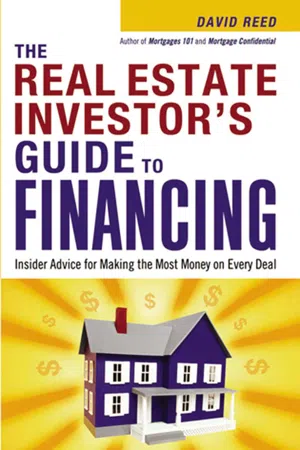
The Real Estate Investor's Guide to Financing
Insider Advice for Making the Most Money on Every Deal
- 240 pages
- English
- ePUB (mobile friendly)
- Available on iOS & Android
eBook - ePub
The Real Estate Investor's Guide to Financing
Insider Advice for Making the Most Money on Every Deal
About this book
To get the biggest return, real estate investors need the right financing. And as they buy multiple properties, their debt to equity rises, making it more difficult to get the kind of deal they need. As many investors have learned the hard way, getting the wrong financing can wipe out their profits, hold them back from selling because of a lack of equity, or force them to try to sell for more than the market will bear. The Real Estate Investor's Guide to Financing is the one book that shows readers how to get the right financial package for the biggest return on their investment. As a respected author and mortgage banker, David Reed has spent more than 20 years helping investors finance their properties. Here, he offers advice on such crucial topics as: * financing options for different property types * the financial implications of renting vs. flipping * setting rental rates * the challenges and benefits of being a landlord, including rent loss coverage * the pros and cons of having partners * tips on financing a second home, duplex, multi-family unit, or condo Complete with essential advice on financing and a glossary of investment terms, this is the one guide that will help readers start making real money.
Information
CHAPTER 1
Basic Finance for the Investor
While there are certainly plenty of real estate books on the market that specialize in real estate investment, those same books fall short when it comes to one of the most important aspects of real estate investing: financing.
Buying real estate as an investment can bring great rewards. Holding real estate and watching its value rise over the long term is a nice way to retirement for many people.
One of the advantages of real estate can also be a disadvantage, however. It’s not a liquid asset. You can’t get your money out of it as easily as you can get money out of an ATM. If it’s a stinker, you have to sell it, and that takes time and it takes money.
You can’t just change your mind because of a heavy dose of buyer’s remorse, take your receipt for your investment condo back to the store, and get your money back after saying something like, “Well, it was the wrong size, and my aunt gave me one for Christmas.”
Real estate investment needs commitment. You need to decide that it’s right for you before you get involved.
There are two different types of investors: those who buy and hold, and those who buy and sell quickly, a process that is often called flipping. Flippers attempt to find bargains, fix them up, then sell them for a profit. And these two types of investors are not exclusive; you can both be a flipper and hold for the long term.
Flipping brings a whole new element to real estate investing compared to simply holding onto property for a long period of time, then either selling it when you think you’ve made enough money or keeping it and passing it down to your grateful heirs.
Flipping requires more than just buying; it requires you to know how to make repairs on a home and evaluate how much of a return in the form of increased value those repairs would generate. Or maybe the issue isn’t just increased value but simply making the place livable.
Flipping requires different financing strategies from those used for long-term investments. Any real estate investment book you read concentrates more on either finding, fixing, and flipping real estate or finding and keeping real estate while paying little attention to the financial aspect—perhaps one of the most critical pieces of the real estate investment puzzle.
Getting the wrong financial package can wipe out your profits, hold you back from selling because of lack of equity, or perhaps require you to sell for more than the market will bear because of the bad loan you got when you bought the property in the first place.
If you’re a flipper, financing is critical. If you’re long term, financing is also critical, but at least in long-term deals you can always refinance the property down the road if you made a bad loan choice in the beginning. We’ll discuss refinancing investment properties in detail in Chapter 4.
But then again, because you’re reading this book, you won’t be making those mistakes, now will you?
One advantage that a long-term investor has is the ability to buy in other markets.
Let’s say, for instance, that your local real estate market is humming right along. You know that you can find a property, fix it up, and sell it for a profit. Or maybe your market is really moving and you can find a piece of property that takes absolutely no work (or very little), and because of the real estate demand in your area, you know you can make another 10 percent on your investment.
You know you can do this because you know your market. You know the neighborhoods. You know the contractors who work on your properties, or if you do most of the rehab yourself, you can drive to the job site every day.
That’s not true if you’re buying in Texas and you live in California. Yes, you can fly in and look at properties, but if you want to fix and flip, you’ve got a brand-new problem. How do you find someone you trust to be the contractor while you’re a couple of time zones away? How do you monitor the contractor’s progress?
How do you pay the workers, and how do you make sure they’re not sitting around drinking beer all day long while you’re frantically trying to get your contractor to return your voicemails?
The truth is, you can’t. If you’re a flipper, then a long-distance rehab project may not be for you. In fact, if you were planning on making $20,000 on a nice little flip, then all the labor, plane fare, and headaches won’t be worth it at the end.
Yes, you can be a long-distance flipper if the properties you’re buying don’t need any work and you think you can sell them quickly and for a profit. Yet, you’re not local. You’re not the only real estate investor, and there will be local professional investors who can sniff out a flip a lot more quickly than you can simply by being where the property is. By the time you’ve found a potential investment, gotten on the plane, and rented a car to look at your potential investment, if it was such a good deal, it’s probably been snatched up while you were checking your bags.
I will note that sometimes faraway investors can have the upper hand when they’re in a part of the country that is doing better economically than the locale they want to invest in.
For instance, a town may have experienced some huge layoffs as a result of downsizing, creating a significant economic hit. If you are living in an area that is not depressed, you may have more disposable income and be able to buy a house for less than market value.
But even then, as a flipper, if you invest in a depressed area, who are you going to sell to—another flipper? If the local economy you’re buying into is in the middle of some major economic upheaval, then home buyers aren’t exactly going to be lining up along the street waiting to bite on that “bargain” house you found. Many of the people in the town where you found your bargain have, unfortunately, been laid off.
Being a long-distance flipper, then, is a challenge. You don’t know the area as well as the locals do, you can’t monitor your project efficiently, and it’s hard to find buyers in a depressed market.
On the other hand, such opportunities bode well for long-term investors. If you see that a certain area outside where you live is going through some difficult times, you can find a bargain house and hold onto it, waiting to sell until the economy recovers.
I own a home in Austin, Texas, that I bought in the late 1990s. The seller was an investor from California who had bought the house some 10 years earlier—right in the middle of the S&L debacle. Combine that crisis with an oil and gas industry that was suffering through perhaps one of its most trying times, and you can see why real estate in Texas was depressed.
The investor bought in 1988 during an economic downturn in Texas and sold 10 years later, doubling his money, after the economy recovered. He was long term.
Not just that, but the property I bought was listed as a “fixer-upper” that needed some “tender loving care,” meaning that it had its challenges. In fact, the California owner had never lived in the property but had rented it to various people for the entire decade.
When I bought the house, it needed some work. The carpet was old, the tile in the kitchen area was coming up, and the entire house needed some significant updating—Significant with a capital S.
My wife and I had been looking in that particular part of Austin for nearly a year, trying to find the perfect deal. We had seen so many similar houses that we knew immediately that the property was a steal. The property had been listed, and within 24 hours of its original listing, it had had three offers—all from locals.
We not only offered the asking price but also bumped it up by a few thousand dollars (because we knew we had found a bargain) and won the bid. We bought the home, completely remodeled it, and turned it into a very nice piece of property. We still own the home today, and the property has appreciated nearly fourfold since we bought it. And I doubt that we will ever sell it. Okay, we will, but not for a long, long time. I know the area, and it’s a keeper.
Sometimes people get into real estate investments by accident. For instance, you find a house you really, really want to move into, but your current property isn’t selling for what you’d like to sell it for, so you keep it and rent it out.
Or perhaps you inherited a property from a relative and decide to keep it long term and not sell right away.
Occasionally life simply causes you to get into real estate when you had no initial motivation to do so. You’d never thought of it, and now you’re in it. And you find out you like it!
The Pros and Cons of Being a Landlord
First and foremost, the landlord owns the property and collects (hopefully) the rent each month. The landlord is also at the bidding of her tenants when it comes to repairs and maintenance of the property.
This doesn’t mean day-to-day maintenance. A landlord may not be responsible for a clogged sink, but he might be responsible if the clogged sink is due to tree roots from outside the house invading the outdoor plumbing.
Typically, if something goes wrong, you as the landlord have got to fix it. If it’s an emergency situation or something that makes the property uninhabitable or dangerous, not only may the terms of the rental agreement require you to fix it, but local or state laws may also require that you fix it.
Think fallen tree limbs knocking down power lines or a flood from a broken pipe. Or suppose there’s no heat in the winter or cool air in the summer because of a poor heating or cooling system.
This means that you’ve got to have some money handy, or at a minimum a few credit cards or trade lines opened up at Lowe’s or Home Depot. When your tenants squawk, you’ll need to have whatever they’re squawking about fixed, and pronto.
Being a landlord also means collecting rents on time; after all, if one of the reasons you want to buy investment property is to have the tenants pay your mortgage for you, then it stands to reason that you’ll want to be paid on a regular basis.
That’s also one of the advantages of holding: having someone else pay your mortgage for you while your asset appreciates in value. Let’s look at an example of how that works.
You want to buy a duplex for $200,000, and you put 20 percent down. You finance the property at 6.50 percent for 30 years, so the monthly payments you make to the mortgage company come in at around $1,250 per month, including taxes and insurance.
Rents in that neighborhood go for about $900 per month per unit, so your duplex brings in about $550 per month over and above your payments. That’s not counting regular maintenance, but you’re still ahead.
Now let’s also assume that property in that area is appreciating at a rate of about 5 percent per year.
After five years, you’ve made just over $33,000 in additional income. Your tenants have paid for your investment by more than making your payments each month. Your property has also appreciated to $255,250.
The total value of your holdings = $40,000 down payment + $55,250 appreciation + $33,000 income. That’s a $128,250 equity position, or a gain of $88,250. Plus, if you invested that $33...
Table of contents
- Cover
- Title
- Contents
- Acknowledgments
- CHAPTER 1 Basic Finance for the Investor
- CHAPTER 2 Types of Investment Property
- CHAPTER 3 The Players
- CHAPTER 4 Loan Types for Investment Property
- CHAPTER 5 Interest Rates and Rate Strategies
- CHAPTER 6 Investment Properties and Closing Costs
- CHAPTER 7 Credit and Investment Real Estate
- CHAPTER 8 Documentation of Assets and Rental Income
- CHAPTER 9 Creative Financing for Real Estate Investments
- Epilogue
- Glossary
- Amortization Tables
- Index
- Copyright
Trusted by 375,005 students
Access to over 1.5 million titles for a fair monthly price.
Study more efficiently using our study tools.
Frequently asked questions
Yes, you can cancel anytime from the Subscription tab in your account settings on the Perlego website. Your subscription will stay active until the end of your current billing period. Learn how to cancel your subscription
No, books cannot be downloaded as external files, such as PDFs, for use outside of Perlego. However, you can download books within the Perlego app for offline reading on mobile or tablet. Learn how to download books offline
Perlego offers two plans: Essential and Complete
- Essential is ideal for learners and professionals who enjoy exploring a wide range of subjects. Access the Essential Library with 800,000+ trusted titles and best-sellers across business, personal growth, and the humanities. Includes unlimited reading time and Standard Read Aloud voice.
- Complete: Perfect for advanced learners and researchers needing full, unrestricted access. Unlock 1.5M+ books across hundreds of subjects, including academic and specialized titles. The Complete Plan also includes advanced features like Premium Read Aloud and Research Assistant.
We are an online textbook subscription service, where you can get access to an entire online library for less than the price of a single book per month. With over 1.5 million books across 990+ topics, we’ve got you covered! Learn about our mission
Look out for the read-aloud symbol on your next book to see if you can listen to it. The read-aloud tool reads text aloud for you, highlighting the text as it is being read. You can pause it, speed it up and slow it down. Learn more about Read Aloud
Yes! You can use the Perlego app on both iOS and Android devices to read anytime, anywhere — even offline. Perfect for commutes or when you’re on the go.
Please note we cannot support devices running on iOS 13 and Android 7 or earlier. Learn more about using the app
Please note we cannot support devices running on iOS 13 and Android 7 or earlier. Learn more about using the app
Yes, you can access The Real Estate Investor's Guide to Financing by David Reed in PDF and/or ePUB format, as well as other popular books in Business & Business Education. We have over 1.5 million books available in our catalogue for you to explore.