- 336 pages
- English
- ePUB (mobile friendly)
- Available on iOS & Android
eBook - ePub
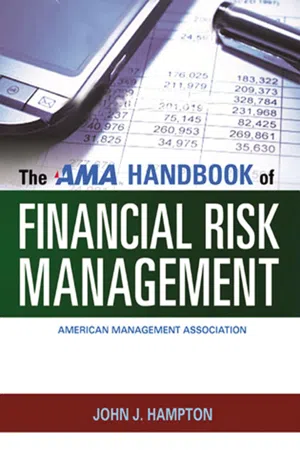
The AMA Handbook of Financial Risk Management
About this book
In this indispensable book from the industry-leading American Management Association, financial expert John Hampton offers game-changing tips for dealing with the most important areas of financial decision-making. Filled with strategies, principles, and measurement techniques, The AMA Handbook of Financial Risk Management shows readers how to categorize financial risks, reduce risks from cash flow and budget exposures, analyze operating risks, understand the interrelationship of risk and return, manage risks in capital investment decisions, determine the value of common stock, and optimize debt in the capital structure. Engaging and detailed explanations and practical applications enable anyone involved in the financial management of an organization to recognize the factors at stake and the solutions that would produce the best organizational outcomes. Managing financial risk boils down to understanding how to reduce a complex business environment into workable concepts and models. This strategic guide shows you how to make these individual decisions with the big picture in mind.
Part 1 | Introduction to Financial Risk
This handbook serves all three purposes in the emerging field of financial risk management. Achieving these goals is rather a sizable task when we consider all the risks that organizations face. A partial and unstructured list might include the following:
• Investment risk. The firm makes an investment. The investment has risks associated with it. We may fail to earn a return or lose the invested capital.
• Currency risk. The investment was in a different country from the home country and involves a different currency. We have an exchange-rate exposure.
• Liquidity risk. We own securities or other assets that have value. Unfortunately, no one wants to buy them when we are ready to sell.
• Cash flow risk. Our activity did not create a sufficient cash flow to pay our obligations, and now we have to abandon it.
• Debt risk. We borrowed money, and now we cannot pay the interest and repay the loan balance.
• Mortgage risk. We put up an asset as collateral for a loan, and now we might lose it.
• Credit risk. We lent someone money who cannot repay it.
• More credit risk. We sold goods to another party, and we have not yet received any cash payment for them.
• Insurable risk. We took out insurance, but the insurance company became insolvent before it paid for the loss of our assets.
• Interest-rate risk. We gambled that interest rates would rise, but they dropped.
• Valuation risk. We bought a piece of property at the top of the market, and now it is worth much less.
• Information technology risk. We failed to keep up with new developments in computers and telecommunications, and now competitors are taking over our markets.
• Hedging risk. We thought the price we paid for raw materials was dropping, but it skyrocketed.
The list could go on and on. One large corporation identifies 2,100 business unit risks and 800 common risks across all business units. This handbook tries to bring some order to the listing by focusing on the nature of individual risks and techniques to deal with the most important financial decisions facing firms. This is the goal of Part 1.
Chapter
1
Categorizing Financial Risks
THE ENTERPRISE RISK MANAGEMENT FRAMEWORK
Financial risk management is developed within a framework of enterprise risk management. In this section, we discuss that framework.
Enterprise Risk
This is defined as the variability of risks and opportunities when firms conduct business operations. It is a double-edged sword, as it focuses on both an upside and a downside. The focus is:
• Missed opportunities. The failure to undertake a business venture when it provides economic value possibilities at an acceptable level of risk
• Financial losses. The exposures that arise from business operations that can cause losses to current economic value
Financial risk is a subset of enterprise risk that encompasses the financial consequences, both good and bad, of managing enterprise risk and pursuing opportunities.
Enterprise Risk Management
A modern approach to understanding enterprise risk is to examine it in the context of enterprise risk management (ERM), one of the most popular and misunderstood of today’s important business topics. ERM addresses the methods and processes used by organizations to manage risks and seize opportunities related to the achievement of their objectives. ERM encourages organizations to identify relevant events, developments, and circumstances; assess them in terms of likelihood and magnitude of impact; develop a strategy to reduce risk or seize opportunity; and monitor the progress toward objectives. This process is designed to protect enterprises from harm and create value for owners and other stakeholders.
ERM tells us that there is a new world of risk. No longer is risk management largely limited to the isolated silos of production, distribution, marketing, and segmented lines of business or business units. We do not assume that the chief marketing officer is responsible for the financial exposures and opportunities in the marketplace anymore than the chief financial officer is accountable for financial risks. The risk picture is incomplete when it is limited to the individual components of an organization. This realization encourages new approaches to assess an organization’s appetite for risk, avoid unacceptable exposures, and seize opportunities.
Business Risk
ERM is rapidly replacing earlier approaches to risk management. Many risk discussions start with the term business risk, which has a variety of definitions, including:
• Risk associated with the unique circumstances of a particular industry or competitor in a market
• A situation, the result of either internal conditions or external factors, that may have a negative impact on the profitability of a given company
• The possibility of a destructive shift in the data, assumptions, and analysis that are used in planning for the employment of assets to achieve financial goals
Sometimes the definitions contradict each other. As an example, one definition refers to the possibility of loss inherent in a firm’s operations and environment that may impair a firm’s ability to achieve adequate returns on its investment. The proponents of this definition go on to define financial risk as exposures arising from the use of debt or the creation of other liabilities. With these definitions, total corporate risk becomes the combination of business risk and financial risk. This contradicts the other definitions, where financial risk is a subset of business risk.
Addressing Financial Risk
Organizations have two ways to address risk. The wrong way is to assume that people can understand hundreds or even thousands of exposures. This is not possible. Risks and opportunities must be organized and accepted at various levels by risk owners. A brief overview of the new ERM includes the following specific features:
• Upside of risk. Most people discuss risk as the possibility of loss. This is totally insufficient, as risk also has an upside. A lost opportunity is just as much a financial loss as damage to people and property. This is a key insight. Ask the ancient Chinese warrior Sun Tzu or the fictional Godfather character Michael Corleone.
• Alignment with the business model. A business model is a framework for achieving goals. Within it, each manager supervises a limited span of subordinates, functions, or subsidiaries. The manager also oversees a limited number of risks and initiatives. ERM encourages us to align the hierarchy of risk categories with the business model.
• Risk owners. Just as someone is accountable for revenues, profits, and efficiency in each organizational unit, a single person should be responsible for each category of risk. When questions arise, we should not be dealing with a committee or multiple individuals. We should go directly to the risk owner. However, some risk assessments must be shared. Exposures arising from the culture, the leadership, or even the reputation of the organization should be assessed using collaboration among key executives and the board.
• Central risk function. Although risks cannot be managed centrally, organizations need a central risk function. Its role is to scan for changing conditions from a central vantage point and share the findings with the risk owners. This approach recognizes that risks cross units and responsibilities, and that critical risks and opportunities can easily be missed in the day-to-day operation of a business. In a change from traditional thinking, organizations should consider creating a central risk function that, by itself, does not have any responsibility for risk management. Risk goes with the risk owners. Risks that cross units or responsibilities are identified centrally and dealt with using customized solutions. Just as the internal auditor identifies and reports noncompliant procedures but does not suggest how to correct them, the central risk function identifies and shares its findings.
• High-tech platform. ERM encourages the use of new technologies to clarify risks and opportunities. We now have the capability to tie together the whole story of risk from the top to the bottom of the organization. We can show the relationships visually, isolate key factors, and prepare reports on the status of the exposures we face and the opportunities we pursue. Technology is a friend of risk management.
RISK CATEGORIES
Like so many concepts in a complex modern organization, the term financial risk management conjures up various responses. What does it mean? Is it limited to financial risks, such as excessive debt or a shortage of cash? Does it cover business interruption, product-liability lawsuits, or natural disasters that affect operations? How does it differ from corporate finance, where the chief financial officer seeks to increase the value of the firm and achieve required returns suitable to the risk of investments? Finally, is financial risk management the sole purview of the CFO? Are production, marketing, administration, and other executives exempt from the discussion?
Financial risk management encompasses the tools that we use in the framework of enterprise risk management. The tools are part of the planning process as firms develop strategies for creating economic value. They assist in decision making as companies assess risk and seize opportunity.
This approach to financial risk is fundamentally different from earlier definitions. Financial risk management recognizes that every business decision has an upside and a downside. Thus, risks are viewed as being in the realm of uncertainty that can have favorable or unfavorable outcomes. Within this framework, managers identify a variety of exposures and opportunities under the umbrella of financial risk.
Categorizing Financial Risks
Enterprise risk management encourages the organizing of risks and opportunities into a hierarchy that matches the business model of an organization. One structure creates the following categories:
• Production. The creation of the goods and/or services sold or distributed by the organization
• Marketing. Efforts to reach customers or clients or to identify or develop markets for products or services
• Cash flows. Management of cash flows from operations, investment of capital, and creation of an appropriate return on invested assets
• Compliance. Aligning activities with legal and regulatory requirements and processes
• Technology. Dealing with changes in assets and systems that provide information and communications
• Business disruption. Preparing for negative events that slow or cease a business’s operations and taking steps to return to normal activity
We can illustrate the structuring of risks by stepping down one level below each category.
Production Risk
Assigned to a chief production officer but shared on the high-tech platform, the exposures and opportunities in this area cover risks such as:
• Design. Does production coordinate with marketing, finance, legal, and others to develop the right produ...
Table of contents
- Cover Page
- Title Page
- Copyright Page
- Dedication
- Contents
- Preface
- Introduction
- Part 1. Introduction to Financial Risk
- Part 2. Accounting, Cash Flow, and Budget Exposures
- Part 3. Analyzing Operating Risks
- Part 4. Relationship of Risk and Return
- Part 5. Nature of a Capital Investment Decision
- Part 6. Factors That Affect the Value of a Firm
- Index
Trusted by 375,005 students
Access to over 1.5 million titles for a fair monthly price.
Study more efficiently using our study tools.
Frequently asked questions
Yes, you can cancel anytime from the Subscription tab in your account settings on the Perlego website. Your subscription will stay active until the end of your current billing period. Learn how to cancel your subscription
No, books cannot be downloaded as external files, such as PDFs, for use outside of Perlego. However, you can download books within the Perlego app for offline reading on mobile or tablet. Learn how to download books offline
Perlego offers two plans: Essential and Complete
- Essential is ideal for learners and professionals who enjoy exploring a wide range of subjects. Access the Essential Library with 800,000+ trusted titles and best-sellers across business, personal growth, and the humanities. Includes unlimited reading time and Standard Read Aloud voice.
- Complete: Perfect for advanced learners and researchers needing full, unrestricted access. Unlock 1.5M+ books across hundreds of subjects, including academic and specialized titles. The Complete Plan also includes advanced features like Premium Read Aloud and Research Assistant.
We are an online textbook subscription service, where you can get access to an entire online library for less than the price of a single book per month. With over 1.5 million books across 990+ topics, we’ve got you covered! Learn about our mission
Look out for the read-aloud symbol on your next book to see if you can listen to it. The read-aloud tool reads text aloud for you, highlighting the text as it is being read. You can pause it, speed it up and slow it down. Learn more about Read Aloud
Yes! You can use the Perlego app on both iOS and Android devices to read anytime, anywhere — even offline. Perfect for commutes or when you’re on the go.
Please note we cannot support devices running on iOS 13 and Android 7 or earlier. Learn more about using the app
Please note we cannot support devices running on iOS 13 and Android 7 or earlier. Learn more about using the app
Yes, you can access The AMA Handbook of Financial Risk Management by John Hampton in PDF and/or ePUB format, as well as other popular books in Business & Finance. We have over 1.5 million books available in our catalogue for you to explore.