![]()
SECTION 1
The Connection That Moves You
Chapter 1—Connecting Movement to a Learning Brain Chapter 2—Training with the Brain in Mind Chapter 3—Applying the Benefits of Movement These three chapters provide a basic grounding in brain research that demonstrates how these findings are incorporated into training and other learning events. The section also explains eight specific benefits that come from using movement to enhance both the learner experience and expected organizational results.
Chapter 1 sets the stage with an exploration of the key theories, conclusions, and assumptions about the power of movement to increase the effectiveness of learning events.
Chapter 2 demonstrates how these practices have been validated and, in some cases, challenged by brain science conducted over the last twenty years.
Chapter 3 further deconstructs these recent findings to offer eight ways that movement enhances learning outcomes, along with other key recommended learning strategies.
![]()
CHAPTER 1
Connecting Movement to a Learning Brain
Despite the development of sophisticated distance learning technologies that allow learners to access training from any place or at any time using the most convenient device they have on hand (a desktop computer, tablet, laptop, or smartphone), a majority of training still occurs in traditional classroom settings.
Such a statistic is hardly a surprise to trainers who increasingly use these advanced learning tools but still find they spend a considerable amount of time in physical classrooms. One reason that classroom training remains the predominant delivery method is that eLearning is not appropriate for all types of training, as, for example, when role play is essential to the training. A more important reason, a least from my perspective, is that the connection and collaboration between learners in a classroom fulfills our human need for community, and it is this connection that fosters greater learning success.
The learning techniques described in this book are likely familiar to experienced learning professionals. What this book shows is a direct connection between movement and well understood and researched conclusions based on brain research. More importantly, it shows readers how to tap into this valuable learning wellspring and make movement a reliable training effectiveness ally.
MAKING A CONNECTION
I am not neuroscientist or a doctor. I’m not even a researcher. I am just someone who has spent years reading everything I could get my hands on about how the human brain learns, and in particular, how to take advantage of the intrinsic connection between movement and learning. This intense passion has been at the center of my professional work for the last 20 years and it underscores every written or training/learning contribution I’ve made to the field, including this book.
The roots of this book reach back to 2006, when I collaborated with Traci Lengel, a dynamic and successful Health and Physical Educator in northern Pennsylvania, to create a graduate course called It’s All About You: Wellness and School. The course, offered by the Regional Training Center to Pennsylvania, Maryland, and New Jersey, included my previous nutrition training work along with significant portions of my work discussed in this book—the brain/body connection, physical fitness, stress management, time management, and social wellness.
As it turned out, the course was very popular with its target audience—educators—who used the positive life-changing information they discovered through the class to change the learning dynamics in their own classes. Based on the success of this class, Traci and I decided to collaborate on a second training design that focused on the connection between movement and learning.
In 2008, we field tested a course called The Kinesthetic Classroom: Teaching and Learning Through Movement. This course was also a success and, in fact, it became one of the most successful courses in the 25-year history of the Regional Training Center. The course included a Six-Part Framework for using movement that Traci created and I helped her fine tune. The framework makes movement user friendly and accessible to all teachers in all content areas and at all grade levels. Dozens of instructors now teach this course to thousands of teachers in Pennsylvania, New Jersey, and Maryland, who use the concepts to improve learning outcomes in their classes.
Another positive outcome of my work with Traci was the publication in 2010 of our bestselling book, The Kinesthetic Classroom: Teaching and Learning Through Movement. Training in Motion goes beyond The Kinesthetic Classroom to include information about connecting cognitive function, physical fitness, and movement theories to both effective teaching and improved facilitation abilities.
As a full-fledged brain and movement enthusiast, I want Training in Motion to inform corporate trainers and other learning professionals about taking advantage of this brain/body connection to improve the effectiveness and bottom-line value of their training and learning programs.
BRAIN BASICS
Training in Motion is a book about using movement to enhance the training process so I will reference—directly or indirectly—the conclusions or implications of brain research throughout. However, the reason for this introduction on brain basics is to provide grounding and context for the discussion that follows and a baseline brain-related vocabulary to guide your learning.
So, to begin with, here are some interesting facts about the brain according to Sousa (2011). The brain:
Weighs a little more than three pounds.
Is about the size of a small grapefruit.
Represents about 2 percent of our body weight but burns almost 20 percent of our calories.
Contains approximately a trillion cells made up of neurons (specialized cells that process information) and glial cells that support and protect the neurons. Neural connections and networks are at the core of learning and memory.
Some Parts of the Brain
To understand the brain, it’s helpful to divide it into exterior parts (lobes) and interior parts. Each has unique qualities, traits, and
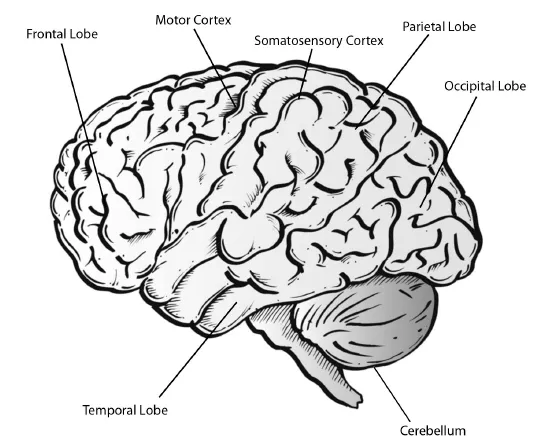
First, the exterior parts: Have you ever forgotten something important and hit yourself in the forehead with the palm of your hand? If you have, you’ve directly connected with your brain’s frontal lobe, which is one of the four major areas (lobes) of the exterior human brain. This area is the executive control center and personality area; its job is planning and thinking (for example, making plans for a 2:00 dental appointment and then forgetting to show up). This is the area of the brain that also curbs emotional excess and helps us solve problems.
Every time you wash your hair and massage the area above your ears you’re making a connection with your brain’s temporal lobes, which are responsible for processing sound and language.
If you’ve ever sat back in your desk chair and clasped your hands behind your head to stretch or relax and enjoy a moment of satisfaction or deep thought, your hands are embracing the brain’s occipital lobes, which are responsible for visual processing. And, if you happen to be in the habit of clasping your hands near the top of your head, you’re showing some love for your brain’s parietal lobe, which is responsible for processing sensory information, spatial orientation, and calculations.
Finally, if you comb your hair from the middle of your head (more common among women these days, but it was a men’s style in the 1970s), then you are raking your comb across the area of your brain at the very top called the somatosensory cortex (directly in front of the parietal lobe), which is responsible for processing touch signals. Combing your hair this way also connects you with your brain’s motor cortex (directly in back of the frontal lobe), which is responsible for coordinating body movement (see Figure 1.1).
Figure 1.1 Some Exterior Parts of the Brain
Clearly, the brain is a much more complicated organ than this simple tour, but our description serves two purposes. First, it’s a very graphic way of explaining the concepts, and second, if you pretend to make the movements suggested—hitting your forehead, washing and combing your hair—then you are validating the underlying premise of this book of connecting movement to learning.
Interior Parts of the Brain
Physically touching the interior parts of your brain as an aid to learning is obviously not possible, so I’ll use a two-story house with a basement as a learning analogy. First, think of the brain stem as your brain’s basement. Nearly all homes locate basic infrastructure and operational connections in the basement, such as plumbing, electrical, cable, telephone connections, and heating and air conditioning equipment. Our brain’s basic survival connections and functionality, including the regulation of our heartbeat, respiration, body temperature, and digestion, are all centered in the brain’s basement.
Most of the life of a typical home happens in the kitchen, living or family, and dining rooms. The brain’s limbic system, located above the brain stem basement and below the cerebrum (a typical home’s second fl...