- 256 pages
- English
- ePUB (mobile friendly)
- Available on iOS & Android
eBook - ePub
About this book
Nearly all managers dream of being inspiring leaders who elicit the most from their people. But while they may understand the skills needed to manage their teams, very few know how to put their knowledge into practice. Now, any manager can get exceptional results and make an important contribution to the organization. Becoming an Extraordinary Manager focuses not just on "understanding" principles of good management, but on taking action. Readers will learn the basic attitude and skills outstanding managers must know, including:• why it's critical to be interested in, rather than interesting to, their people • the best ways to motivate their team • effective interviewing techniques • conducting a performance review • time management • introducing change • delegation • thinking and acting about their people positively (the self-fulfilling prophecy) • building a high-performance team • retaining top talent • handling performance problems • listeningLively in style and thorough in content, this is the book that gives every manager a complete guide to avoiding the ordinary and becoming the best.
Information
CHAPTER 1

Introduction
Extraordinary managers make the whole greater than the sum of its parts. They add value to their organization. They get extraordinary results from ordinary people. Average managers wind up with ordinary results no matter how good their people are. There are even managers who, unfortunately, drag their groups down so that they get ordinary results from extraordinary people. The whole, then, becomes less than the sum of its parts. These managers have little, if any, value. They don’t really manage much of anything. They’re “straw bosses.” After the worthwhile stalks of wheat and other grains are harvested, straw is what’s left over on the ground. It’s used primarily for animal bedding. The term straw boss has come to mean a low-level manager who isn’t good for much. Such managers have very little authority. They’re leftovers. The term also connotes someone who is petty and makes things more difficult, not better, for employees. I know some companies that have more than their share of “straw bosses.” I’m willing to wager that you do, too.
Overall, I’ve found there to be four basic kinds of people:
1. Those who make things happen. You can count on these people 100 percent of the time. No matter what the assignment, no matter what the obstacles to overcome, no matter what the deadline. They’re always improving themselves. Their development curve looks like a skyrocket. I’m assuming you’re this kind of person. Why else would you have bought this book?
2. Those who watch things happen. These people are the spectators. They sit up in the stands. They second-guess and play Monday-morning quarterback. You probably say the same things to them that I do: “If you can do better, you come down on the field of play where the action is.” Of course, they never do. They don’t want to get their hands dirty. They don’t want to stick their necks out.
3. Those who wonder what’s happening. These are the people who are always confused. Things are never clear enough for them. They’re always waiting for something. They say things like, “I have the responsibility but not the authority.” They want things to be given to them. On retirement day, they’ll still be waiting for instructions and direction.
4. Those that everything happens to. These are the victims. The “Woe is me!” people. They claim they have such terrible luck. In truth, they make their own bad luck. You hate to even say “Hi!” to them. That’s the only opening they need. They’ll give you an hour’s worth of their latest problems and their latest troubles. You wish you could hold a mirror up to these people. Maybe then they’d see themselves for the way they really are. Some of them have had fifteen or sixteen different jobs. They always say, “No one understood me. No one listened to me. They made promises they didn’t keep. It wasn’t fair.” After that many jobs, you’d think they’d learn that their own behavior has a lot to do with their lack of success. But they just don’t want to face the truth. So they play the “blame game.”
Because you’re a “Make things happen” kind of person, I’m willing to share my experience with you. I spent sixteen years working in corporations, large and small, and the last eighteen years as a consultant for many of what are considered the very best Fortune 500 companies. I’ve seen my share of good managers. I’ve seen a whole lot of bad ones. Too many bad ones. I’ve been an observer. A note-taker. In this book, I’ll report to you on those observations. I’ll try to talk in simple, commonsense terms about what’s done wrong and how it can be done right. Work should be more than just work. It doesn’t have to be boredom, drudgery, and something to be avoided. People don’t have to go around talking about “Blue Monday” and “Hump Day Wednesday” and “Thank God it’s Friday.” There are too many employees who just put in their time. Kind of like prisoners in a maximum-security prison. They’re just waiting to get released for the weekend, a holiday, or vacation. It doesn’t have to be that way. The truth is, there’s no such thing as unmotivated people, just bad management.
When the cake comes out wrong, it’s seldom the fault of the ingredients. The odds are the flour, sugar, and eggs were just fine. It’s probably the fault of the baker. Some bakers are good and others aren’t so good. Some managers are good and others aren’t so good. The best have special recipes that they’ve learned. They take ordinary ingredients and incredible things happen. You can be like that, too. I’m not saying that the ingredients don’t matter. Get good ingredients. But it takes much more than that to be a great baker.
I’m going to give you practical steps to follow that can help you become a better manager or prepare for a management position. I know you’ve got good intentions. Everyone has good intentions. The problem is that we judge ourselves based on our intentions. Others judge us on our actions. So, rather than focus on building an understanding of good management principles, we’ll focus on actions you can and should take.
I’ve heard all the excuses that managers give as to why they don’t manage. Excuses like, “I’m too busy,” and “My boss won’t let me,” and “I’m not going to hold people’s hands.” To understand how ridiculous these excuses are, let’s put them in a different context. Let’s say you were having your house painted. The painting crew was doing a terrible job. The radio was blaring, they were making a mess out of your yard, and not much work was getting done at all. You call the crew chief over and say, “I’m very disappointed in the work your crew has been doing.” He claims it’s not his fault because he’s “too busy” and the “boss won’t let me” and he’s “not going to hold people’s hands.” My guess is you’d be outraged. You’d probably call the owner of the painting company and demand that this crew chief be replaced. You wouldn’t let him get away with saying those things. Why should we let our managers get away with it?
Recently I asked several hundred people in various training sessions a simple, straightforward question: “Do managers know how to motivate people?” A whopping 75 percent said, “No!” If we asked a different question—for example, “Do salespeople know how to sell?”—and 75 percent said “No,” wouldn’t someone be upset? What if 75 percent of the accounting people weren’t good with numbers? Wouldn’t someone want action to be taken? I asked those same people if would they fire their manager on the spot if they were able to. A full 25 percent of employees said, “Yes!” What does that tell you about their respect for the people they work for?
So, why aren’t there more good managers? We’ve got many good programmers. Most programmers are very capable. There are a few bad ones, of course, but the vast majority are just fine. We’ve got many good accountants. Most accountants are very capable. There are a few bad ones, of course, but the vast majority are just fine. You get the idea. With management, it’s just the opposite. There are some good ones. But many aren’t very good at all. They cause more harm than good. They discourage, demotivate, and drive good people out of organizations. They negatively affect business results and cost companies untold amounts of money to repair the damage they cause.
I can’t tell you how many hours I’ve spent captive in an office while the boss brags on and on about how wonderful he is. He’d tell stories about his vacation, his family, his hobbies, while I sit there thinking about how much work I have to do. The boss is going “Talk, talk, talk,” while the clock goes, “Tock, tock, tock.” You say the same thing has happened to you? And it drives you crazy, too? Okay, so you know what I mean when I talk about managers who “discourage, demotivate, and drive people out of the organization.” Why a company would pay people in management positions to tell personal stories and build up their egos like mini-tyrants, at the expense of people’s valuable time, is beyond me.
I talked to an employee recently who told me that her manager wanted to hold an individual development planning discussion with her. She was delighted. She said she had never had such a discussion and was thrilled that a manager would show that much interest in her. She did her research and prepared a lot of information for the meeting. Unfortunately, the meeting was postponed because the manager was too “busy.” That meeting was postponed nine more times. She said she is now so disgusted that she deleted all the information she had prepared and said that, if and when the manager reschedules the meeting again, she purposely won’t show up to try to get back at the manager. Employees should be treated with the same respect that customers are given. Imagine postponing a customer meeting because you’re too “busy”?
Why Aren’t There More Good Managers?
There are five main reasons why there aren’t more good managers:
1. Most occupations require some demonstrated competence, but management doesn’t. Many occupations require certification or a license, where you have to pass a test to demonstrate a certain level of knowledge and proficiency. To become a plumber or an electrician, for example, you’ve got to be licensed. Frankly, even a dog has to be licensed. What do you need to become a manager? Nothing. Nothing at all. You just have to be in the right place at the right time. Maybe you’re the last one standing. Everyone else has quit and you’ve hung around the longest. It’s the “Poof! You’re a manager” process. Imagine if there were a “Poof! You’re a heart surgeon” process. I don’t think things would work out very well that way.
2. Most managers are thrown into the fray without training or preparation. They’re given little guidance and direction. We invest little and we get little in return. That’s the way it happened to me. It was very typical. I can still remember the day of the week and the time of day. We were finishing up our employee coffee break. It was just a normal daily coffee break. We spent the whole time complaining about management. They were fools, bureaucrats, out of touch, and cared only about themselves. The usual story. I got called into a vice president’s office at 10:15 A.M. My first thought was, “I must be in trouble. What have I done wrong?” The vice president told me that starting Monday, I’d be a manager. I was floored. I said, “Why me?” I felt I was being punished. He talked to me about how much the organization needed me. It’s not the kind of thing you can turn down. I remember asking him, “What am I supposed to do?” He gave me the classic response: “You’ll figure it out.” Well, some people do figure it out. A lot of people, unfortunately, never do.
3. Everyone is, to some extent, a reflection of who they’ve modeled themselves after. Parents, teachers, and older siblings have an obvious impact on children. Those managers we’ve worked for have had an impact on us. Some of us say, “I’ll have to remember how it feels to be treated this way. I’ll be sure not to do that when I become a manager.” But most say, “This is what managers are supposed to do, I guess. I’m required to be like the person I work for. That must be what the company wants.” So, a generation of mediocre or poor managers gives rise to a new generation of mediocre or poor managers.
The challenge in such circumstances is to stop the cycle and break the “stagnant quo.” Be different. Be better. Be wary, though. You may get in trouble. There will be plenty of people around with the dread disease known as “hardening of the attitudes.” I don’t think you can be any good if you’re afraid to get in trouble or be called crazy for wanting to change things. As Nobel prize–winning physicist Richard Feynman said, “Here’s to the crazy ones. . . . You can quote them, disagree with them, glorify or vilify them. About the only thing you can’t do is ignore them, because they change things. . . . Because the people who are crazy enough to think they can change the world are the ones who do.”
4. Even after they become managers, people continue to be rewarded for being good individual contributors. Knowing what people are rewarded for always helps you understand the way they behave. Ever read a manager’s performance review? It’s usually hard to find a single line about management performance. It’s typically about the projects the managers worked on and the problems they’ve solved. It’s about how hard they personally have worked. They’re like super employees. If that’s how we’re going to continue to reward managers, as individual contributors, that’s what they’re going to continue to focus on.
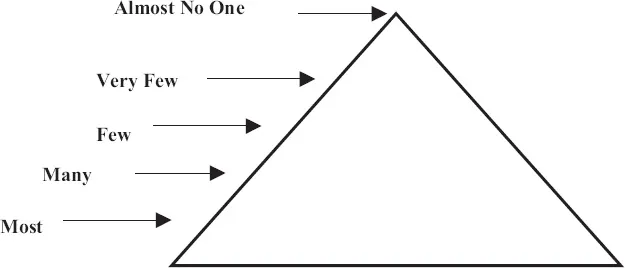
5. Truthfully, the job is hard. Most people can become programmers or accountants with some education and some work. Management requires skill that a lot of people don’t have or aren’t willing to work at. The higher you go up the pyramid, the more difficult the jobs are. That’s why the pyramid gets narrower and narrower at the top. Figure 1-1 looks at how many people can do jobs at the different levels. It helps explain why people who make it to the top are paid perhaps 200 times what people at the bottom make. If you’re good enough to make it to the top, you should be paid 200 times what people at the bottom are paid. People at the top of every profession earn substantially more than people at the bottom. They can do things that very few people can do. That’s the way it’s always been. That’s the way it always will be. In a free market economy, people make what they are worth. If that weren’t true, the market would correct it.
Figure 1-1. How many people can do jobs at the different levels of management?
It Takes Work
So, becoming an outstanding manager takes hard work. There’s no easy way to do it. There’s no magic pill. There’s a very old story about a king who said to his chief adviser, “Go out and find the secret of success. State it simply and succinctly so the people will do it.” The adviser spent a year researching the topic and came back to the king with three books full of his findings. The king said, “That’s not simple or succinct enough. The people are lazy. They won’t read three books.” So, the adviser spent another year and came back with one book. The king said, “That’s not simple or succinct enough. The people are lazy. They won’t read a book.” So, the adviser spent another year and came back with one chapter. The king said, “That’s not simple or succinct enough. The people are lazy. They won’t read a chapter.” Finally, the adviser spent another year and came back with five words. The king said, “Now you’re talking. The people will relate to something that’s that easy to digest.” The adviser said, “Here’s the piece of paper with the five words.” The paper said, “There ain’t no free lunch.” The adviser was killed.
The unfortunate adviser was trying to relate the truth that success requires hard work, dedication, and good instruction. Imagine an athlete who thought he was so gifted that no practice or training was necessary. Imagine if the athlete said he was “too busy.” The odds would certainly be against the athlete. You may think you can take the easy way out and win the lottery. The truth is, you have to pay up-front even to do that. You have to give up a dollar or two to get your one in 13 million chance to strike it rich. It’s amazing how many people have a plan like “win the lottery” and yet they don’t sacrifice anything up-front. They don’t even buy a ticket.
As with any principle, there are exceptions. Some people are natural managers. But they’re extremely rare. Like the natural athlete I once played golf with. I’m convinced he could have been a professional athlete in any sport he chose. He was that good. He had never played golf before. He barely knew which end of the club to hold. He hit a perfect 300-yard drive off the first tee. He turned to me and asked, “Was that okay?” I said, “That wasn’t bad.” The rest of his game was the same way. He shot par that day. The first time he had ever played! He needed no golf lessons, no preparation, no practice. He was a natural. Maybe one in a million. Some managers are like that. But the rest of us mere mortals need advice and counsel from those who have gone before us.
One of the problems with management training programs is that managers like to use them to “brush up” their skills and take “refreshers,” thinking that somehow ...
Table of contents
- Cover
- Half title
- Title
- Dedication
- Contents
- List of Figures
- Foreword
- Acknowledgments
- 1 Introduction
- 2 Moving Up to Manager: How to Get and Begin the Job
- Section I: Motivating Others
- Section II: Attracting and Retaining Top Talent
- Section III: Planning and Organizing Your Group’s Performance
- Section IV: Driving Results Through Your Organization
- Section V: Lifelong Development
- Appendix: Job Satisfaction Survey Details
- Bibliography
- Index
- About the Author
- Copyright
Trusted by 375,005 students
Access to over 1.5 million titles for a fair monthly price.
Study more efficiently using our study tools.
Frequently asked questions
Yes, you can cancel anytime from the Subscription tab in your account settings on the Perlego website. Your subscription will stay active until the end of your current billing period. Learn how to cancel your subscription
No, books cannot be downloaded as external files, such as PDFs, for use outside of Perlego. However, you can download books within the Perlego app for offline reading on mobile or tablet. Learn how to download books offline
Perlego offers two plans: Essential and Complete
- Essential is ideal for learners and professionals who enjoy exploring a wide range of subjects. Access the Essential Library with 800,000+ trusted titles and best-sellers across business, personal growth, and the humanities. Includes unlimited reading time and Standard Read Aloud voice.
- Complete: Perfect for advanced learners and researchers needing full, unrestricted access. Unlock 1.5M+ books across hundreds of subjects, including academic and specialized titles. The Complete Plan also includes advanced features like Premium Read Aloud and Research Assistant.
We are an online textbook subscription service, where you can get access to an entire online library for less than the price of a single book per month. With over 1.5 million books across 990+ topics, we’ve got you covered! Learn about our mission
Look out for the read-aloud symbol on your next book to see if you can listen to it. The read-aloud tool reads text aloud for you, highlighting the text as it is being read. You can pause it, speed it up and slow it down. Learn more about Read Aloud
Yes! You can use the Perlego app on both iOS and Android devices to read anytime, anywhere — even offline. Perfect for commutes or when you’re on the go.
Please note we cannot support devices running on iOS 13 and Android 7 or earlier. Learn more about using the app
Please note we cannot support devices running on iOS 13 and Android 7 or earlier. Learn more about using the app
Yes, you can access Becoming an Extraordinary Manager by Len Sandler in PDF and/or ePUB format, as well as other popular books in Business & Management. We have over 1.5 million books available in our catalogue for you to explore.