eBook - ePub
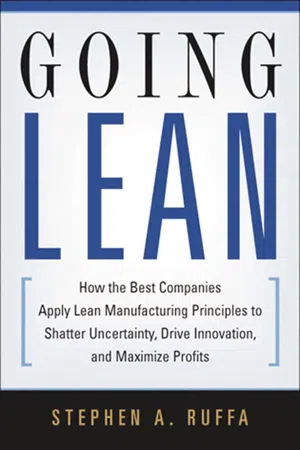
Going Lean
How the Best Companies Apply Lean Manufacturing Principles to Shatter Uncertainty, Drive Innovation, and Maximize Profits
- 288 pages
- English
- ePUB (mobile friendly)
- Available on iOS & Android
eBook - ePub
Going Lean
How the Best Companies Apply Lean Manufacturing Principles to Shatter Uncertainty, Drive Innovation, and Maximize Profits
About this book
Efficient operations and powerful innovations are not limited to seasons of growth and high demand. Going Lean introduces the powerful yet unexpected mind-set that's reshaping the rules for business competitiveness: Lean Dynamics ™. This approach, based on the now-famous Toyota Production System--empowers companies to thrive in virtually any environment--even when sudden shifts occur or they experience unpredictable conditions. Through a detailed exploration of this approach, readers will learn how to: become broadly effective in creating and sustaining value; set a critical foundation for achieving sustained excellence; identify sources of lag and create robust value streams that thrive in today's dynamic conditions; describe the underlying techniques to maintain steady and predictable flow; create a system based on "pull," or external demand that consistently introduces new innovation; strive for perfection; and deliver industry-leading returns. Led by a new breed of companies--Toyota, Walmart, and Southwest Airlines--this innovative mind-set changes the game for businesses everywhere. Going Lean teaches readers how their companies--big or small--can leverage this revolutionary thinking to measure and achieve real results.
Information
Part I | |
From Crisis to Excellence |
AMERICA'S MANAGEMENT PRACTICES once made its corporations the envy of the world. For most of the last century they became the standard for all. Yet, with uncertainty and crisis striking from every direction—from overseas competition to economic slowdowns and surging oil prices—the time has come to revisit their underlying presumptions that no longer work but continue to serve as the foundation for how companies do business.
Chapter 1 shows how this growing environment of uncertainty, coupled with disconnects in how businesses operate, undermines corporations' ways of doing business. Chapter 2 examines the roots of this breakdown by exploring the basis for America's system of management—from its origins in Henry Ford's Model T line to its heyday during postwar expansion, to its challenges in operating in today's increasingly dynamic marketplace. It shows why this system's inherent dependence on stable conditions—once central to its success—now belies corporations' best efforts to keep chaos under control.
Chapter 3 demonstrates that there is a better way. It shows how a few firms have broken from today's cycle of loss to adopt a system of lean dynamics that protects their operations against the ill effects of change and uncertainty others have come to accept. It introduces the concept of the value curve, using hard data to illustrate how Toyota, Wal-Mart, and Southwest Airlines consistently sustain greater value to create an overwhelming competitive advantage. Chapter 4 concludes this part by examining the five common characteristics that distinguish this new system of management.
One | |
Awash in Chaos! |
Today's problems come from yesterday's “solutions.”
—Peter M. Senge1
UNPREDICTABILITY: Corporations everywhere struggle against its devastating effects. For, where there is change and uncertainty, there is crisis.
Yet change is everywhere in their world these days. Increasing competition, shifting customer expectations, and disruptive world events have shattered the marketplace and undermined once-straightforward management techniques. To meet this challenge, companies seek to take on new practices. But instead of making the fundamental shift they need, most insist on simply adding new features to the same foundation with which they are most familiar.
Their lesson is clear: The same system that powered their success for much of the past century now stands in the way of their progress.
Peter Drucker once wrote of the collapse of a diverse group of once-powerhouse corporations who suffered their fate by doing nothing wrong. The world simply changed around them; in each case, they did not see the need to respond until it was too late.2 Many of today's greatest companies now face this same reality; they must embrace a new vision of the future and act—or concede their industries to those who do.
American managers take pride in their ability to react to the effects of uncertainty, demonstrating time and time again their tremendous capability to overcome adversity. Throughout much of the past century, this basic strength powered their firms to heights in productivity and innovation never before imagined—and made possible their very system of management.
But what happens when these effects extend beyond corporations' abilities to react? Perhaps the economy slows, technology shifts, or customers simply change their tastes. What happens when unforeseen external forces drive the marketplace to shift entirely? The bottom line is disruption and workarounds—chaos that translates to poor quality, missed deliveries, and dissatisfied customers. Sales plummet, efficiencies collapse, and operating costs skyrocket. Corporations frantically search for solutions, blaming their environment—all the while failing to see that much of their problem comes from within. Consider the examples in the following paragraphs.
- US Airways, like most major airlines, creates efficiencies by working to keep its planes fully loaded. Rather than flying its passengers directly to their destinations, the company first shuttles them to a number of hub airports—central locations where it concentrates the core of its operations. This way it can reliably fill its fleet of larger, more sophisticated aircraft by bringing together travelers using smaller aircraft from each of these feeder routes (or spokes) to complete the long-haul part of their journey. For many years this industry standard worked fairly well. Flights generally arrived on time; fare structures drew sufficient passenger volumes for airlines to expand; and corporate profits were large enough to attract no shortage of competitors.That is, until conditions abruptly changed.After September 11th the entire industry's passenger volume plummeted. US Airways, like its peers, found that keeping flights reasonably full meant dropping others—parking many of its largest aircraft that it no longer could keep busy. Spoke routes were hit hard as well, but their importance in sustaining passenger volumes at the airline's hubs probably meant continuing flights even with very low passenger loads. The company laid off employees in droves; sudden, dramatic changes to planning, staffing, and other activities must have created great turmoil, further impacting the efficiencies of the airline's operations.3The outcome? Revenues plunged; costs mounted while idle and underutilized planes continued racking up costs. The company faced an unwinnable choice: either charge increased prices to its passengers (further driving down passenger volume and undermining its efficiencies), or absorb the costs directly and suffer financial loss. Either way, the airline faced a deep crisis; like so many others it ultimately fell into bankruptcy.
- How do factory workers respond to shortages of parts and materials that disrupt their operations? Often by keeping more of these items on hand to carry them through the next stock-out. By tucking away as many as possible the next time the parts become available, they assure that their shops can continue to operate without disruption into the future. Or can they? Consider what happens when the weatherman calls for snow. Shoppers across the region turn out in droves, stocking up on essential groceries. We have all experienced the consequences: By the time you reach the supermarket there are no eggs, milk, bread, or toilet paper anywhere to be found! What causes this to happen? Such widespread reaction to uncertainty overwhelms the supply system. The result? Many cannot get what they need for days, until the system finally recovers from this event.Just as with the snowstorm, workers who hoard materials to buffer their own shop's needs introduce tremendous variation into their supply system. Not only can such well-intended actions cause initial shortages, but they set the stage for these to occur on a regular basis. Demand patterns no longer match production needs as workers deplete and restock their hidden stores at largely random intervals. Resupply becomes chaotic, no longer based on meaningful consumption forecasts. All of this makes the availability of the items they need even less certain, further increasing workaround activities as others act similarly to prevent shortages.The bottom line? Workarounds—reactive fixes intended to protect against the effects of uncertainty—often make the problem worse. They themselves create unpredictability, amplifying the effects of change and setting off crises that spread up and down the production line, ultimately impacting suppliers and customers alike.
- Over recent years, major automobile producers have bolstered their profitability by selling large trucks and Sport Utility Vehicles, or SUVs. For the Ford Motor Company, profits from SUVs became enormous contributors to its revenue; their high profitability increasingly offset lagging sales across other product lines. The company focused great attention on product and process development, seeking refinements that might sustain or further grow the company's SUV market share. Then the marketplace suddenly shifted. In September 2005, gasoline prices turned sharply upward—rising past the $3-pergallon threshold. Drivers everywhere felt the pinch; they began trading in their larger vehicles for smaller cars that consumed less gasoline. The impact? Demand for SUVs plummeted by more than fifty percent. The company's overall sales sank by more than twenty percent—just as other firms who were better known for their fuel-efficient vehicles saw sales increases by more than ten percent.4Clearly, Ford faced no easy answer. Shifting to produce a significantly different mix of vehicles would likely drive up costs while causing planning and scheduling nightmares. Reducing overall production volumes to match customers' much lower demands might make matters even worse—perhaps undermining the firm's economies of scale and driving disruption through its factories and across its suppliers' activities as well.The company clearly faced a difficult situation. Not only would it probably have to rethink everything from its product mix to its business strategy, an enormous task unto itself, but it now had to play catch-up at the same time that it found its revenue stream severely impacted.
- Manufacturers and distributors across the country increasingly outsource major functions traditionally performed by their own workforces. Instead of buying and storing large quantities of parts or components, many now create long-term arrangements for their suppliers to deliver precise quantities of materials just as they are needed to support their operations or those of their customers. This means that rather than tracking and managing supply activities at each step along the way, these corporations might now simply measure their suppliers' outcomes against preset agreements. Initial results can seem tremendous. Corporations yield great savings by reducing or even eliminating warehoused inventories used to replenish factory bins. Their suppliers instead keep the right quantities on hand. All seems to run like clockwork—just so long as conditions turn out precisely as planned.But think of what happens when unforeseen changes in demand suddenly emerge. Inventories these suppliers use to offset normal demand fluctuations can quickly dry up, insufficient to buffer spikes that go far beyond levels anticipated at the outset of these arrangements. Unable to draw items from pools of inventory, suppliers' ability to meet their agreed-to commitments can quickly disintegrate. Worse still, with only their outcomes tracked, their diminishing capabilities might be obscured from view until their buffers finally break down, escalating into all-out crisis.The end result? Those downstream find themselves caught off guard. Deliveries can degrade or stop with no advance warning, creating immediate shortages for shops or factories who, because of these arrangements, have given up protective measures of their own. Work stoppages up and down the line can drive costly expediting and widespread disregard for established procedures. And at the end of the line is the customer who, in one way or another, must deal with the burden created by these failures.
It is not hard to find similar situations that show in real terms the effect that sudden change has on those who continue to manage in the manner they have in the past. We see here just a few examples; many others exist that show how corporations' conventional ways of structuring work, introducing new products or innovations, and implementing improvement initiatives do not work well within the uncertain and dynamic conditions so prevalent today. Too often such actions lead to long-term problems, declining competitiveness, or even bankruptcy. Sadly, despite the near-certainty that today's dynamic environment is here to stay, many firms continue to insist on running their business in this manner.
A Solution That Doesn't Follow the Problem
Michael Hammer, the well-known author and originator of business reengineering, labels as “contemporary myth” the presumption that successful companies operate as “a showcase of efficiency.”5 His critical observation—that American corporations are replete with disruption and crisis—describes what I, too, found during factory visits, making clear to me that this problem extends far beyond only a few firms, or just a single industry.
But if disruption is so widespread, why isn't it fixed? Perhaps because managers remain generally unaware of its lasting effects within their firms' operations. Companies have become adept at managing crises—mobilizing enormous teams and diverting whatever resources they need to quickly stabilize a disruptive situation. Once they conquer a crisis, it is soon forgotten; managers quickly shift their attention to dealing with the next problem. Yet, in its wake they leave behind armies of expeditors, piles of inventories, and extraordinarily long lead times; and these continue to accumulate over time as mountains of waste.
Such waste takes many forms. Companies apply countless resources to purchase and maintain unneeded inventories; they stand up huge workforces for stocking and issuing supplies and enormous warehouses in which to store them; they incur costs in identifying and correcting defects, waiting for late deliveries, or identifying and executing workarounds to minimize schedule impacts caused by supply shortages. They perform unnecessary processing steps, cause excess movement of people and materials, and extend transportation distances. Each of these creates a negative impact on bottom-line results, drawing time and attention from engineers, managers, and workers—time that could otherwise be spent adding value to the corporation and its customers.
The late Taiichi Ohno, architect of the famed Toyota Production System, targeted seven distinct forms of waste in his quest for operational excellence (waste in overproduction, waiting, transportation, processing, inventory, motion, and defects—most of which were mentioned in previous paragraphs). Ohno set forth a powerful vision: He believed that a firm's production operations should progress smoothly without disruption—a vision demanding the virtual elimination of waste.
Each of Ohno's wastes corresponds to some form of loss in value—loss in material, factory, and equipment utilization, time, man-hours, and dollars that companies must ultimately pass to their customers. And each of these losses can be linked to a common underlying condition: Variation—deviations from intended objectives.
Variation—A Fundamental Driver of Loss
To understand the effects of variation, consider your drive to work in the morning. Suppose the journey begins twenty miles from your place of employment. On the average your drive may take about thirty minutes—a reasonable commute in many cities. Except your chance of arriving late is substantial; great potential exists across these twenty miles of distance to encounter such disruptive factors as road construction, traffic accidents, increased volume, or the effects of a...
Table of contents
- Cover Page
- Title Page
- Copyright Page
- Table of Contents
- Permissions
- Acknowledgments
- Introduction: Solving the Mystery of Success
- Part I: From Crisis to Excellence
- Part II: The Foundational Elements
- Part III: Implementing Lean Dynamics
- Appendix: Constructing the Value Curve
- Glossary
- Notes
- Index
- About the Author
Trusted by 375,005 students
Access to over 1.5 million titles for a fair monthly price.
Study more efficiently using our study tools.
Frequently asked questions
Yes, you can cancel anytime from the Subscription tab in your account settings on the Perlego website. Your subscription will stay active until the end of your current billing period. Learn how to cancel your subscription
No, books cannot be downloaded as external files, such as PDFs, for use outside of Perlego. However, you can download books within the Perlego app for offline reading on mobile or tablet. Learn how to download books offline
Perlego offers two plans: Essential and Complete
- Essential is ideal for learners and professionals who enjoy exploring a wide range of subjects. Access the Essential Library with 800,000+ trusted titles and best-sellers across business, personal growth, and the humanities. Includes unlimited reading time and Standard Read Aloud voice.
- Complete: Perfect for advanced learners and researchers needing full, unrestricted access. Unlock 1.5M+ books across hundreds of subjects, including academic and specialized titles. The Complete Plan also includes advanced features like Premium Read Aloud and Research Assistant.
We are an online textbook subscription service, where you can get access to an entire online library for less than the price of a single book per month. With over 1.5 million books across 990+ topics, we’ve got you covered! Learn about our mission
Look out for the read-aloud symbol on your next book to see if you can listen to it. The read-aloud tool reads text aloud for you, highlighting the text as it is being read. You can pause it, speed it up and slow it down. Learn more about Read Aloud
Yes! You can use the Perlego app on both iOS and Android devices to read anytime, anywhere — even offline. Perfect for commutes or when you’re on the go.
Please note we cannot support devices running on iOS 13 and Android 7 or earlier. Learn more about using the app
Please note we cannot support devices running on iOS 13 and Android 7 or earlier. Learn more about using the app
Yes, you can access Going Lean by Stephen A. RUFFA in PDF and/or ePUB format, as well as other popular books in Business & Business General. We have over 1.5 million books available in our catalogue for you to explore.