![]()
CHAPTER 1
DETERMINE WHICH TASKS TO DELEGATE
The Five-Step Delegation Process
1 Determine which tasks to delegate
2 Identify the right person for the job
4 Monitor progress and provide feedback
Helen has just received a phone call from her boss requesting that she take responsibility for the company's three-day orientation program for newly hired salespeople. The program includes some product training but is largely focused on introducing the newcomers to the departments and people with whom they will interact both in the office and while working in their assigned territories. “I like to pass this job around to our most successful sales managers,” the boss told her. “I know that I can rely on you to do a great job.”
The gratification she felt on hearing her boss's flattering words quickly fades as she stares into the screen of her work-scheduling software. Every day is crammed with deadlines, meetings, travel, customer appointments, and other obligations. Where will she find the five days she needs to plan and execute the orientation session? She can't say no to her boss's request, but she can't invent more hours and days either.
The solution, as Helen sees it, is to postpone some appointments and travel and to delegate some of her calendar and “to-do” items to other members of the sales team. But which items?
Helen faces one of the perennial decisions faced by all managers and many supervisors: In making the most of their limited time, they must periodically off-load certain work to others. But which should they retain for themselves and which should be delegated? To find the answer, let's jump right in with Step 1, which requires looking at all the things that weigh on your time and determining which can—and which cannot—be outsourced to others.
In principle, you should delegate as much as possible; doing so will develop the capabilities of your staff and give you more time for important and strategic work. You can delegate anything from simple tasks to decisions to entire projects or processes. Generally, you should consider delegating anything that your subordinates—considering their skills and available time—are capable of handling or can be trained to handle. These tasks will be determined by your situation. As you think about what you should delegate, be guided first by this question: What tasks are you now doing that do not require your unique knowledge, skills, or authority? The answer will identify opportunities for possible delegation. There's still no assurance that the right people with the right skills and sufficient time will be available to take them on.
SHARED AND UNIQUE SKILLS
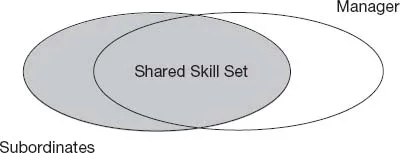
You and your subordinates very likely share some skills in common (see Figure 1-1). These may be the ability to contact customers via telephone, by e-mail, or face-to-face; to generate monthly department progress reports; to schedule meetings; to keep track of when people plan to take their vacations; to check the accuracy of expense reports; to provide coaching to new employees; and so forth. The list of shared skills may be long, especially if you've worked your way up the ladder in the department. You had to learn all those things to get where you are now. And even though you're the manager, it's likely that some people have specialized skills you don't have. For example, the manager of an ad department may have no idea how to do what his graphic designer can accomplish. But there is also a skill set that is uniquely yours, things that only you can do by virtue of your training, experience, or authority. Budgeting, planning, sales forecasting, customer/supplier negotiating, effective meeting management, and mentoring are just a few of the skills that we normally think of as uniquely managerial skills. True, a sharp protégé may have mastered some of these skills, but few subordinates of lower or middle managers will have them.
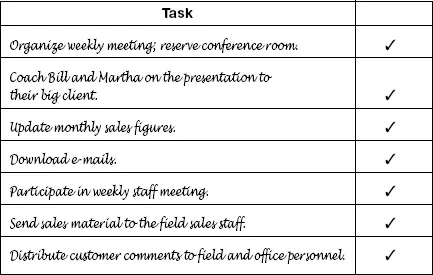
Now that you understand the shared skill set in your work group, consider the many tasks you are personally handling that fall within that shared skill set. Remember, these are tasks you are doing that do not require your unique capabilities as a manager—things that other people could do. These may include developing monthly reports, setting up outside appointments, filing, or correspondence. To be systematic, make a list of these tasks, like the one shown in Figure 1-2. Now take a look at your list and ask yourself, “Which of these tasks could I reasonably delegate to someone else?” Put a check mark next to these. Don't worry about who will pick up these tasks. We'll get to that in the next chapter.
FIGURE 1-1. EMPLOYEE AND MANAGER SKILL SETS.
Whenever possible, identify entire tasks, not bits and pieces of jobs. By making one person responsible for an entire task, not only do you give that person a greater sense of control and responsibility, but you also avoid the coordination problems and “hand-off errors” that typically plague jobs that are delegated among several people. If the task is too large for one person to take it on, consider delegating it to a team. Delegating to a team is different from delegating different parts of a task to different individuals. A team can organize the work assigned to it and hold itself accountable as a group for the work's successful completion.
FIGURE 1-2. YOUR TASKS IN THE SHARED SKILLS SET.
DELEGATE RECURRING TASKS
When you're considering tasks to delegate, an easy way to begin is to list tasks that recur frequently or regularly. Recurring tasks, such as the following, show up at all levels of the organization and require different levels of skill:
- Reserving a conference room and ordering lunch for the weekly sales meeting
- Reviewing inventory levels and placing regular orders
- Checking the accuracy of expense reports submitted by your people
- Updating the monthly budget report with the latest sales and expense figures
Almost by definition, these tasks become routine, which means that once you've shown someone how to handle them, you won't have to show them again. By contrast, a onetime chore may not be worth delegating, given the time you'll have to invest in training someone to do it right. The time available for training and overseeing progress should always become part of your calculus in deciding what to delegate. True “onetime chores,” however, are rare in the business world.
THE QUALITY ISSUE
Quality is the final issue to consider in identifying tasks to delegate. By quality we mean a job done right and on time. This issue must be foremost in your mind whenever you delegate. Ask yourself the following questions:
- Is the task so technical that extensive coaching will be necessary to bring the delegatee to a high level of proficiency? Your schedule may be too overloaded to take on a big coaching project at this time (but do incorporate it into your future plans so you can move this task off your plate).
- Is there enough time to recruit the person and explain how to do the job? If a deadline is just around the corner, you may not have time to accomplish this.
- What's “good enough” for this task? Will an “adequate” job be satisfactory, given the nature of the task? Not every task requires a master's touch.
- What will be the consequences of a job done poorly? If the consequences of less than perfect performance are manageable, then you can start an employee on the learning curve and monitor the outcome. If perfect execution is critical to the achievement of a major goal, consider the risk you'll be taking in handing it off to a subordinate.
TASKS THAT NEVER SHOULD BE DELEGATED
A few essential managerial activities should stay with you and never be delegated to others. These include hiring, performance review, firing and disciplinary actions, and certain specific tasks that have been delegated to you by someone else.
Hiring
It's usually a good idea to seek your subordinates’ insights about job candidates. Many managers routinely ask their people to meet with visiting candidates to describe workplace routines and answer any questions the candidates may have. Afterward, they share with managers their impressions of the candidates. This collaboration benefits everyone. It is important that candidates understand the environment of the job for which they are applying, and it is equally important that current employees get a chance to interact with these individuals who may be joining their work group as peers. Southwest Airlines, the most successful company in its industry, uses a panel of employees from different levels and functions to interview and screen job applicants. The final decision, however, remains with the manager for whom an applicant will work. Subordinate input to the decision is fine, but hiring is not something that can or should be delegated.
Along this same vein, you should retain the job of selecting people for project teams. Be open to advice, but make these selections yourself.
Performance Review
Many companies use annual performance review sessions to appraise employee performance, identify areas in which the person needs training or coaching, and communicate employee goals for the coming year. Is this one of your company's routines? These reviews, based on face-to-face meetings between managers and their direct reports, are also used to make decisions about bonuses and promotions. Naturally, performance review is a responsibility that stays with you; it cannot be delegated. However, you should be aware that there is a mechanism through which employees can legitimately weigh in on the workplace performance of others—including their own bosses. It's called 360-degree feedback. With this appraisal method, anonymous information about an individual's workplace performance is collected from people who regularly interact with that person: subordinates, work team members, and “internal customers.” In most cases, 360-degree feedback ...