- 240 pages
- English
- ePUB (mobile friendly)
- Available on iOS & Android
eBook - ePub
About this book
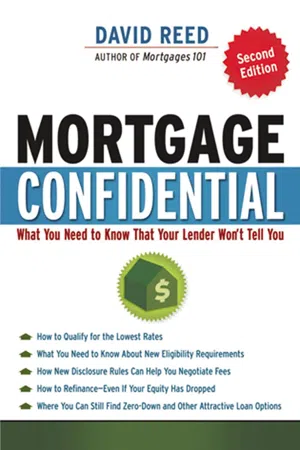
Anyone who wants to get the best deal when financing a home needs to be armed with a little insider advice. The second edition of Mortgage Confidential lets readers in on what lenders really look for before they approve a loan, options they won't often divulge, which costs they have control over, and little-known sources of down payment money. Including up-to-the-minute information on new licensing and disclosure rules and the latest eligibility requirements, the book shows readers how to: Complete the loan application to maximize their chances of approval • Steer clear of credit repair scams • Pay zero closing costs • Qualify for the lowest rates • Avoid origination charges • Determine whether paying "points" can save them money • Identify a "rip-off" loan program • Refinance—even if their equity has dropped • And more! Whether looking into securing a mortgage for the first time or seeking to refinance, Mortgage Confidential gives readers the confidence and information necessary to get through this complicated process and find the ideal loan for their needs.
Information
Topic
CommerceSubtopic
Immobilier
CHAPTER 1
Where Mortgage Loans
Really Come From
Really Come From
The big myth about mortgage money has been around for a long, long time. It’s about where the money comes from. Lenders don’t use money deposited by other customers to make mortgage loans. In fact, it’s most likely that they borrow the money from somewhere else. This is called their credit line, and it is where mortgage bankers get their money.
Other mortgage companies don’t actually make loans at all; instead, they simply arrange the financing. This is called brokering. This is important, because if you don’t understand how the lender makes its money, you won’t understand where the pitfalls are.
By knowing how both a mortgage broker and a mortgage banker make money, you’ll begin to get a glimpse of how each operates. This will help you uncover some of the mysteries of the mortgage process.
Your bank brokers. Your credit union brokers. Even your mortgage banker brokers. The main distinction in issuing mortgages is whether the loan application is taken by a mortgage broker who finds your loan for you or by a mortgage banker who has the money lying around somewhere and is anxious to lend that money to you as long as you pay it back on time and with a little interest, thank you very much.
Lenders make money in three basic ways:
- They collect the money each month in the form of interest.
- They make the money up front in junk fees, origination charges, and points.
- They sell the loan, either at the time when your loan is being financed or later on down the road, to other lenders or investors who buy and sell mortgage loans.
Mortgage brokers make all their money up front. You won’t send your broker any house payments, and your broker doesn’t “sell” your mortgage. A common misperception is that a mortgage broker will sell your loan to a lender.
You’ll see this statement made time and time again by people who don’t know any better. You’ll even hear mortgage brokers themselves talk about how they sell loans in order to make money. They say that they take a loan application, find a lender for you, and then sell your loan to that lender.
That’s not what really happens. A mortgage broker doesn’t “own” your loan. One can sell only something that one owns. Instead, a mortgage broker gets paid either by you or by the lender who provides your financing, or by some combination of the two. But your loan is not sold. When you hear this term being bandied about by a mortgage broker, the broker is just trying to sound important. In fact, the broker may be important, but it’s not because he has the ability to sell your loan to the highest bidder (or the lowest, for that matter).
A mortgage banker funds mortgages using its own money. A mortgage broker does not. A mortgage banker can either keep your loan or sell it to someone else because it owns the loan. Mortgage bankers include the retail banks that you see on nearly every street corner and credit unions.
Mortgage bankers make money by making loans, but first they have to have the money in order to lend it, right? Guess what? They borrow it from other lenders or establish a credit line at their bank or with other investors. Your bank doesn’t open up its vault, raid its customers’ piggy banks, and use those funds to make a mortgage loan.
If you’re getting your mortgage from your mortgage banker or your bank and you think that your loyalty to it will be a deciding factor in the loan approval, you’re wrong. Mortgage bankers can borrow the money they need in one lump sum at a negotiated interest rate, park that money in an interest-bearing account, and begin issuing mortgage loans one loan at a time.
Let’s say a credit line is available at 3.00 percent. A lender will arrange that financing, then turn around and issue mortgage loans.
An individual loan officer at that mortgage company will find a borrower for her employer. For example, a buyer wants a 30-year fixed-rate loan and gets it at 6.00 percent. The lender transfers the money from its credit line to make the mortgage. The lender can then keep that mortgage and collect the monthly payments in the form of interest each month based upon the loan amount and the rate on that loan.
The lender does this over and over again, month after month, and makes money in the form of interest.
Or the lender can decide to sell that loan to someone else. Lenders can make money by finding someone else who is willing to pay a certain amount of money to buy the loans it has made. How much do loans cost? Whatever the market decides, but typically your banker will make a 1 percent “commission” on each loan. If a lender sells $100 million in mortgages to someone else, the lender will make $1 million immediately and will not have to wait for it in the form of monthly payments.
For instance, a 30-year mortgage loan at 7.00 percent on $200,000 has a monthly payment of $1,330 per month. Over 30 years, that loan yields just over $279,000, in addition to paying back the original $200,000 borrowed. That’s a lot of money.
CONFIDENTIAL: Odds Are, Your Mortgage Will Be Sold.
A lender can decide to make money on a particular loan by collecting interest each and every month, or it can sell that loan for a single payment to a willing buyer. That $200,000 loan at 7.00 percent has a potential return of $279,000. That’s the value if the loan is held for the full 30 years, which quite frankly doesn’t happen that often.
But still, there is considerable value in that note. That’s why lenders sell loans. And selling a loan also frees up more money to make yet another mortgage. That process can be repeated over and over again, and in fact often is.
Whether or not a mortgage company sells your loan is purely a business decision, based upon how active that mortgage company is in the market. If a mortgage banker is feeling aggressive about the mortgage market and is ready to make a few bucks, it contacts its legion of loan officers and tells them to go out and sell new loans.
Why do some lenders sell loans, while at the same time others buy them? Why buy a loan when you can just go out and make one instead? The practice of making a mortgage loan is called originating that loan. When a loan officer finds a home loan, that loan is originated by that person.
But that loan officer doesn’t come cheap. Nor do the building he works in and the people who help process the loan. Nor does all the insurance the banker pays for along with the electricity bill, payroll, and—well, you get the picture. It costs a lot of money to find a loan. Some lenders will forgo the originating process and simply buy loans from other lenders and collect the monthly interest.
Why the difference? It depends upon a multitude of things, but primarily it rests on the current focus of the lending institution. A mortgage is a solid investment. People will do everything they can to keep their homes by making their payments on time. Banks like that.
This steady rate of return allows banks and other lenders to strategize their business plan. If a lender knows that it will get X percent each and every month, that helps it develop new marketing strategies and provides the stability it needs when it decides to invest in other ventures, such as a shopping center or a small business loan.
It surprises some people to learn that their bank or credit union has sold their loan to someone else, often to someone that they’ve never heard of. And many times this leaves people feeling that they have been betrayed by their own bank.
In fact, the odds are that your loan will be sold to someone else at some point in time.
CONFIDENTIAL: Not Only Can Your Bank Sell Your Mortgage, but You Gave It Permission to Do So.
When you visit your bank, you see all those cheery people in those posters that line the walls with sayings like, “Let us be your home loan lender!” or “You’re our customer and our Number 1 priority!” or some such.
Because you have your checking account, your savings account, your auto loan, and probably a credit card at your bank, you feel comfortable there. After all, your bank is your friend, right? At least, that’s what the posters say.
So you decide to get a home loan from your bank. You move in, and then a few weeks later, you get a notice saying, “Your Bank has just sold your loan to Big Mortgage Company. Thank you for letting us serve you.”
This comes as a surprise to most consumers. They didn’t know that this could happen. Consumers can feel let down or even lied to when their bank sells their home loan. After all, if you wanted your mortgage to be from Big Mortgage Company, you would have applied there in the first place, right? Of course you would.
But guess what? You did know about it. At least, you signed a piece of paper claiming that you knew about it. How’s that? Surprised?
Federal law requires mortgage companies to disclose two things to you regarding selling your loan:
- Whether or not your loan will be sold
- What percentage of the loans that your lender issues will be sold
Trust me. You signed this. I fully understand that you signed maybe 20 documents of various types when you applied for a home loan, but this is one that you signed. The problem with these disclosures is that consumers may not be aware of what exactly is going on, primarily because of the language used to tell the borrower that the loan could be sold.
The obscure term that is used is “servicing rights.” A loan servicer is the organization that you send your payments to, and the form you signed is called the servicing disclosure. Your potential lender is required to tell you what percentage of its loans it sold last year to other investors. This is usually done by checking a box, such as 0–25%, 26–50%, 51–75%, or 76–100%.
So should you feel betrayed because your bank sold your loan to someone else? You could. In fact, when your bank sells your loan suddenly, there might be some other unexpected consequences that you didn’t count on.
CONFIDENTIAL: If Your Bank Sells Your Loan, You May Lose Some Privileges.
A few years ago, I took out a mortgage loan from my bank. Because I had both my mortgage and my credit card with my bank, I suddenly got free checking, a free safe deposit box, and reduced fees and rates on various bank offerings. I even got cashier’s checks and notary services at no charge—all because my mortgage was with my bank. Then, after about a year of financial bliss, I was informed that my loan had been sold to another bank where I had no accounts at all.
Guess what? That’s right. Since my mortgage was no longer with my original bank because the bank had sold it, I also lost all of those freebies I originally had. And that bugged me. It could bug you, too, but the very fact that your loan can be sold in the first place yields a greater benefit: lower rates.
CONFIDENTIAL: Sometimes Your Rate Is Not Reduced When You Pay Points.
Mortgage bankers can also make money up front, at the initial loan application, in the form of various “junk” fees, discount points, or origination charges.
A discount point is a percentage of a loan amount: 1 “point” is equal to 1 percent of the loan you’re about to take. Thus, 1 point on $300,000 is $3,000, 2 points is $6,000, and so on. The term discount points is sometimes used because points represent a percentage of the loan and are used to lower the interest rate on that loan.
Points are nothing more than prepaid interest on a mortgage. You pay the lender its interest ahead of time, at the beginning of your new loan, and in exchange you get a slightly lower interest rate. Normally, 1 discount point will reduce your rate by about 1/4 percent. Normally.
The fact is that mortgage lenders can charge you pretty much anything they can get away with and still be competitive in the marketplace. A lender might charge you 3 points, but these might not be discount points because your rate is not reduced accordingly. If an interest rate of 8.00 percent is available at 1 point, then 7.75 percent should be available for 2 points. If this is your situation, you’re paying a discount point.
Sometimes lenders will charge you points and not reduce the rate at all. In this case, you’re getting no discount whatsoever. To see if this is happening to you, ask your lender for various rate and point quotes—say, everything from 6.00 percent to 7.00 percent. For each 1/4 percent change in rate, you should see 1 point. If you’re not seeing that spread, ask your loan officer to sharpen his pencil and do the math again.
CONFIDENTIAL: Some Fees Are Junk Fees.
Lenders also make money on origination charges. In some parts of the country (California, for example), origination charges are uncommon, but they are common in most places. An origination fee is also usually expressed as a percentage of the loan amount. A 1 percent origination fee on a $250,000 loan is $2,500. A 2 percent fee is $5,000.
Finally, lenders make money on junk fees, so called because they don’t go directly to pay for any particular product or service. When you pay $15 for a credit report and get, well, a credit report, you’re getting a product or service.
What you’re getting for a junk fee is sometimes obscure. Common junk fees may be called administration fees or commitment fees. You’ll also see application fees, broker fees, or processing charges. We’ll discuss closing costs in greater detail in Chapter 4, but charging junk fees at the time of application is still another way that mortgage companies can make money on a loan.
This third method of making money on a loan, charging fees at the time of the loan application, is the way mortgage brokers make money. The mortgage broker can charge you a processing fee and/or an origination fee, but it does not make money by selling loans or collecting monthly payments.
CONFIDENTIAL: Mortgage Brokers Must Tell You How Much They’re Making on Your Loan.
One interesting difference between mortgage brokers and mortgage bankers is that brokers are required by law to tell you exactly how much money they’re going to make and who’s going to pay them.
When you apply for a mortgage loan, mortgage brokers have a legal obligation not only to discuss the closing costs you’ll encounter, but also to tell you where their income is coming from. This is disclosed on a disclosure form called the Good Faith Est...
Table of contents
- Cover
- Title
- Contents
- Introduction
- CHAPTER 1 Where Mortgage Loans Really Come From
- CHAPTER 2 The Mortgage Loan Process
- CHAPTER 3 Risk Elements
- CHAPTER 4 Closing Costs
- CHAPTER 5 Interest Rates
- CHAPTER 6 Credit
- CHAPTER 7 Loan Choices
- CHAPTER 8 Refinancing
- CHAPTER 9 Buying and Building New
- APPENDIX Payment Tables
- Glossary
- Index
- Copyright
Trusted by 375,005 students
Access to over 1.5 million titles for a fair monthly price.
Study more efficiently using our study tools.
Frequently asked questions
Yes, you can cancel anytime from the Subscription tab in your account settings on the Perlego website. Your subscription will stay active until the end of your current billing period. Learn how to cancel your subscription
No, books cannot be downloaded as external files, such as PDFs, for use outside of Perlego. However, you can download books within the Perlego app for offline reading on mobile or tablet. Learn how to download books offline
Perlego offers two plans: Essential and Complete
- Essential is ideal for learners and professionals who enjoy exploring a wide range of subjects. Access the Essential Library with 800,000+ trusted titles and best-sellers across business, personal growth, and the humanities. Includes unlimited reading time and Standard Read Aloud voice.
- Complete: Perfect for advanced learners and researchers needing full, unrestricted access. Unlock 1.5M+ books across hundreds of subjects, including academic and specialized titles. The Complete Plan also includes advanced features like Premium Read Aloud and Research Assistant.
We are an online textbook subscription service, where you can get access to an entire online library for less than the price of a single book per month. With over 1.5 million books across 990+ topics, we’ve got you covered! Learn about our mission
Look out for the read-aloud symbol on your next book to see if you can listen to it. The read-aloud tool reads text aloud for you, highlighting the text as it is being read. You can pause it, speed it up and slow it down. Learn more about Read Aloud
Yes! You can use the Perlego app on both iOS and Android devices to read anytime, anywhere — even offline. Perfect for commutes or when you’re on the go.
Please note we cannot support devices running on iOS 13 and Android 7 or earlier. Learn more about using the app
Please note we cannot support devices running on iOS 13 and Android 7 or earlier. Learn more about using the app
Yes, you can access Mortgage Confidential by David Reed in PDF and/or ePUB format, as well as other popular books in Commerce & Immobilier. We have over 1.5 million books available in our catalogue for you to explore.