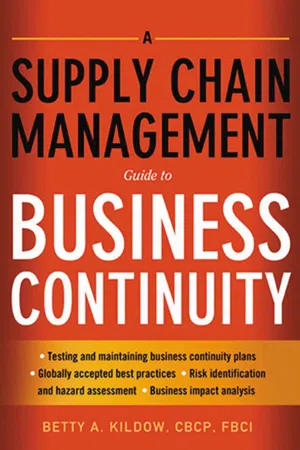
A well-monitored supply chain is any business's key to productivity and profit. But each link in that chain is its own entity, subject to its own ups, downs, and business realities. If one falters, every other link—and the entire chain—becomes vulnerable. Kildow's book identifies the different phases of business continuity program development and maintenance, including: • Recognizing and mitigating potential threats, risks, and hazards • Evaluating and selecting suppliers, contractors, and service providers • Developing, testing, documenting, and maintaining business continuity plans • Following globally accepted best practices • Analyzing the potential business impact of supply chain disruptions Filled with powerful assessment tools, detailed disaster-preparedness checklists and scenarios, and instructive case studies in supply chain reliability, A Supply Chain Management Guide to Business Continuity is a crucial resource in the long-term stability of any business.
- 272 pages
- English
- ePUB (mobile friendly)
- Available on iOS & Android
eBook - ePub
A Supply Chain Management Guide to Business Continuity
About this book
Information
Subtopic
OperationsIndex
BusinessCHAPTER 1
Business Continuity Basics
AS A RESULT of catastrophic natural and human-caused disasters that have occurred over the past two decades, coupled with increasingly stringent regulatory requirements, the interest in and need for business continuity has never been greater. For a large corporation or a small to medium-size enterprise, a business continuity program produces a level of resilience that enables the continuity or quick resumption of operations following any disaster. It is this capacity that ensures an organization’s ability to safeguard the interests of stakeholders, stay competitive, and comply with regulatory requirements. In some cases, business continuity can mean the difference between life and death for an organization.
Supply chains are the lifeblood of organizations. This is most obvious for retailers, wholesalers, distributors, and manufacturers. However, it is equally true for all other types of companies and businesses, whether they are private sector, public sector, or not-for-profits, as well as for government agencies. And, while the product itself is different from that of companies that produce and deliver a tangible commodity, service providers also have their own supply chains in the delivery of their service to customers.
Linking organizations, industries, and even economies, these arteries of business are extremely complex. Although we think in terms of the generally accepted terminology supply chain, the terms supply network or supply chain system better describe these multifaceted operations. In today’s demand-driven supply chains, products and information are rapidly flowing, at times simultaneously and concurrently, in order to ensure that products and services are delivered in the correct quantities, to the right place at the right time, at the required quality levels, and with the ongoing requirement that everything always be done economically. As customers, we require it. As suppliers and service providers, it is our company’s mission.
To omit the supply chain from business continuity planning is to omit the arteries that deliver the lifeblood to all business operations and make it possible to produce and distribute our commodities and services and thus meet customer needs and requirements. If business continuity plans do not include strategies for continuing or rapidly restoring supply chain operations following a disaster or otherwise significant interruption of operations, it is almost a certainty that restoration of operations will be delayed or halted as an ad hoc approach is taken to reestablishing the supply chain.
What Business Continuity Is . . . and Is Not
There is not yet one meaning of business continuity that is understood, accepted, and applied universally. There are both theoretical and the functional definitions, and the lines between them often become blurred. Chief among these are the definitions of business continuity and disaster recovery, which even today are often used almost interchangeably.
For purposes of the discussions in this book, I use the following definition of business continuity, which is one of the most commonly accepted definitions: A proactive approach to ensure continuity or rapid restoration of delivery of the organization’s service or product following a disaster; the ability of an organization to provide service and support for its customers and to maintain its viability before, during, and after a disaster.
Beyond a dictionary definition, business continuity is:

To further define business continuity, it may also be helpful to acknowledge some misconceptions—things that business continuity is not. For example, business continuity is not:
The Value of Business Continuity Planning
There is an often cited statistic regarding the success of businesses that have experienced a major disaster that has become a business continuity/disaster recovery version of an urban legend. The statistic has been used and quoted so widely and so often that few know its origin. The gist of this statistic— which, incidentally, is from 2002 and from the U.S. Bureau of Labor Statistics—is that 43 percent of businesses never reopen and another 29 percent are no longer in business within two years of their experiencing a disaster. While out of context, this statistic is somewhat general and would seem to encompass everything from small mom-and-pop operations to large international corporate behemoths, it is nevertheless often used as a business continuity selling point.
History has proved that there are no companies that are so big and powerful that nothing bad can happen to them. Yet when there is no direct return on investment, it can be challenging to define the value of business continuity planning, which is the process to develop, implement, and maintain strategies and procedures to ensure that key operations and essential business functions can continue or quickly be restored in the event of a disaster, major emergency, or significant threat to the organization and its operations. Though not visible on a P&L statement, here are just a few examples of the value of business continuity that cannot be tied directly to the bottom line:
The bottom line is that in addition to being good business management, business continuity simply makes good sense.
A Historical Perspective
It may be helpful for those newly assigned to business continuity planning responsibilities, as well as for those more experienced in this regard, to take a look back at its history. Also interspersed as road markers in the discussion that follows are a few milestones in the evolution of supply chain management. (These “road markers” are presented here in italic type.)
The roots of business disaster management began with emergency preparedness and response planning required to comply with occupational safety standards enacted after the death of 146 workers in the 1911 Triangle Shirtwaist Factory fire in New York City. These efforts focused on preparations for actions to be taken to respond to what were primarily physical events, such as a fire, hurricane, or earthquake. Emergency response plans to address threats to the safety of people were already in place in many organizations, with a focus on life safety systems, emergency supplies and equipment, and trained employee emergency response teams. The primary goal was to keep people safe and protect the physical assets of the company and to begin stabilizing the company immediately following a disaster.

In the first half of the twentieth century, the supply chain was a series of linear paper-based processes that connected suppliers, wholesalers, retailers, and end consumers—literally a chain of people and paper links. For most companies, the supply chain was limited in geographical scope and included a small number of suppliers and service providers. In the post–World War II economic boom, it became evident that there was a need to improve the existing low-or no-tech, nonscienti...
Table of contents
- Cover Page
- Title Page
- Copyright Page
- Dedication
- Contents
- Foreword
- Acknowledgements
- Introduction
- Chapter 1 Business Continuity Basics
- Chapter 2 The Business Continuity Program: Who Owns It, What Drives It?
- Chapter 3 Business Continuity Best Practices
- Chapter 4 The Organization, the Supply Chain, and Business Continuity
- Chapter 5 Risk Identifi cation and Hazard Assessment
- Chapter 6 The Business Impact Analysis
- Chapter 7 Supply Chain Business Continuity Strategies
- Chapter 8 Business Continuity Plan Documents
- Chapter 9 Testing and Maintaining Business Continuity Plans
- Chapter 10 Business Continuity Standards, Regulations, and Requirements
- Appendix A Business Continuity Planning Assessment Questionnaire
- Appendix B General and Supply Chain–Specific Hazards
- Appendix C Pandemic Planning
- Appendix D The Business Continuity Team
- Appendix E Continuity Plan Samples
- Glossary
- Index
Trusted by 375,005 students
Access to over 1.5 million titles for a fair monthly price.
Study more efficiently using our study tools.
Frequently asked questions
Yes, you can cancel anytime from the Subscription tab in your account settings on the Perlego website. Your subscription will stay active until the end of your current billing period. Learn how to cancel your subscription
No, books cannot be downloaded as external files, such as PDFs, for use outside of Perlego. However, you can download books within the Perlego app for offline reading on mobile or tablet. Learn how to download books offline
Perlego offers two plans: Essential and Complete
- Essential is ideal for learners and professionals who enjoy exploring a wide range of subjects. Access the Essential Library with 800,000+ trusted titles and best-sellers across business, personal growth, and the humanities. Includes unlimited reading time and Standard Read Aloud voice.
- Complete: Perfect for advanced learners and researchers needing full, unrestricted access. Unlock 1.5M+ books across hundreds of subjects, including academic and specialized titles. The Complete Plan also includes advanced features like Premium Read Aloud and Research Assistant.
We are an online textbook subscription service, where you can get access to an entire online library for less than the price of a single book per month. With over 1.5 million books across 990+ topics, we’ve got you covered! Learn about our mission
Look out for the read-aloud symbol on your next book to see if you can listen to it. The read-aloud tool reads text aloud for you, highlighting the text as it is being read. You can pause it, speed it up and slow it down. Learn more about Read Aloud
Yes! You can use the Perlego app on both iOS and Android devices to read anytime, anywhere — even offline. Perfect for commutes or when you’re on the go.
Please note we cannot support devices running on iOS 13 and Android 7 or earlier. Learn more about using the app
Please note we cannot support devices running on iOS 13 and Android 7 or earlier. Learn more about using the app
Yes, you can access A Supply Chain Management Guide to Business Continuity by Betty Kildow in PDF and/or ePUB format, as well as other popular books in Business & Operations. We have over 1.5 million books available in our catalogue for you to explore.