Technology has introduced dramatic new efficiencies to supply chain design, management, and control--but only to those who can open their minds to these new methods and strategies. This book presents innovative articles from eighteen of today's top young Ph.D. scholars, each based on discussions at the 2000 Frank Batten Young Leaders Forum of the College of William and Mary. These ""rising stars"" from the country's most prestigious operations management programs each take a fresh perspective on current practices and future directions in supply chain management and overall business strategy. Provocative yet valuable questions are asked--and answers provided--on subjects including: * Development of effective performance metrics * Techniques to streamline the order management cycle * Methods to leverage product design and manufacture to reduce supply chain costs * Ways to share knowledge throughout an organization concerning forecasts, manufacturing and sourcing plans, and distribution.
eBook - ePub
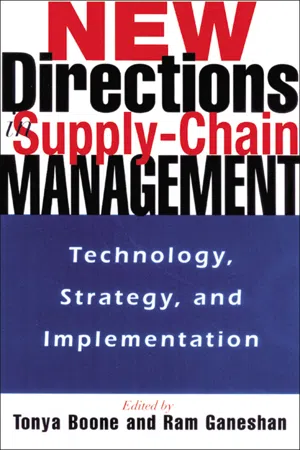
New Directions in Supply-Chain Management
Technology, Strategy, and Implementation
- 400 pages
- English
- ePUB (mobile friendly)
- Available on iOS & Android
eBook - ePub
New Directions in Supply-Chain Management
Technology, Strategy, and Implementation
About this book
Information
Subtopic
OperationsIndex
BusinessSection I
INTEGRATING NEW TECHNOLOGIES
INTO SUPPLY-CHAIN OPERATIONS
Chapter 1
The Relationship-Technology Interface: A Path to Competitive Advantage
Massachusetts Institute of Technology
INTRODUCTION
HOW WILL EMERGING, WEB-BASED technologies impact supply chains in the future? The answer to this question carries tremendous stakes. It is estimated that the Internet has the potential to carve more than $1 trillion from the $7 trillion spent annually on components, supplies, and services worldwide (USA Today, 7 February, 2000, p. B1). How this will happen is a top-priority issue in many industries and corporations today. In this chapter, I strive to improve our understanding of this critical issue by developing a conceptual framework for how supply-chain organizations might respond to emerging technologies in order to create competitive advantages. The framework suggests that one means by which buyers and suppliers can jointly improve their competitive position is to learn how to “smartly” integrate the new technologies into their everyday activities and processes. This can be accomplished through careful consideration of the Relationship-Technology interface.
Throughout the chapter, I use the term “relationship” to refer to how supply-chain firms organize and coordinate their ongoing exchange activities. The relationship is a form of governance, which is “a shorthand expression for the institutional framework in which contracts1 are initiated, negotiated, monitored, adapted, and terminated” (Palay 1984, p. 265). This is a much broader concept than control, including elements of establishing and structuring exchange, as well as aspects of monitoring and enforcement. I also use the term “technology,” consistent with other authors, to reflect scientific knowledge applied to useful purposes (Capon and Glazer 1987; John, Weiss, and Dutta 1999; Quinn, Baruch, and Zien 1997). However, I restrict the scope of this term to refer to the new, emerging technologies developed specifically for use on the Internet via the World Wide Web. While there has been an explosion of new technology in this domain, there has also been some confusion and misunderstanding around the role of these technologies in supply-chain activities.
In this chapter, I contend that part of this confusion can be displaced by the recognition that there exists an interdependence between the ongoing exchange relationship and emerging technologies that can and should be systematically understood and managed. To some degree, this may explain why we witness starkly different outcomes among firms who attempt to incorporate new technologies in their supply-chain activities. Consider the scenario of a firm utilizing the Web as a low cost channel for reaching new consumers. On one hand, there are examples such as Herman Miller (HM) and its contract dealers (Garner 1999). HM, known for its high-end, ergonomic office furniture, typically sells its premium cubicle systems to major corporations under big contracts at volume discounts. In 1998, the company began to reach out via the Web to individual customers such as telecommuters, freelancers, and small business owners. After a communication and education campaign, HM successfully convinced all of its network dealers (its most strategic dealers) that the Internet channel reaches new customers without eroding the dealers’ existing customer base. The dealers realized that the handling and selling costs for these users did not justify the margin on the purchase, so dealers didn’t mind that the online store pursued these customers, because their real focus was serving the major contracts. Thus, HM was able to successfully utilize the Internet as a means of reaching new customers and growing sales.
Now consider the case of Compaq Computer, who attempted a similar strategy, but experienced very different outcomes (Fortune, 6 September, 1999). In an attempt to take business away from Dell, Compaq created a unique set of business-oriented Prosignia computers for Internet-only sales and targeted the small and medium-size businesses, which weren’t their dealers’ primary sales focus. It also created a way for the dealers to profit from Internet referrals. However, the dealers viewed Compaq’s activities as a sign of indifference toward their role and ultimately shunned selling any Compaq PCs, which had a crippling effect on the company for several years.
In both cases, the suppliers intended to use the Internet to reach new customers without cannibalizing the sales of their existing distributors and yet the firms experienced very different outcomes. I hypothesize that these differences may be the result of the type of relationships that were in place at the time the Web-based efforts were developed. HM and their dealers had a history of cooperatively working together to cover the costs associated with a customer’s customization preferences. Together, they had crafted customer-specific access into HM’s intranet to reflect the customer’s business processes, volume pricing, and product preferences. On the other hand, Compaq’s relationships with its dealers were historically contentious, with Compaq attempting power plays on the dealers. When it introduced the Prosignia line, Compaq began to deal in a more rigid fashion with the dealers, requiring them to adhere to minimum price rules and provide additional services. Thus, it may be that the types of relationships that were developed in these supply chains created a backdrop from which these chains viewed and responded to the opportunities created by new technologies.
In some cases, the relationship context facilitated their ability to adapt to and value the potential opportunity created by the Web, while in other cases, the relationship context impeded their ability to embrace the opportunity for progress and support the change. This is why I contend that the ongoing relationships of buyers and suppliers and the decision to invest in and utilize new technologies are interdependent variables in the management of supply chains. The successful deployment and utilization of Web-based technologies is systematically related to the type of relationship that has been developed in the supply chain. This implies that the relationship context should be a strategic consideration in the firm’s decision to make supply-chain investments in new technologies. By understanding the interface between the relationship and emerging, Web-based technologies, buyers and suppliers can improve their competitive position and better exploit the opportunities that these technologies offer.
In the pages to follow, I describe the possible specifications of the interface between relationships and technology (see also Figure 1.1): (1) Relationships → Technology, (2) Technology → Relationships, and (3) Relationships ↔ Technology. I discuss related theoretical research in progress and experience with firms who are creatively exploiting the interface of these two variables. The chapter begins with a review of the relevant literature on the development and management of supply-chain relationships for competitive advantage and then describes how a systematic understanding of the relationship-technology interface might be leveraged. A discussion of the implications for management and directions for future research concludes the chapter.

FIGURE 1.1The relationship-technology interface.
SUPPLY-CHAIN RELATIONSHIPS AS COMPETITIVE ADVANTAGE
During the 1990s, there was a growing recognition that long-term, cooperative exchange between buyers and suppliers offered significant opportunities for firms to jointly create and achieve extraordinary financial performance. The marketplace was replete with examples of this. Baxter Healthcare Corporation works closely with hospitals on storing and distributing supplies to and within a hospital. By focusing on the creation of optimal inventory levels and non-price benefits, both parties receive several valuable outcomes—the hospital gains reduced inventory investment and operating costs, while Baxter receives increased revenue, market share, and customer loyalty. Similarly, in 1986, Xerox worked closely with their suppliers to develop customized processes and components that reduced their copier manufacturing costs 30 to 40 percent. In turn, the suppliers received sales and volume guarantees, an enhanced understanding of their customers’ needs, and a strong position with Xerox for future sales. Hence, the nature of a firm’s relationship with other organizations in the supply chain is a strategic choice, worthy of study in its own right. The supply-chain relationship can have a profound impact on the implementation of marketing programs (Ruekert, Walker, and Roering 1985), product differentiation (Porter 1985), and can serve as a barrier to entry into a particular market (Reve 1986).
More recently, these relationships have come to represent a significant source of long-term competitive advantage (cf., Dyer 1996; Dyer and Singh 1998), a critical resource of the firm to be systematically leveraged. In an industrial supply context, competitive advantages are defined as strategic benefits gained over competing dyads that enable the dyad to compete more effectively in the marketplace (Sethuraman, Anderson, and Narus 1988). In the Resource Based View (RBV) of the firm framework, there are four theoretical conditions that underlie the achievement of competitive advantages: (1) resource heterogeneity, (2) ex-ante limitations to competition, (3) ex-post limitations to competition, or causal ambiguity, and (4) imperfect mobility. These characteristics also create the backdrop for the attainment of competitive advantages in interorganizational relationships. These conditions are briefly reviewed and its relevance is discussed in an industrial supply context.
Resource heterogeneity refers to the resource bundles and capabilities that underlie production in a firm (Barney 1991). These resources have varying levels of productivity efficiency that enable firms to produce more economically or better satisfy customer demands than their competitors. When these factors are inelastic in supply and insufficient to satisfy demand, then the low-cost firm will earn supernormal profits in the form of rents to their scarce resources. Other high-cost firms will breakeven. This is known as the Ricardian rents argument (Ricardo 1817; Rumelt 1987). A key aspect of the argument is that the superior resources remain limited in supply. This allows efficient firms to sustain their competitive advantage as long as the resources cannot be expanded or freely imitated by competition. Pralahad and Hamel (1990) note that core competencies that are enhanced as they are applied (that is, those that involve collective learning and are knowledge based) contain natural learning trajectories that also serve as a basis for competitive advantage.
In supply-chain relationships, buyers and suppliers bring together unique competencies in differing functional areas. These competencies may involve learning curves and differing levels of efficiency. When they are combined, the dyad gains access to critical resources that enable the creation of superior value in the marketplace. The more unique the combination of capabilities and the more inelastic the supply of the joint capability, the greater the potential for generating supernormal returns relative to competing dyads. For example, suppose a computer chip manufacturer and a car manufacturer consider the possibility of developing a chip that optimizes the performance of a new car. The chip manufacturer possesses chip design capabilities while the car manufacturer has car production capabilities. The heterogeneity of capabilities along with the inelasticity of supply of these capabilities allows for the creation of a unique, joint competency (that is, car-chip optimized capabilities). This competency serves as the basis for superior product offerings to downstream customers.
Ex-ante limitations to competition means that there must be limited competition for a particular resource position prior to any firm’s establishing the position. Barney (1986) contends that economic performance depends not only on the returns from various strategies, but also on the cost of implementing the strategies. Imperfections in strategic resource markets, where the necessary resources for implementation are acquired, enable the creation of supernormal returns. Without these imperfections in the markets, firms can only hope for normal returns. Rumelt (1987) argues that unless there is a difference in the ex-post value of a venture and the ex-ante cost of acquiring the necessary resources, the entrepreneurial rents are zero.
The car-chip collaboration between the two manufacturers may be an area in which there is limited competition. In the car market, there are many ways in which car manufacturers can create new customer value and earn supernormal rents. Some might offer better designs, lower costs, more efficient distribution, and so on. Each car manufacturer may choose one or more of these bases by which to differentiate its competitive offering. Since each manufacturer is heterogeneous in its ability to exploit or access these resources, the potential for competitive advantages is created. In the previous example, the design of a unique microprocessor that optimizes the performance of a new car is just one of many possible ways in which a car manufacturer may compete in the industry; hence, competition for this position may be limited or even unrecognized as a possible basis for competitive strategy. In order for competitors to duplicate this advantage, they would have to collaborate with the chip manufacturer or some other chip manufacturer and have similar capabilities for exploiting th...
Table of contents
- Cover
- Half title
- Title
- Contents
- Preface
- Section 1: Integrating New Technologies into Supply-Chain Operations
- Section 2: Technology-Based Product and Service Development
- Section 3: Knowledge Management and Supply Chain Integration Issues
- Index
- About the Contributors
- Copyright
Trusted by 375,005 students
Access to over 1.5 million titles for a fair monthly price.
Study more efficiently using our study tools.
Frequently asked questions
Yes, you can cancel anytime from the Subscription tab in your account settings on the Perlego website. Your subscription will stay active until the end of your current billing period. Learn how to cancel your subscription
No, books cannot be downloaded as external files, such as PDFs, for use outside of Perlego. However, you can download books within the Perlego app for offline reading on mobile or tablet. Learn how to download books offline
Perlego offers two plans: Essential and Complete
- Essential is ideal for learners and professionals who enjoy exploring a wide range of subjects. Access the Essential Library with 800,000+ trusted titles and best-sellers across business, personal growth, and the humanities. Includes unlimited reading time and Standard Read Aloud voice.
- Complete: Perfect for advanced learners and researchers needing full, unrestricted access. Unlock 1.5M+ books across hundreds of subjects, including academic and specialized titles. The Complete Plan also includes advanced features like Premium Read Aloud and Research Assistant.
We are an online textbook subscription service, where you can get access to an entire online library for less than the price of a single book per month. With over 1.5 million books across 990+ topics, we’ve got you covered! Learn about our mission
Look out for the read-aloud symbol on your next book to see if you can listen to it. The read-aloud tool reads text aloud for you, highlighting the text as it is being read. You can pause it, speed it up and slow it down. Learn more about Read Aloud
Yes! You can use the Perlego app on both iOS and Android devices to read anytime, anywhere — even offline. Perfect for commutes or when you’re on the go.
Please note we cannot support devices running on iOS 13 and Android 7 or earlier. Learn more about using the app
Please note we cannot support devices running on iOS 13 and Android 7 or earlier. Learn more about using the app
Yes, you can access New Directions in Supply-Chain Management by Tonya BOONE,Ram GANESHAN in PDF and/or ePUB format, as well as other popular books in Business & Operations. We have over 1.5 million books available in our catalogue for you to explore.