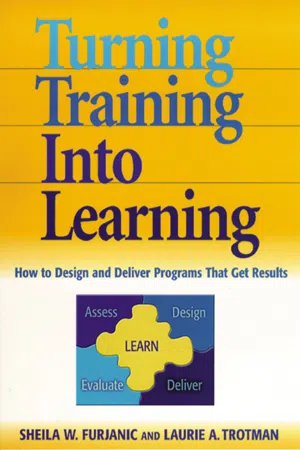
Just as you can lead a horse to water, but it won't necessarily drink, so you can give an employee training, but he may not actually learn...unless, of course, the trainer uses this insightful new book. Turning Training into Learning provides a specific, tested method for making sure training equals real learning. Written for anyone who must train others, this step-by-step guide shows exactly how to create a program that engages trainees and ensures that they remember and use what they've learned when they get back to work. Readers learn how to: * Analyze exactly what a particular trainee needs * Establish a safe environment where questions are welcomed * Demonstrate to learners why the training is relevant to them * Understand the process by which adults learn * Place real learning within the context of the traditional training cycle: assessment, design, delivery, and evaluation.
This part introduces the process that creates the foundation for the main event—LEARN. The training process includes four stages that are performed by the trainer to successfully deliver training programs; they include assess, design, deliver, and evaluate. Each of these stages is presented in a separate chapter (see Figure P1-1).
Figure P1-1.Stages of the training process.
Each of the four stages in the training process plays an equally important part in shaping the success of the learning process. Without all four stages, there may not be learning (see Figure P1-2).
Figure P1-2.The training process puzzle.
1
Assessing the Need for Training
While each of the four stages in the training process is important, assessment helps you aim the entire process in the right direction. The assessment stage helps you clarify the request, determine the driving force behind it, and decide whether or not training is the right response. It requires taking time to investigate each potential training situation before you start designing the training effort. Assessment can mean the difference between a training session that is nothing more than a recess from work and learning that gets results.
The ten basic questions shown in Figure 1-1 will help you assess the need for training. The first nine questions lead up to the big decision—Should training happen?
Figure 1-1. Guide to Chapter 1.
Question 1: Who Needs Training?
Your request for training can come from any one of a number of possible sources (or clients), including the top management of an organization, the management staff in a department or unit, and even front-line staff members. But proceeding with any training effort without first analyzing it can be a waste of your resources and your participants’ time.
It is important to take a close look at the intended audience and ask some basic questions about the way your participants interact with each other on the job. Five different types of audiences are described in Figure 1-2, categorized by the way the participants interact with each other. This checklist will help you answer the question, Who needs training?
If your intended participants work together as team members or if they share the same function but are not considered a team, your job may be a little easier than if the participants are from various areas within the organization because:
You can collect examples recognizable by the specific group.
The participants will already know each other and can make your job easier by helping each other learn and retain what is learned.
Figure 1-2.Training checklist.
Who Needs Training?
1.Who is the intended audience?
Intact work team members who are dependent on each other to accomplish daily work and meet goals (e.g., a book publishing team made up of an acquisitions editor, marketing manager, production manager, art director, and team leader).
Staff members who share the same function and work toward the same goal but are not considered a team (e.g., cashiers from all shifts of a large supermarket).
Members of special project teams whose work flows directly from one department to another (e.g., hospital admitting representatives who capture insurance information, medical records representatives who code patient charts for billing, and billers who seek reimbursement from third-party payers).
Any staff member at a specific level who chooses to attend (e.g., any manager or supervisor who elects to attend).
Any staff member who is given permission to attend (e.g., any staff member who voluntarily elects to attend and obtains permission).
2.Will this training be required?
Yes (mandatory)
No (voluntary)
A copy of this form is provided as Figure B-1 in Appendix B.
You will have support for the proposed training at the departmental level.
You will have a smaller number of supervisors or managers to work with as you help participants return to the job and apply what they have learned.
It will be easier to track your success.
On the other hand, if your participants come from a variety of locations throughout the organization, you may have an opportunity to develop more interesting class discussions because all participants have an opportunity to be exposed to other areas they may not be familiar with. The participants from diverse areas add a dimension to the learning due to their breadth of experiences and varied responsibilities within the organization.
Gathering Background Information
You will want to gain more information about groups of participants who work together, such as the way work flows from one person to another and the background of the participating group. Figure 1-3 lists some questions you might want to ask. Question 12, inviting the person who requested the training to open up and tell you more, often leads to information you wouldn’t otherwise have learned.
You can sometimes uncover important information that will help you shape the training effort and defuse potentially difficult situations. One trainer was assessing a request to present customer service training to the staff in a large health and beauty aid store. By asking the right que...
Table of contents
Cover
Half title
Title
Contents
Acknowledgments
Introduction
Part One The Training Process: Creating the Foundation
Part Two The LEARN Process: Linking Training to Learning
Appendix A: The LEARN Process
Appendix B: LEARN Tools
Index
Copyright
Trusted by 375,005 students
Access to over 1.5 million titles for a fair monthly price.
Study more efficiently using our study tools.
Frequently asked questions
Yes, you can cancel anytime from the Subscription tab in your account settings on the Perlego website. Your subscription will stay active until the end of your current billing period. Learn how to cancel your subscription
No, books cannot be downloaded as external files, such as PDFs, for use outside of Perlego. However, you can download books within the Perlego app for offline reading on mobile or tablet. Learn how to download books offline
We are an online textbook subscription service, where you can get access to an entire online library for less than the price of a single book per month. With over 1.5 million books across 990+ topics, we’ve got you covered! Learn about our mission
Look out for the read-aloud symbol on your next book to see if you can listen to it. The read-aloud tool reads text aloud for you, highlighting the text as it is being read. You can pause it, speed it up and slow it down. Learn more about Read Aloud
Yes! You can use the Perlego app on both iOS and Android devices to read anytime, anywhere — even offline. Perfect for commutes or when you’re on the go. Please note we cannot support devices running on iOS 13 and Android 7 or earlier. Learn more about using the app
Yes, you can access Turning Training into Learning by Sheila W. FURJANIC,Laurie A. TROTMAN in PDF and/or ePUB format, as well as other popular books in Business & Human Resource Management. We have over 1.5 million books available in our catalogue for you to explore.